Veronika the Cow: How a Single Animal is Redefining Livestock Intelligence
A Swiss Brown cow named Veronika has become a scientific sensation by demonstrating flexible, purposeful tool use—a cognitive feat previously documented clearly only in primates like chimpanzees. Living as a companion animal, Veronika selects specific ends of a brush to scratch different parts of her body, adjusting her technique with notable dexterity. This landmark discovery, published in Current Biology, challenges long-held assumptions about bovine cognition and suggests that gaps in observation, rather than genuine cognitive limits, may have shaped our understanding of farm animals. The finding opens new avenues for research into animal intelligence and welfare.
The iconic 1982 Far Side cartoon "Cow Tools" by Gary Larson humorously depicted a cow standing proudly next to a bizarre, useless collection of objects. The joke hinged on a universal premise: cows simply aren't smart enough to create or use tools. For decades, this assumption went largely unchallenged in the scientific community. That is, until researchers encountered Veronika. This single Swiss Brown cow is forcing a dramatic reevaluation of livestock intelligence, demonstrating tool-use abilities so sophisticated they rival those of primates.
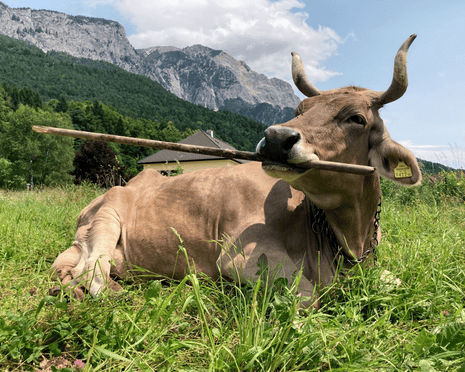
The groundbreaking study, published in the journal Current Biology, documents the first confirmed case of flexible, multi-purpose tool use in cattle. Led by cognitive biologists, the research centers on Veronika, a pet cow who lives with organic farmer Witgar Wiegele in Austria. Unlike cattle in intensive farming systems, Veronika enjoys a long life in a complex, stimulating environment with daily human interaction. It was in this setting that her remarkable behavior—using sticks and brushes to scratch herself—was first observed and later systematically studied.
The Anatomy of a Cognitive Breakthrough
Tool use is formally defined as the employment of an external object to achieve a goal through physical interaction. Veronika's actions not only meet this definition but exceed it, entering the realm of flexible, multi-purpose tool use. This means she doesn't just use an object; she uses different features of the same object for different outcomes, adjusting her technique based on the task at hand.
In controlled experiments, researchers placed a deck brush on the ground and observed Veronika's interactions. The results were clear and consistent. For scratching broad, firm areas like her back, she deliberately chose the bristled side of the brush. When addressing more sensitive regions on her lower body, she switched to using the smoother wooden handle. This selective behavior indicates a high degree of bodily awareness and problem-solving.

Overcoming Physical and Perceptual Barriers
What makes Veronika's tool use particularly impressive are the significant physical limitations she overcomes. Cows lack opposable thumbs or even hands. Veronika must manipulate all tools exclusively with her mouth, a significant motor constraint. Despite this, she shows careful control over her grip and movement, suggesting she anticipates the effects of her actions.
Her tool use is "egocentric," meaning it is directed at her own body. While this is often considered less complex than using tools on external objects or other animals, it presents a unique cognitive challenge: the user must coordinate the tool's movement in relation to their own body map without direct visual guidance for all areas. Veronika's ability to do this with apparent precision hints at an underlying cognitive architecture more advanced than previously credited to bovines.
Rethinking Intelligence in Domesticated Animals
The discovery has profound implications for how we perceive livestock. As lead researcher Alice Auersperg of the University of Veterinary Medicine, Vienna, notes, "The findings highlight how assumptions about livestock intelligence may reflect gaps in observation rather than genuine cognitive limits." For centuries, cattle have been observed primarily in the context of food production, where opportunities for complex, self-directed behavior are limited. Veronika's case suggests that given the right environment—one with mental stimulation, social interaction, and longevity—latent cognitive abilities can surface.
This aligns with a growing body of evidence in animal cognition science that intelligence is not merely a fixed trait but is expressed through interaction with a challenging environment. Veronika's unique life as a companion animal, full of variety and novel objects to manipulate, likely provided the necessary conditions for this behavior to emerge and be refined over more than a decade.

Scientific and Ethical Implications
The research team, including Antonio Osuna-Mascaró, is now investigating which specific environmental and social conditions foster such behaviors. They have also issued an open invitation to the public, stating, "Because we suspect this ability may be more widespread than currently documented, we invite readers who have observed cows or bulls using sticks or other handheld objects for purposeful actions to contact us." This citizen science approach could reveal whether Veronika is a unique prodigy or a representative of an underestimated species-wide capability.
Beyond pure science, the study prompts important ethical considerations. If cows possess the cognitive capacity for flexible tool use, a marker of complex intelligence, it strengthens the argument for ensuring their welfare in agricultural systems goes beyond basic physical needs to include mental enrichment. Understanding their true cognitive potential is the first step toward respecting it.
Conclusion: Beyond the Cartoon
Veronika's story brings a poignant twist to Gary Larson's classic cartoon. As the researchers wryly conclude in their paper, "[Veronika] did not fashion tools like the cow in Gary Larson's cartoon, but she selected, adjusted, and used one with notable dexterity and flexibility. Perhaps the real absurdity lies not in imagining a tool-using cow, but in assuming such a thing could never exist."
The tale of Veronika is more than a curious anecdote; it is a powerful reminder of the mysteries that remain in the animal kingdom, even among species we live alongside. It challenges us to observe more carefully, question our assumptions more deeply, and recognize that intelligence manifests in diverse and unexpected ways. As science continues to peel back the layers of animal cognition, Veronika the cow stands as a landmark figure, proving that sometimes, truth is indeed stranger—and smarter—than fiction.