NASA's Rocket Missions Unlock the Electrical Circuitry of the Northern Lights
In a groundbreaking scientific campaign, NASA successfully launched three sounding rockets directly into the aurora borealis over Alaska. The missions, including the twin-rocket GNEISS project, aimed to map the complex electrical currents that power the northern lights. By creating a 3D 'CT scan' of the auroral plasma, scientists gained unprecedented data on how energy from space flows into and through Earth's upper atmosphere, completing a circuit that has long puzzled researchers. This work advances our understanding of space weather and its effects on satellite operations and atmospheric dynamics.
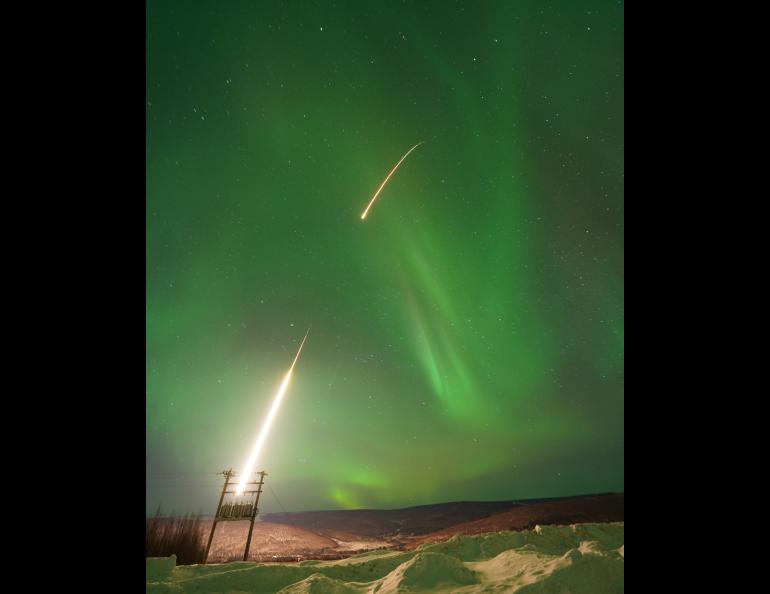
NASA has achieved a significant milestone in space science by successfully firing three sounding rockets into the heart of the northern lights over Alaska. This daring campaign, launched from the Poker Flat Research Range, was designed to probe the fundamental electrical forces that create the aurora's dazzling displays. The results provide an unprecedented three-dimensional view of how these celestial light shows are 'wired,' revealing the complete electrical circuit that connects space to our sky.
The Missions: Targeting Auroral Mysteries
The February 2026 campaign consisted of two distinct missions. The first was the Black and Diffuse Auroral Science Surveyor, which launched on February 9. Its target was the enigmatic 'black auroras'—dark patches that appear within the glowing lights, potentially marking areas where electrical currents reverse direction. The rocket climbed to an altitude of approximately 224 miles (360 kilometers), with principal investigator Marilia Samara confirming all instruments performed perfectly and returned high-quality data.
The second mission, known as GNEISS (Geophysical Non-Equilibrium Ionospheric System Science), was a twin-rocket operation launched just 30 seconds apart on February 10. Each rocket reached an altitude of about 198 miles (319 kilometers). Principal investigator Kristina Lynch of Dartmouth College reported that the coordinated launch, ground stations, and instrument deployments all operated as expected, capturing a robust dataset.
Understanding the Auroral Electrical Circuit
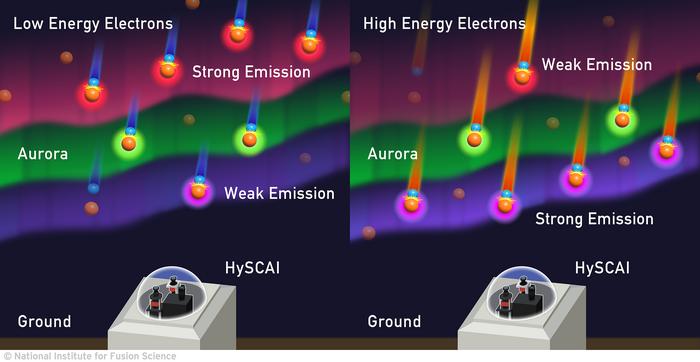
The visible aurora is just one component of a vast, invisible electrical system. It is powered by electrons streaming from space into Earth's upper atmosphere, where they collide with and energize atmospheric gases, causing them to glow—akin to electricity flowing through a wire to light a bulb. However, electricity requires a complete circuit. The focused beam of incoming electrons must be balanced by a return flow back to space.
This return current is far more complex and scattered than the incoming stream. After igniting the aurora, electrons spread out in multiple directions, their paths shaped by atmospheric collisions, shifting winds, pressure gradients, and electromagnetic fields. Mapping this diffuse return flow has been a major scientific challenge, crucial for understanding how energy is ultimately distributed and dissipated in the upper atmosphere.
GNEISS: A 3D CT Scan of the Sky
The GNEISS mission was specifically engineered to solve this mapping problem. "We're not just interested in where the rocket flies," explained Kristina Lynch. "We want to know how the current spreads downward through the atmosphere." The mission's innovative approach involved launching two rockets on slightly different trajectories into the same auroral display. Each rocket then released four subpayloads, creating a network of measurement points within the glowing region.
As the rockets flew, they transmitted radio signals through the ionized gas, or plasma, surrounding them. Ground-based receivers captured these signals. The plasma altered the signals as they passed through, similar to how body tissues affect X-rays during a medical CT scan. By analyzing these signal changes, scientists can deduce the plasma density and pinpoint the pathways of electrical currents. Lynch describes the result as "a large-scale CT-style scan of the aurora," providing a revolutionary 3D picture of its electrical environment.
Why This Research Matters for Space Weather
Mapping auroral currents is more than an academic exercise; it has practical implications for understanding and predicting space weather. The electrical currents investigated by GNEISS control how energy from the Sun is deposited into Earth's upper atmosphere. When these currents spread out, they heat the atmosphere, generate winds, and create turbulence. This turbulence can affect satellites orbiting in low-Earth orbit, potentially impacting their trajectories and operations.
This rocket-based research complements other observation methods. NASA's EZIE satellite mission, launched in 2025, measures these currents from orbit. By combining direct rocket measurements, satellite data, and ground-based imagery, scientists can build a comprehensive, multi-angle view of the auroral system. "If we can put the in situ measurements together with the ground-based imagery, then we can learn to read the aurora," Lynch stated, highlighting the integrated approach to space science.

Conclusion: Illuminating the Connection Between Earth and Space
NASA's successful auroral rocket campaign marks a leap forward in heliophysics. By flying instruments directly through the aurora, scientists have captured rare, in-situ data that reveals the complete electrical circuit of these natural phenomena. From investigating the dark mysteries of black auroras to constructing a detailed 3D map of electrical pathways, these missions turn fleeting light shows into lasting scientific insight. The findings will enhance models of space weather, improve our understanding of atmospheric heating, and help safeguard the technology in orbit around our planet. As we continue to explore the dynamic interface between Earth and space, missions like these prove that sometimes, you have to launch a rocket into a mystery to truly understand its brilliance.