Read on bbc.com
NASA Sets March Launch for Historic Artemis II Moon Mission
NASA has targeted early March for the launch of Artemis II, the first crewed mission to orbit the Moon in over 50 years. Following a successful "wet dress rehearsal" of the Space Launch System rocket, the four-person international crew is preparing for a 10-day journey around the far side of the Moon. This critical mission paves the way for future lunar landings and marks a significant step in humanity's return to deep space exploration, amidst growing international competition in lunar ambitions.
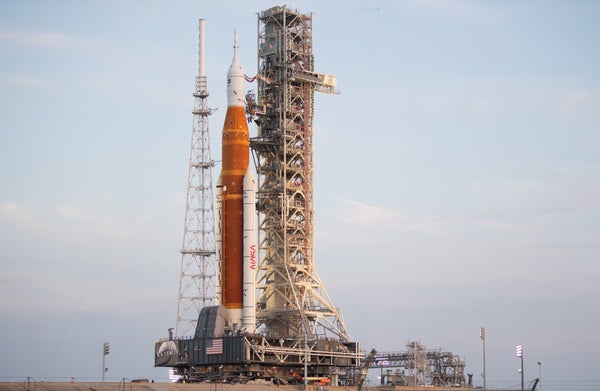
NASA has officially set the stage for humanity's return to the Moon, targeting early March for the launch of the historic Artemis II mission. This announcement follows a successful "wet dress rehearsal"—a critical pre-launch test where the massive Space Launch System (SLS) rocket was fully fueled and put through its countdown sequence at the Kennedy Space Center in Florida. The mission represents the first time astronauts will travel around the Moon since the Apollo 17 mission in 1972, marking a pivotal moment in space exploration history.

The Artemis II Mission Overview
Artemis II is designed as a 10-day journey that will carry four astronauts around the far side of the Moon and back to Earth. The crew consists of three Americans—Reid Wiseman, Victor Glover, and Christina Koch—and one Canadian, Jeremy Hansen, representing an international collaboration in space exploration. Their mission serves as a crucial test flight to validate systems and operations before NASA attempts a lunar landing with Artemis III.
The astronauts will travel aboard the Orion capsule, which sits atop the 98-meter-tall (322-foot) SLS rocket. The interior of their spacecraft is approximately the size of a minibus, where the crew will live, work, eat, and sleep throughout their journey. After launch, the first day will be spent in Earth orbit for system checks before the four-day transit to the Moon begins.
Critical Pre-Launch Testing
The successful wet dress rehearsal represents a major milestone after previous challenges. An initial attempt in early February ended prematurely due to a hydrogen fuel leak at the launch pad. NASA officials confirmed that issues with seals and filters have now been resolved, allowing the team to complete the full fueling process and countdown sequence as planned.
"Every night I look up at the Moon and I see it and I get real excited because I can feel she's calling us and we're ready," said NASA's Lori Glaze during a news conference. "The excitement for Artemis II is really, really starting to build, we can really start to feel it. It's coming." The crew entered quarantine following the successful rehearsal, marking the final phase of their pre-launch preparations.
The Journey to the Moon and Back
During their lunar flyby, the Artemis II crew will travel approximately 6,500-9,500 kilometers (4,000 to 6,000 miles) above the Moon's surface, passing around the far side that is never visible from Earth. This trajectory will provide several hours dedicated to scientific observation and imaging of the lunar surface. After completing their lunar observations, the astronauts will begin their four-day return journey, culminating in a splashdown in the Pacific Ocean.
The SLS rocket has only flown once before during the uncrewed Artemis I mission in November 2022. Artemis II represents its first flight with humans aboard, testing both the rocket's performance and the Orion capsule's life support systems in deep space conditions.

Future Implications and International Context
Artemis II serves as the essential precursor to Artemis III, which aims to land astronauts on the lunar surface by 2028—though NASA acknowledges this timeline is ambitious. The agency has contracted SpaceX to build the lunar lander for Artemis III, which would be transported to the Moon aboard a SpaceX Starship rocket. However, delays in Starship development have prompted NASA to request a streamlined plan from SpaceX to accelerate the return to the Moon.
Simultaneously, NASA has engaged Blue Origin, owned by Jeff Bezos, to develop an alternative accelerated lunar plan for Artemis III. This dual-track approach reflects the urgency of the United States' lunar ambitions amid growing international competition. China has announced plans for a crewed lunar landing by 2030 and has been making steady progress toward this goal. Both nations are targeting the Moon's south pole for potential landing sites and future lunar base locations, setting the stage for a new era of space exploration competition.
Conclusion
The upcoming Artemis II mission represents more than just a return to lunar orbit—it symbolizes a renewed commitment to human exploration beyond Earth's immediate vicinity. With the successful completion of critical pre-launch testing and a targeted March launch window, NASA is poised to write the next chapter in space exploration history. As international interest in the Moon intensifies, Artemis II stands as a testament to human ingenuity and the enduring drive to explore the unknown, paving the way for sustained human presence on the Moon and eventually missions to Mars.