Read on bbc.com
Artemis II: Final Countdown Begins for Historic Crewed Return to the Moon
NASA's Space Launch System rocket has arrived at the launch pad in Florida, marking the final phase of preparations for the Artemis II mission. This historic flight will send four astronauts on a 10-day journey around the Moon, the first crewed lunar mission in over 50 years. The crew, consisting of NASA astronauts Reid Wiseman, Victor Glover, Christina Koch, and Canadian astronaut Jeremy Hansen, will conduct vital science and operations, paving the way for future lunar landings. With a launch window opening in February, the team is prioritizing safety as they prepare for this monumental step in human space exploration.
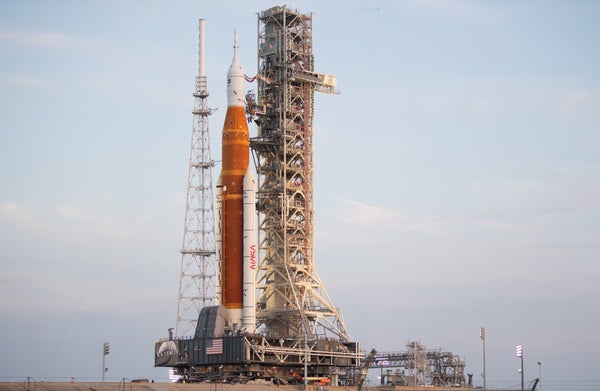
The final chapter in a half-century wait is being written on the sands of Cape Canaveral. NASA's colossal Space Launch System (SLS) rocket has completed its slow, deliberate journey to Launch Pad 39B at the Kennedy Space Center, signaling that the final preparations are now underway for the first crewed mission to the Moon in more than 50 years. The Artemis II mission represents a pivotal moment in modern space exploration, bridging the legacy of Apollo with a new era of sustained lunar presence and future journeys to Mars.
The Journey to the Pad
In a meticulously choreographed operation, the 98-meter-tall SLS rocket began its 12-hour voyage from the Vehicle Assembly Building at 07:04 local time. Carried by a massive crawler-transporter, the rocket trundled along the 4-mile (6.5 km) path at a top speed of just 0.82 mph (1.3 km/h), a pace that underscores the immense scale and precision required for such an endeavor. The rocket arrived at its destination at 18:41 local time, now standing ready for the critical tests that will precede its historic launch.
The Artemis II Crew and Mission Profile
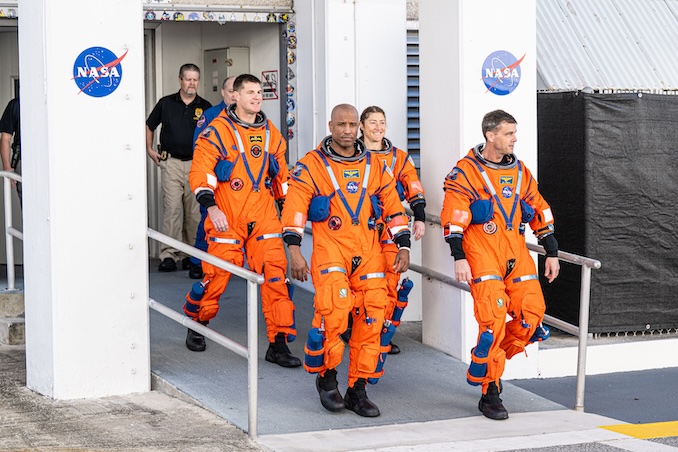
The four astronauts who will make this journey were present to witness the rocket's arrival. The crew consists of NASA's Reid Wiseman (commander), Victor Glover (pilot), and Christina Koch (mission specialist), alongside Canadian Space Agency astronaut Jeremy Hansen (mission specialist). Their 10-day mission, scheduled to launch no earlier than February 6, 2025, will not land on the lunar surface but will instead perform a lunar flyby, traveling farther into space than any human has been before.
The mission profile is complex and groundbreaking. After launch, the Orion spacecraft will first enter a high Earth orbit, approximately 40,000 miles out. From this vantage point, the crew will witness Earth as a single, distant ball—a perspective never before seen by human eyes. They will then embark on a trajectory that will take them a quarter of a million miles to the Moon. A key segment of the flight includes a dedicated three-hour period for lunar observation from the far side, where they will gather crucial data on geology to aid planning for future Artemis III landings at the Moon's south pole.
International Collaboration: The European Service Module
A cornerstone of the mission's success is the result of robust international partnership. The Orion spacecraft's European Service Module (ESM), built by Airbus in Bremen, Germany, is an essential component provided by the European Space Agency (ESA). This module is responsible for propulsion, power, and life support. Its large solar arrays will generate all electrical power, while its tanks hold the oxygen, nitrogen, and water needed to sustain the crew throughout their journey. As Sian Cleaver, a spacecraft engineer at Airbus, emphasized, the safety of the astronauts is the paramount concern driving every engineering decision.
Final Preparations and the Path Forward
With the rocket now on the pad, the Artemis team is engaged in around-the-clock work. The immediate next step is a "wet dress rehearsal," a comprehensive test of fuel loading operations and countdown procedures. This rehearsal is a critical final check before the launch team gives the definitive "go" for launch. While the mission has faced years of delays, NASA leadership has been unequivocal about its priorities. John Honeycutt, chair of the Artemis mission management team, stated that crew safety is the absolute top priority, affirming that the mission will fly only when the team is fully ready.
Artemis II is the crucial proving ground for the hardware and operations needed for Artemis III, which aims to return humans to the lunar surface no earlier than 2027. The success of this upcoming crewed flight is therefore foundational, not just for returning to the Moon, but for establishing the sustainable and exploratory framework that will eventually support human missions to Mars. As astronaut Jeremy Hansen reflected, this mission has the power to change humanity's relationship with its celestial neighbor, inspiring a new generation to look up and dream of what lies beyond.