Read on nature.com
The Atmospheric Mystery of TOI-561 b: A Hot Lava World That Defies Expectations
Astronomers have discovered a baffling anomaly in the exoplanet TOI-561 b, a world so close to its star it should be stripped bare. This super-hot planet, likely covered in molten lava, has somehow retained a surprisingly thick atmosphere despite being relentlessly blasted by stellar radiation. The discovery, detailed in a recent Nature publication, challenges existing models of planetary evolution and atmospheric retention, prompting scientists to reconsider how extreme environments shape worlds beyond our solar system.
In the vast catalog of discovered exoplanets, some worlds stand out not just for their strangeness, but for their defiance of scientific expectation. TOI-561 b is one such world. Recent observations have revealed a profound mystery: this super-hot planet, orbiting perilously close to its host star, possesses an anomalously thick atmosphere. According to established astrophysical models, the intense radiation from its star should have long ago boiled away this gaseous blanket, leaving behind a barren, airless rock. The fact that it hasn't presents a compelling puzzle for astronomers and reshapes our understanding of planetary resilience.

The Enigmatic World of TOI-561 b
TOI-561 b is classified as an ultra-short-period planet, meaning it completes an orbit around its star in a matter of hours. This proximity subjects the planet to extreme temperatures, likely rendering its surface a global ocean of molten lava. The environment is so hostile that, until recently, scientists assumed such worlds could not maintain substantial atmospheres. The star's relentless radiation and stellar winds were thought to efficiently strip away any primordial gases. However, data analyzed by researchers, including a team led by J. T. Teske and published in The Astrophysical Journal, tells a different story for TOI-561 b. The planet seems to be cloaked in a layer of gases that has stubbornly persisted against all odds.
Challenging Planetary Evolution Models
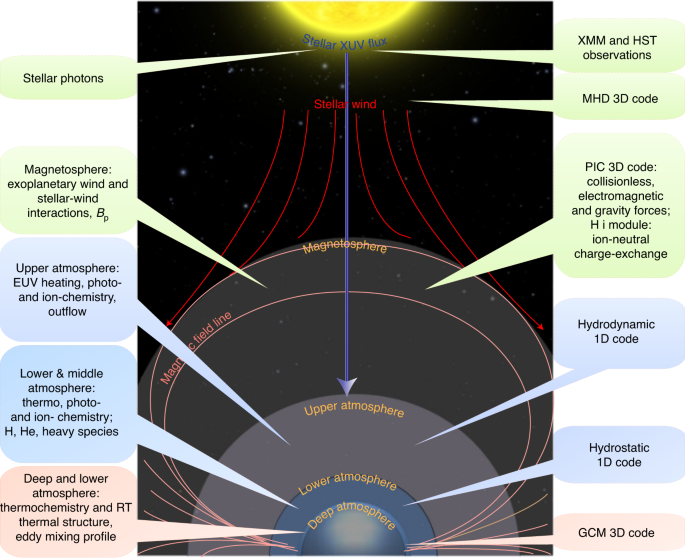
The retention of TOI-561 b's atmosphere directly challenges current theories of atmospheric escape. There are several mechanisms by which a planet can lose its air: thermal escape, where hot gas molecules achieve escape velocity; hydrodynamic escape, where the upper atmosphere is heated and flows away like a wind; and non-thermal processes driven by stellar activity. For a planet like TOI-561 b, all these processes should be operating at maximum efficiency. The discovery, as highlighted in the Nature news article, forces a re-evaluation. Scientists must now consider whether the atmosphere is being actively replenished, perhaps from volcanic outgassing from the molten interior, or if it possesses unique chemical properties that make it more resistant to stripping. Alternatively, the planet's initial atmospheric inventory may have been far more massive than previously thought possible for its location.
Implications for Exoplanet Science and Habitability
This single anomalous world has significant implications for the broader field of exoplanet research. If TOI-561 b can hold onto an atmosphere, it suggests that other extreme worlds in the so-called "hot Earth" or "lava world" categories might also harbor unexpected atmospheric diversity. This expands the range of planetary environments we consider dynamic and complex. Furthermore, while TOI-561 b itself is far too hot for life as we know it, its existence hints at the possibility of atmospheric persistence under duress. Understanding the mechanisms at play could inform the search for atmospheres on planets in more temperate zones around active stars, where atmospheric erosion is also a major concern for potential habitability.
The mystery of TOI-561 b's thick atmosphere is a powerful reminder that the universe is full of surprises. It underscores that our models of planetary formation and evolution are works in progress, constantly refined by new discoveries. As astronomers continue to study this enigmatic world with advanced telescopes like the James Webb Space Telescope, they hope to determine the composition of its atmosphere and unlock the secret to its tenacity. Each piece of data will not only solve the puzzle of TOI-561 b but will also rewrite the rules for planets across the galaxy.