Read on Nature
How a Precessing Magnetar Engine Powers Superluminous Supernovae
A groundbreaking study published in Nature reveals how a Lense–Thirring precessing magnetar engine drives the extreme luminosity of superluminous supernovae. Observations of SN 2024afav show 'chirped' light-curve bumps directly linked to a magnetar's properties, providing the first observational evidence of the Lense–Thirring effect in a magnetar environment. This discovery confirms the magnetar spin-down model for these cosmic explosions and opens new avenues for testing general relativity in the violent centers of young supernovae.
Superluminous supernovae (SLSNe) represent some of the most energetic explosions in the universe, shining with brightness at least ten times greater than their ordinary counterparts. For years, astronomers have debated what powers these extreme cosmic events, with magnetars—rapidly spinning neutron stars with immense magnetic fields—emerging as a leading candidate. Now, a landmark study published in Nature provides compelling evidence for a specific magnetar engine mechanism that not only explains the extraordinary luminosity but also reveals fascinating details about the physics at play.
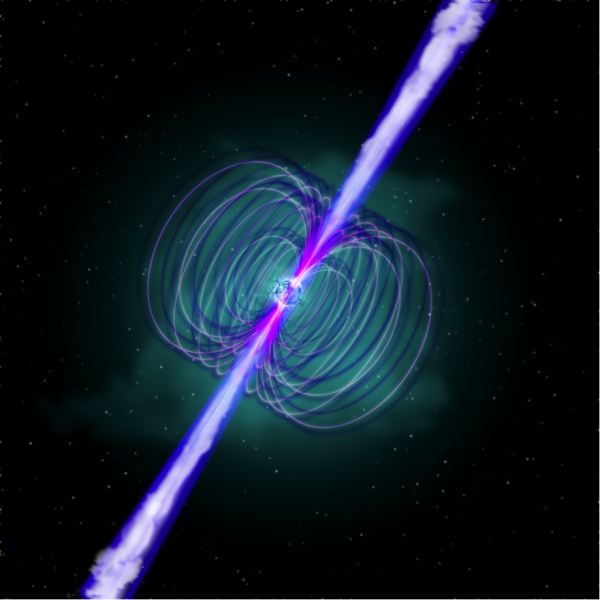
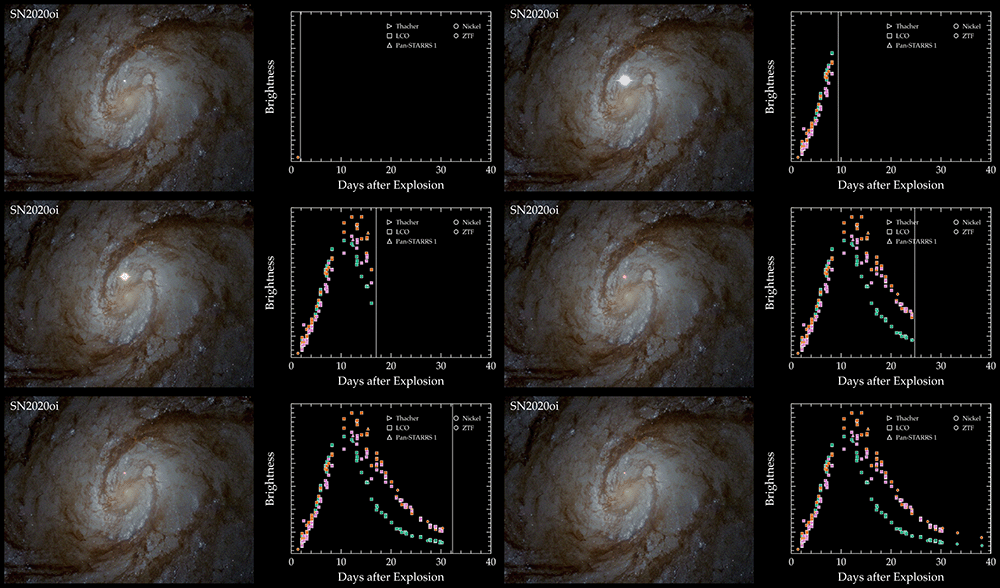
The research focuses on SN 2024afav, a hydrogen-poor superluminous supernova (SLSN-I) observed with unprecedented detail. What makes this discovery particularly significant is the identification of clear 'chirped' light-curve bumps—modulations in brightness that decrease in period over time. These patterns provide a direct observational link to the properties of the central engine, offering a new window into understanding the most powerful stellar explosions in the cosmos.
The Magnetar Engine Model
The standard magnetar model for SLSNe-I proposes that the rotational energy of a rapidly spinning, highly magnetized neutron star powers the supernova's extreme luminosity. As the magnetar spins down, it converts rotational energy into radiation that heats the expanding supernova ejecta, creating the brilliant display we observe. However, this model alone couldn't explain the complex light-curve bumps observed in many SLSNe-I, leaving a significant gap in our understanding.
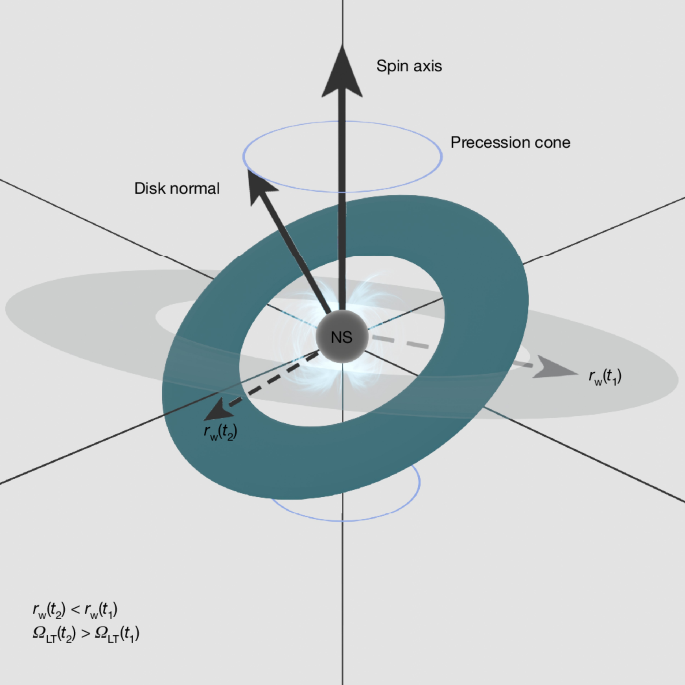
The new research reveals that SN 2024afav's light curve contains precisely these challenging features—multiple bumps with decreasing periods. The analysis demonstrates that these modulations can be explained by a magnetar centrally located within the expanding supernova ejecta, surrounded by an infalling accretion disk undergoing Lense–Thirring precession. This combination creates a self-consistent picture where both the overall light curve and the bump frequency independently constrain the magnetar's fundamental properties.
Lense–Thirring Precession in Action
The Lense–Thirring effect, also known as frame-dragging, is a prediction of Einstein's general theory of relativity where a massive rotating object drags spacetime around with it. In the context of SN 2024afav, researchers propose that this effect causes the infalling accretion disk around the newborn magnetar to precess—wobble like a spinning top. As material from the disk falls onto the magnetar, it modulates the energy output, creating the observed bumps in the light curve.
What makes this discovery particularly compelling is that the precession period decreases over time—the 'chirped' pattern mentioned earlier. This decreasing period provides crucial information about the system's evolution and allows astronomers to independently calculate the magnetar's properties. The analysis yields a spin period of P = 4.2 ± 0.2 milliseconds and a magnetic field strength of B = (1.6 ± 0.1) × 10¹⁴ Gauss, values consistent with theoretical predictions for magnetar engines.
Confirming the Magnetar Hypothesis
This research represents the first observational evidence of the Lense–Thirring effect in the environment of a magnetar and provides strong confirmation of the magnetar spin-down model for SLSNe-I. The ability to independently constrain both the spin period and magnetic field strength from the light-curve features represents a significant advancement in our understanding of these extreme cosmic events.
The study's methodology involved high-cadence multiband observations from facilities including the Las Cumbres Observatory global telescope network. Researchers analyzed both the photometric light curves and spectroscopic data, comparing their findings against alternative explanations such as circumstellar material interactions or other modulation mechanisms. The Lense–Thirring precession model provided the most consistent explanation for all observed features.
Implications for Astrophysics and General Relativity
Beyond confirming the magnetar engine model for superluminous supernovae, this discovery opens new avenues for testing general relativity in extreme environments. The violent centers of young supernovae represent laboratories for physics under conditions impossible to recreate on Earth, offering unique opportunities to study relativistic effects like frame-dragging in action.
The research also has implications for our understanding of neutron star formation and evolution. The inferred properties of the magnetar—its rapid spin and immense magnetic field—provide clues about the progenitor star and the supernova explosion mechanism itself. As future surveys like the Legacy Survey of Space and Time (LSST) discover more SLSNe, astronomers will be able to test whether this mechanism is common among these extreme events or represents a particular subclass.
This breakthrough demonstrates how detailed observations of cosmic explosions can reveal fundamental physics operating in the most extreme environments in the universe. By connecting theoretical predictions about general relativity with observable phenomena in distant supernovae, astronomers continue to push the boundaries of our understanding of both stellar evolution and the fundamental laws governing spacetime itself.