Unlocking the Secrets of Early Vertebrate Evolution: New Insights from 400-Million-Year-Old Fish Fossils
Recent paleontological breakthroughs are rewriting our understanding of how life transitioned from water to land. By applying advanced imaging techniques to enigmatic fossils from Australia's Gogo Formation and reconstructing a 410-million-year-old lungfish skull from China, scientists are revealing critical anatomical details about Earth's earliest vertebrates. These discoveries provide unprecedented insights into the evolutionary journey of lobe-finned fishes, the direct ancestors of all land-dwelling vertebrates, including humans. This article explores the significance of these findings and what they tell us about a pivotal moment in evolutionary history.
The transition from aquatic to terrestrial life represents one of the most significant evolutionary leaps in Earth's history. For decades, scientists have sought to understand the anatomical and physiological changes that enabled vertebrates to leave the water. Recent research, leveraging cutting-edge technology and newly discovered fossils, is providing fresh answers. By re-examining ancient specimens from Australia and China, paleontologists are piecing together a more detailed narrative of how our distant fish ancestors evolved the features that would eventually allow their descendants to walk on land.

The Gogo Formation: A Window into the Devonian Reef
Located in the Kimberley region of northern Western Australia, the Gogo Formation is a fossil-rich deposit from the Late Devonian period, often described as Australia's first 'Great Barrier Reef.' This site has yielded exceptionally preserved fossils that offer a rare, three-dimensional look at early marine life. A recent study published in the Canadian Journal of Zoology focused on a particularly puzzling fossil fragment from this location. Initially described in 2010, the specimen was so unusual that researchers considered it a potentially new type of fish. Led by Dr. Alice Clement from Flinders University, a team used advanced computed tomography (CT) scanning to create comprehensive digital images of both the external and internal structures of the fossil's cranium.
This high-tech analysis revealed the complex architecture of the brain cavity and, crucially, corrected previous misinterpretations. "We were able to confirm that previous impressions were probably viewed upside down and back to front," Dr. Clement explained. The work, supported by the Australian Research Council, adds a vital data point to the collection of early vertebrate species from Gondwana. By comparing the inner ear structure of this specimen with other Gogo lungfish, researchers are building a more nuanced understanding of the diversity and evolution of lobe-finned fishes during this critical period.

Paleolophus: A Missing Link from Ancient China
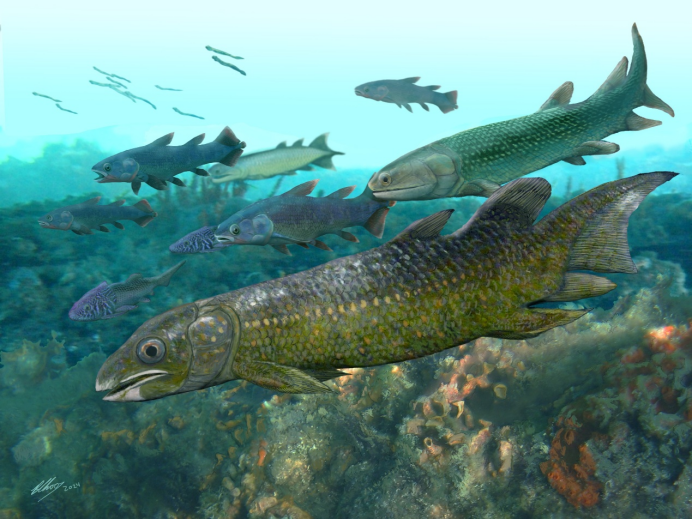
Simultaneously, a separate discovery from southern China is offering complementary insights. Published in Current Biology, this study details the reconstruction of a 410-million-year-old lungfish skull from a species named Paleolophus yunnanensis ('Old crest from Yunnan'). This fossil, investigated through a collaboration between Flinders University and the Chinese Academy of Sciences, represents a lungfish from a key transitional period. Dr. Brian Choo, a researcher involved in the study, notes that Paleolophus provides an unprecedented look at a time "between their earliest appearance and their great diversification a few million years later."
The exceptional preservation of the Paleolophus skull allows scientists to examine early adaptations in feeding mechanisms. By comparing it with both earlier species like Diabolepis from China and later ones like Uranolophus from the United States and Dipnorhynchus from Australia, researchers can trace the rapid evolutionary changes that occurred during the Devonian. This fossil acts as a crucial morphological bridge, highlighting both the conservation of primitive traits and the emergence of specialized features that would define lungfish for millions of years to come.
The Significance of Lungfish in the Vertebrate Story
Lungfish hold a special place in evolutionary biology as the closest living relatives of tetrapods—the four-limbed vertebrates that include amphibians, reptiles, birds, and mammals. Modern species, like the Australian lungfish from Queensland, possess a mix of aquatic and terrestrial adaptations, such as the ability to breathe air. Studying their ancient ancestors provides direct anatomical evidence of the changes that preceded the move onto land. The insights gained from fossils like those from Gogo and Yunnan help explain how structures like fins began to transform into limbs and how respiratory systems adapted to extract oxygen from air.
These findings do more than just catalog ancient species; they refine the timeline and mechanisms of a major evolutionary transition. The research demonstrates how periods of rapid diversification, like the mid-Devonian, produced the anatomical experimentation that ultimately led to terrestrial life. Each new fossil and each new analysis with modern technology adds a piece to the puzzle, bringing the story of our own deep evolutionary past into sharper focus.
Conclusion: A Continually Evolving Narrative
The reanalysis of the Gogo fossil and the discovery of Paleolophus exemplify how modern paleontology continues to revolutionize our understanding of prehistory. By combining meticulous fieldwork with technologies like CT scanning, scientists can extract new information from old bones and place fragmentary finds into a clearer evolutionary context. This work, conducted on opposite sides of the globe, converges on a single, profound story: the intricate and gradual process by which vertebrate life prepared to conquer the land. As more fossils are found and analyzed, the journey of our fish ancestors from water to land will only become more detailed and compelling, reminding us of the deep and ancient connections that bind all vertebrate life on Earth.