Ancient Fish Fossils Unlock Secrets of Vertebrate Evolution and the Move to Land
Groundbreaking research on 410-million-year-old fish fossils from Australia and China is providing unprecedented insights into how vertebrates evolved and eventually transitioned from water to land. By applying advanced CT scanning to enigmatic fossils from the Gogo Formation and reconstructing a complete lungfish skull from Yunnan, scientists are revealing the anatomical changes that paved the way for terrestrial life. These discoveries highlight the critical evolutionary role of ancient lungfish as the closest living relatives to all land vertebrates, including humans.
For centuries, the transition of life from water to land has stood as one of the most pivotal events in evolutionary history. Now, cutting-edge paleontological research is shedding new light on this monumental shift by examining some of Earth's earliest vertebrates. Scientists from Flinders University and the Chinese Academy of Sciences have made significant breakthroughs by reanalyzing 400-million-year-old fish fossils, offering fresh clues about the anatomical innovations that allowed our distant ancestors to conquer terrestrial environments.
Revisiting the Gogo Formation Enigma
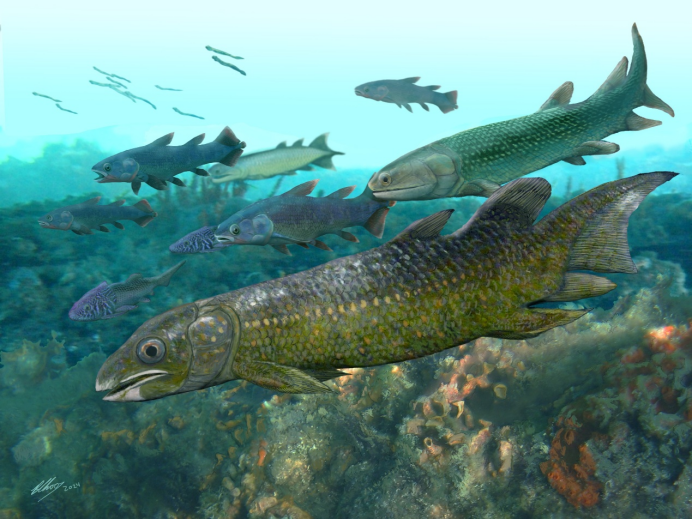
The Gogo Formation in Western Australia's Kimberley region represents a Devonian-era reef system, often called Australia's first 'Great Barrier Reef.' This fossil-rich site has long been a treasure trove for paleontologists. Recent work, led by Dr. Alice Clement from Flinders University's Palaeontology Lab, has focused on a particularly puzzling fossil fragment first described in 2010. Initially, researchers speculated it might represent an entirely new type of fish. However, advanced imaging techniques have now provided clarity.
Using high-resolution CT scanning and computed tomography, the team created comprehensive digital images of both the external and internal cranial structures. "We were able to confirm that previous impressions were probably viewed upside down and back to front," explains Dr. Clement. This technological approach allowed researchers to examine the complex brain cavity in detail, offering a new data point for understanding the diversity of lungfish that thrived in this ancient reef environment. The study, published in the Canadian Journal of Zoology, adds to the growing body of evidence about early lobe-finned fishes in Gondwana.

The Chinese Lungfish: A Missing Link Revealed
Parallel research from southern China has yielded another extraordinary discovery. Scientists have reconstructed the complete skull of a 410-million-year-old lungfish species named Paleolophus yunnanensis ('Old crest from Yunnan'). This fossil, described in the journal Current Biology, provides a crucial snapshot from a period of rapid evolutionary diversification. Dr. Brian Choo, a Flinders University researcher who collaborated on the project, notes that Paleolophus offers an unprecedented look at a lungfish from a time bridging their earliest appearance and their later diversification.
The fossil shows a mix of primitive and advanced characteristics when compared to other early species like Diabolepis from China, Uranolophus from Wyoming, and Australia's Dipnorhynchus. This combination of traits helps scientists map the evolutionary pathway that led to the distinctive feeding adaptations lungfish would develop. "It was a time when the group was just starting to develop the distinctive feeding adaptations that would serve them for the remainder of the Devonian and onwards to the present day," says Dr. Choo.
Lungfish: Our Closest Aquatic Relatives
Lungfish occupy a unique and critical branch on the vertebrate family tree. As Dr. Choo emphasizes, they are the closest living relatives to tetrapods—the four-limbed vertebrates that include amphibians, reptiles, birds, and mammals. Modern species, like the Australian lungfish from Queensland, provide a living link to this ancient past. Studying both fossil and living lungfish offers vital anatomical evidence about how key features, such as limbs and lungs, evolved in preparation for life on land.
The research underscores that the transition to land was not a sudden event but a gradual process of adaptation, with lungfish showcasing many of the proto-adaptations necessary for terrestrial life. Their evolutionary story is, in essence, our own deep-time origin story.
Conclusion: Piecing Together the Vertebrate Puzzle
The combined findings from Australia and China represent significant strides in paleontology. By applying modern technology to ancient fossils, researchers are correcting past misinterpretations and filling gaps in the evolutionary timeline. These studies, supported by grants from the Australian Research Council and the National Natural Science Foundation of China, highlight the importance of international collaboration and continued exploration of fossil sites worldwide.
As scientists decode the anatomy of these 400-million-year-old pioneers, they not only learn about fish but also uncover the foundational blueprints for all land-dwelling vertebrates. Each fossil fragment, once an enigma, now contributes to a clearer understanding of one of life's greatest journeys: the move from sea to land.