The Unseen Power of Cosmic Voids: Where Dark Energy Reigns Supreme
Cosmic voids, the vast empty regions between galaxies, are not the barren wastelands they appear to be. While stripped of stars, planets, and dark matter, they are filled with the fundamental quantum fields of spacetime, carrying vacuum energy—also known as dark energy. In these immense empty spaces, where matter's influence fades, dark energy becomes the dominant force, actively driving the accelerated expansion of the universe and slowly tearing apart the cosmic web. This article explores why these 'empty' regions are crucial to understanding the fate and fundamental structure of our cosmos.
When we gaze at the night sky, our eyes are drawn to the glittering stars and the faint smudges of distant galaxies. Yet, the vast majority of the universe's volume is occupied by something far less conspicuous: cosmic voids. These are the immense, seemingly empty regions that stretch between the filaments and walls of the cosmic web. Contrary to their barren appearance, these voids are not truly empty. They are, in fact, the cosmic arenas where the most mysterious force in the universe—dark energy—exerts its greatest influence, quietly orchestrating the large-scale fate of everything we see.
The Quantum Fabric of "Nothing"
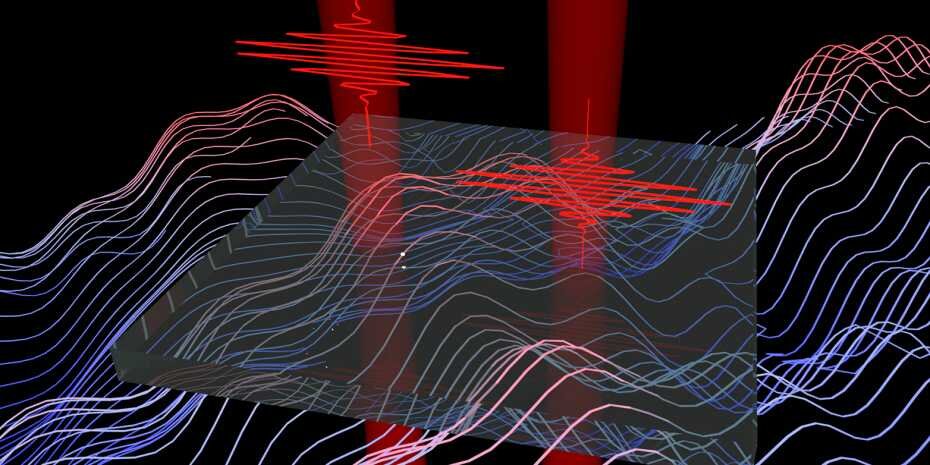
To understand cosmic voids, we must first redefine what we mean by "empty space." In the deepest recesses of a void, if we could theoretically remove all ordinary matter, dark matter, radiation, and neutrinos, we would not be left with pure nothingness. According to quantum field theory, the foundation of modern physics, what remains is the vacuum of spacetime itself, which is permeated by fundamental quantum fields. As detailed in research from Universe Today, every type of particle, from electrons to quarks, corresponds to a field that fills every cubic centimeter of the universe. These fields are eternal and ubiquitous.
A particle, like an electron, is merely a localized excitation or ripple in its corresponding field. Crucially, even in the absence of any particles, the fields themselves persist. This underlying fabric of reality is never switched off. Furthermore, due to the Heisenberg uncertainty principle, these quantum fields contain a baseline, irreducible amount of energy known as vacuum energy. It is this subtle, omnipresent energy that physicists identify as the leading candidate for dark energy—the force responsible for the accelerating expansion of the universe.
Why Dark Energy Dominates in Voids
In most regions of the cosmos, the effects of vacuum energy are utterly negligible. Here on Earth, and within galaxies and galaxy clusters, the gravitational pull from dense concentrations of matter completely overshadows the gentle push of dark energy. The path of a planet's orbit or the collapse of a gas cloud to form stars is dictated by gravity, not by the expansion of space itself.
Cosmic voids present a radically different environment. These are regions hundreds of millions of light-years across where matter is exceptionally sparse. With the gravitational influence of matter so faint, the vacuum energy embedded in space itself becomes the dominant player. If you could place an observer in the heart of a cosmic void, they would effectively be immersed in a bath of dark energy. This is why scientists study voids to understand dark energy's properties; they are the only places in the universe where its effects are not masked by matter.
The Active Role of Voids in Cosmic Evolution
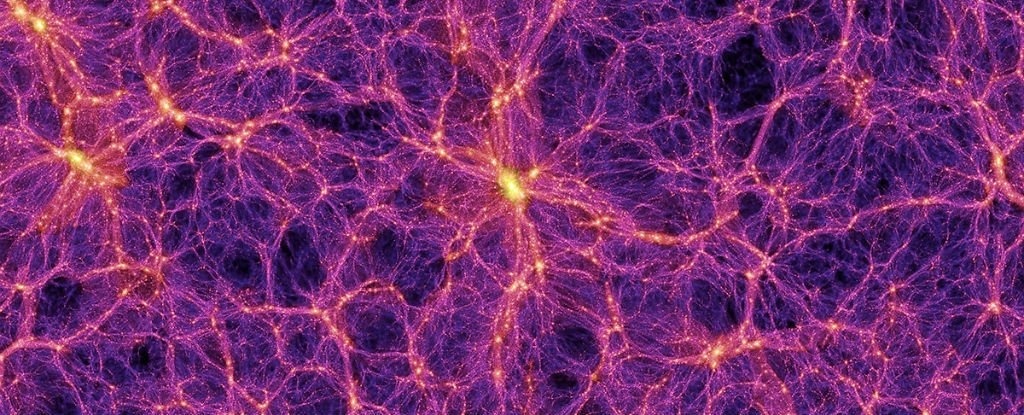
Far from being passive gaps, cosmic voids are dynamically evolving regions. The dark energy within them causes space itself to expand at an accelerating rate. Consequently, the voids themselves are growing. As they expand, they press outward against the surrounding filaments and walls of the cosmic web. This process acts like a slow-motion tug-of-war, with the expanding voids gradually stretching and thinning the web of galaxies.
This has profound implications for the long-term future of the universe. Over tens of billions of years, this relentless expansion driven from within the voids will slowly pull the large-scale structure apart. The intricate network of galaxies and clusters that defines our universe today will become increasingly diluted and disconnected. In a very real sense, the fate of the cosmic web is being decided within these vast expanses of apparent nothingness.

Conclusion: The Critical Importance of Emptiness
Cosmic voids challenge our intuition about emptiness. They are not mere backdrops to the luminous structures of the universe but are active, energy-filled regions that hold the key to understanding dark energy and the ultimate fate of the cosmos. Their lack of conventional matter is precisely what allows the fundamental quantum energy of space to take center stage. By studying these vast nothingnesses, astronomers and physicists are peering into the engine room of cosmic acceleration. The universe's greatest mysteries are not always hidden in the light of stars, but often in the profound darkness between them, where the quantum whisper of empty space shapes everything.