Ancient Lungfish Fossils Unlock Secrets of Vertebrate Evolution and the Move to Land
Groundbreaking research on 410-million-year-old fossils from Australia and China is providing unprecedented insights into the evolution of early vertebrates. By reanalyzing enigmatic specimens from the Gogo Formation and reconstructing a newly discovered lungfish skull, scientists are piecing together how ancient fish developed the anatomical features that eventually enabled their descendants to transition from water to land. This work highlights the critical role lungfish, the closest living relatives to all land vertebrates, play in understanding our own deep evolutionary history.
The transition of life from water to land stands as one of the most pivotal events in the history of our planet. For decades, paleontologists have sought to understand the anatomical changes that allowed ancient fish to become the ancestors of all land-dwelling vertebrates, including humans. Recent breakthroughs, driven by advanced imaging technology and international collaboration, are shedding new light on this profound evolutionary leap. By examining remarkably preserved fossils of ancient lungfish from Australia and China, researchers are decoding the physical transformations that set the stage for terrestrial life.

Deciphering the Enigmatic Gogo Formation Fossils
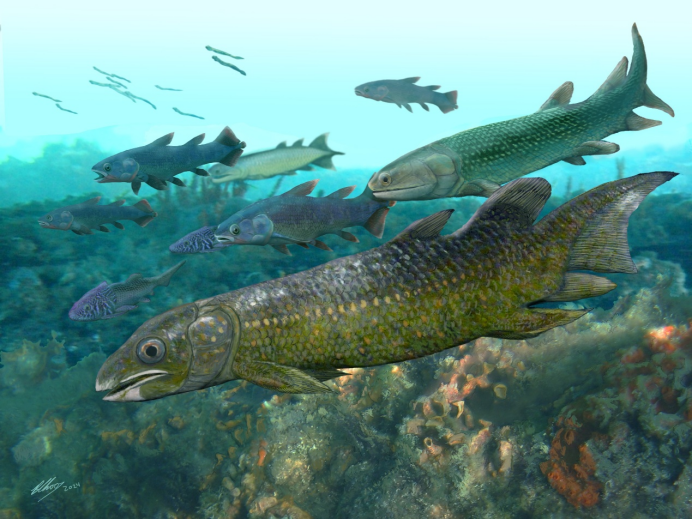
The Gogo Formation in Western Australia's Kimberley region is a world-renowned fossil site, preserving a Devonian-era reef system often called Australia's first 'Great Barrier Reef.' Here, a fragmentary and puzzling fossil, first described in 2010, had long baffled scientists. Initially, it was considered a potential new type of fish entirely unknown to science. However, a recent study led by Dr. Alice Clement from Flinders University's Palaeontology Lab has re-examined this specimen using cutting-edge computed tomography (CT) scanning.
This non-invasive technology allowed the team to create comprehensive digital images of both the external cranium and the internal brain cavity. "Using high-tech scanning, this time we were able to create comprehensive new digital images... showcasing the complexity of the brain cavity of this fascinating lungfish," Dr. Clement explained. The analysis revealed that previous interpretations of the fossil were likely viewing it upside down and back to front. By comparing the inner ear structure with other known Gogo lungfish, researchers confirmed its place within this ancient group, adding a crucial data point to our understanding of early lobe-finned fish evolution in the ancient supercontinent of Gondwana.

A New Window from China: The Paleolophus Skull
Simultaneously, a separate international collaboration has yielded another major discovery. Scientists from Flinders University and the Chinese Academy of Sciences have reconstructed the skull of a 410-million-year-old lungfish named Paleolophus yunnanensis ('Old crest from Yunnan'). This exceptionally preserved fossil was unearthed in rocks from southern China, which were once covered by ancient seas. Dr. Brian Choo, a researcher involved in the study, emphasized its significance: "Paleolophus gives us an unprecedented look at a lungfish from a time between their earliest appearance and their great diversification a few million years later."
This fossil represents a critical evolutionary snapshot. It shows the early development of distinctive feeding adaptations that would characterize lungfish for millions of years to come. By comparing Paleolophus with both earlier primitive species like Diabolepis from China and later forms like Uranolophus from the United States and Dipnorhynchus from Australia, researchers can trace a clearer picture of rapid evolutionary change during the Devonian period.
Lungfish: The Living Link to Our Aquatic Past
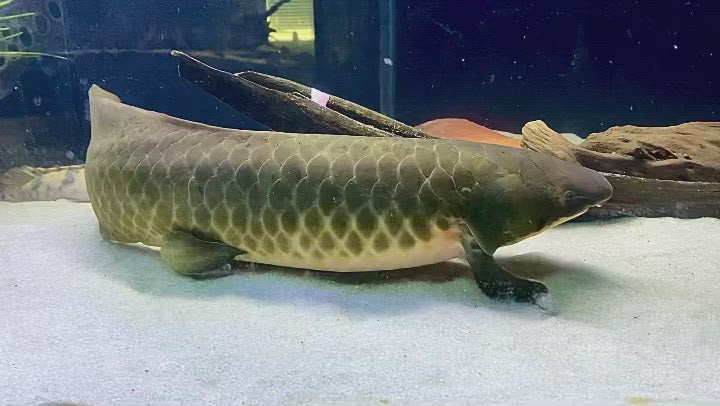
The importance of these fossil studies is magnified by the existence of living lungfish, such as the Australian lungfish found in Queensland. These modern survivors represent an extremely ancient branch of the vertebrate family tree and are the closest living relatives to tetrapods—the four-limbed vertebrates that include amphibians, reptiles, birds, and mammals. Dr. Choo notes that this close evolutionary relationship is why lungfish have long intrigued scientists. Studying their ancient fossils provides direct anatomical evidence of the transitional features that preceded the move onto land.
Features like the structure of the inner ear, the shape of the braincase, and early jaw mechanics preserved in these fossils are evolutionary precursors to the anatomical systems that allowed vertebrates to hear, balance, and feed in a terrestrial environment. Each new fossil discovery, like those from Gogo and Yunnan, fills in gaps in this complex evolutionary narrative.
Conclusion: Piecing Together the Path to Land
The collaborative work on Devonian lungfish fossils, supported by organizations like the Australian Research Council and the National Natural Science Foundation of China, is fundamentally advancing paleontology. By applying modern technology to ancient stones and fostering global scientific partnerships, researchers are not just cataloging extinct species; they are actively reconstructing the journey of life itself. These studies on ancient lungfish provide tangible, anatomical clues about how vertebrates developed the biological toolkit necessary to conquer new environments. As more fossils are analyzed with ever-improving techniques, the story of how our distant fish ancestors took their first steps onto land will continue to come into sharper, more detailed focus.