Ancient Fish Fossils Unlock Secrets of Vertebrate Evolution and the Move to Land
Recent paleontological breakthroughs are rewriting our understanding of vertebrate evolution. By applying advanced imaging to enigmatic fossils from Australia's Gogo Formation and reconstructing a 410-million-year-old lungfish skull from China, scientists are uncovering critical details about the ancient fish that are the closest living relatives to all land vertebrates, including humans. This research provides unprecedented anatomical evidence of how life transitioned from water to land over 400 million years ago.
For over 400 million years, the evolutionary journey from ancient fish to land-dwelling vertebrates has been one of biology's greatest mysteries. Recent breakthroughs in paleontology, driven by advanced imaging technology and international collaboration, are finally illuminating this pivotal chapter in Earth's history. By re-examining fossil treasures from Australia and China, researchers are piecing together the anatomical puzzle of how lobe-finned fish evolved the features that would eventually enable their descendants to conquer the land.
The Gogo Formation: A Window into a Devonian Reef
The Gogo Formation in northern Western Australia is a paleontological goldmine, preserving an ancient Devonian-era reef system often called Australia's first 'Great Barrier Reef.' For decades, Flinders University researchers have studied its remarkably preserved fossils. A recent study, published in the Canadian Journal of Zoology, focused on a particularly puzzling specimen first described in 2010. Initially, its fragmentary state led scientists to speculate it might represent an entirely new type of fish.
Led by Dr. Alice Clement, the team employed advanced computed tomography (CT) scanning to peer inside the fossil without damaging it. This high-tech approach allowed them to create comprehensive new digital images of both the external cranium and the internal brain cavity. "We were able to confirm that previous impressions were probably viewed upside down and back to front," Dr. Clement explained. This correction was crucial for accurate anatomical interpretation.
Advanced Imaging Reveals Hidden Anatomy
Co-author Hannah Thiele collaborated with facilities like the Australian Nuclear Science and Technology Organisation (ANSTO) to analyze the fossil. The scans provided a clear view of the inner ear structure, a key area for understanding sensory evolution. "We were able to compare its most preserved inner ear area with other Gogo lungfish," Thiele noted. "This is an extra data point in the amazing collection of lungfish and early vertebrate species, adding to the wider understanding of the evolution of these earliest lobe-finned fishes." This work underscores the value of revisiting old museum specimens with new technology.

Paleolophus: A Missing Link from Ancient China
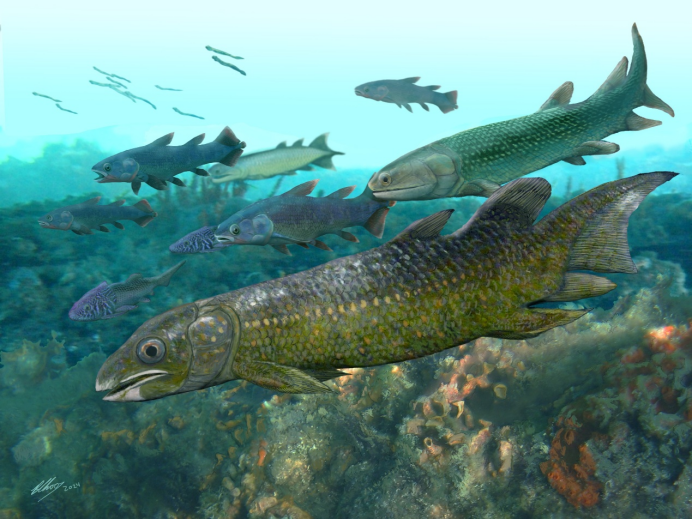
In a parallel discovery published in Current Biology, an international team reconstructed the skull of a 410-million-year-old lungfish named Paleolophus yunnanensis ('Old crest from Yunnan'). This fossil was unearthed in rocks from southern China, which was once covered by a shallow sea. The collaboration between Flinders University researcher Dr. Brian Choo and scientists at the Chinese Academy of Sciences' Institute of Vertebrate Paleontology and Paleoanthropology has yielded a spectacular find.
"Paleolophus gives us an unprecedented look at a lungfish from a time between their earliest appearance and their great diversification a few million years later," said Dr. Choo. This period was critical, as lungfish were beginning to develop the distinctive skull and feeding adaptations that would characterize the group for millions of years to come. The fossil acts as a morphological bridge, showing similarities to both the very primitive Diabolepis from China and later, more specialized species like Uranolophus from the United States and Dipnorhynchus from Australia.
Why Lungfish Are Evolutionary Keystones
Lungfish represent an ancient and enduring branch of the vertebrate family tree. As Dr. Choo points out, they include species still alive today, such as the Queensland lungfish. Their profound significance lies in their close evolutionary relationship to tetrapods—the four-limbed vertebrates that include amphibians, reptiles, birds, and mammals. Studying both fossil and living lungfish provides direct anatomical evidence of the transitional features that facilitated the move from aquatic to terrestrial life.
Features like the structure of their fins (which contain bones homologous to our arm bones), their ability to breathe air via primitive lungs, and the anatomy of their skulls offer a blueprint for understanding our own deep evolutionary past. The research from both Australia and China is gradually mapping the "rapid evolutionary diversification" that occurred during the Devonian period, a time often called the 'Age of Fishes.'
Conclusion: A Collaborative Future for Paleontology
The discoveries from the Gogo Formation and Yunnan province highlight the modern, collaborative nature of paleontology. This research, supported by grants from the Australian Research Council and the National Natural Science Foundation of China, combines cutting-edge technology with traditional fieldwork and respects the cultural heritage of the lands where fossils are found, as acknowledged with the Gooniyandi community in Australia.
By digitally resurrecting these 400-million-year-old creatures, scientists are not just cataloging ancient life; they are tracing the very origins of our vertebrate lineage. Each new fossil scan and reconstruction adds a crucial piece to the story of how life ventured from water to land, ultimately paving the way for the diversity of terrestrial animals we see today, including ourselves.