Read on bbc.com
Europe's Strategic Crossroads: Rethinking Alliances in a New World Order
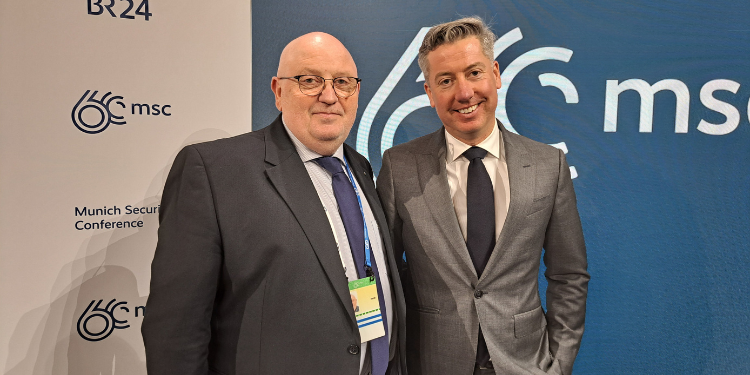
European nations are grappling with a fundamental strategic dilemma: can traditional alliances with the United States through NATO and the EU still provide sufficient security, or must they urgently diversify into new, ad-hoc coalitions? This question has gained unprecedented urgency under the Trump administration, which has adopted a transactional, conditional approach to transatlantic relations. From the Greenland sovereignty crisis to threats over defense spending, trust has been severely damaged. The recent Munich Security Conference highlighted a continent feeling increasingly exposed between an expansionist Russia, an aggressive China, and an unpredictable America. European leaders are now exploring partnerships with like-minded nations such as Australia, Japan, and South Korea while simultaneously attempting to boost continental defense capabilities and strategic autonomy.
The scaffolding-clad church on a Munich pedestrian boulevard, bedecked not with religious iconography but with sleek advertisements for next-generation drones bearing the slogan "Europe's security under construction," serves as a powerful metaphor for a continent in strategic flux. Such overt military marketing would have been unthinkable in Germany just years ago, yet it reflects a profound reassessment underway across European capitals. The comfortable post-Cold War security architecture, underpinned by unwavering American commitment, is fracturing. European nations now confront a pressing question with existential implications: can traditional alliances suffice, or must they urgently diversify their strategic partnerships?
The Erosion of Transatlantic Trust
The foundation of Europe's post-war security—the transatlantic alliance—has never been more strained. According to analysis from the BBC, the relationship has deteriorated significantly since Donald Trump's return to the White House. Actions perceived as hostile by European allies, including threats to Danish sovereignty over Greenland and the temporary pausing of intelligence-sharing with Ukrainian forces, have left "deep scars and a troubling sense of transatlantic wariness." European powers increasingly view the Trump administration as "truly transactional," willing to leverage security and economic relations to achieve its goals. This represents a dramatic shift from the post-war consensus, where the alliance was viewed as built on shared values rather than conditional transactions.
German Defence Minister Boris Pistorius acknowledged this paradigm shift starkly, stating, "We got used to the strong support from the US; we got used to our comfort zone in which we used to live. This time is over, definitely over." The sentiment that "Washington was right" to criticize European underinvestment in defense is now widespread among security elites, even as the manner of the American critique causes resentment. The crisis has revealed a fundamental asymmetry: while Europe has indeed "coasted on America's security blanket for decades," the abrupt and coercive manner of Washington's demand for change has shattered assumptions of mutual goodwill.
Europe's Strategic Vulnerability and Awakening
A palpable sense of exposure is driving Europe's strategic rethink. Eurobarometer polls indicate that more than two-thirds of Europeans (68%) feel their country is under threat, squeezed between an expansionist Russia, an economically aggressive China, and an unpredictable United States. Germany's Federal Office of Civil Protection and Disaster Assistance has issued warnings unseen since the Cold War, suggesting citizens maintain emergency food supplies. This anxiety is translating into action. Germany is now the single largest donor of aid to Ukraine following the halt of US direct assistance and has committed to a defense budget that, by 2029, NATO Secretary General Mark Rutte described as "a staggering amount"—higher than the UK and French equivalents combined.

However, the response is not uniform across the continent. Security analysts like Rachel Ellehuus of RUSI note a growing rift. Nordic and Baltic nations, geographically proximate to Russia, along with Germany and the Netherlands, are significantly boosting defense spending. In contrast, southern European countries like Spain remain "unapologetic" about refusing to meet spending targets demanded by Washington. France and Britain, while verbally committed, struggle to find the "political band aid" to justify the necessary trade-offs—higher taxes, reduced welfare, or increased borrowing—to their electorates. This disparity complicates any unified European defense initiative.
The Search for New Partnerships: "A La Carte" Coalitions
Faced with a conditional US partnership and the slow-moving machinery of large traditional organizations like the EU and NATO, European leaders are increasingly turning to flexible, ad-hoc coalitions. These "a la carte" groupings often include non-European, like-minded democracies, reflecting a strategic diversification beyond the Atlantic basin. A prime example is the "Coalition of the Willing," led by the UK and France, which includes Turkey, New Zealand, and Australia, focused on securing Ukrainian sovereignty in potential peace talks with Russia.
This outward-looking strategy extends to the Indo-Pacific. Japan and South Korea are increasingly viewed as part of the "like-minded family," sharing concerns about authoritarian challenges to the rules-based order. Canada is deepening cooperation with Nordic and Baltic states, creating a network of stability spanning from the Baltic Sea through the North Atlantic to the Canadian Arctic—so much so that one European policymaker joked Canada was becoming "more and more European by the day." These partnerships are not solely military; they encompass supply chain security, technology development, and energy, aligning with French President Macron's long-standing call for European "strategic autonomy."

The Limits of Autonomy and the Path Forward
For all the talk of independence, Europe's limitations remain starkly apparent. The continent remains critically dependent on US security assets, from its nuclear umbrella to advanced intelligence, surveillance, and reconnaissance capabilities. High-tech innovation, particularly in defense sectors like AI and aerospace, still largely trails American advancements. Internal European cooperation is also fraught with difficulty, as evidenced by the ongoing Franco-German disputes over the joint Future Combat Air System (FCAS) project.
The message from Washington is clear and unsettling for Europeans. As U.S. Undersecretary of Defence Elbridge Colby stated, under President Trump, the US is "reprioritising" toward the Indo-Pacific and its own hemisphere. While reaffirming commitment to NATO's mutual defense clause, Colby insisted the US presence in Europe would become "more limited and focused," calling for a "Nato 3.0" where Europe acts as a "partner, rather than a dependent." This forces a harsh reality upon European capitals: they have, in the estimation of analysts, "5-10 years to stand on their own two feet in terms of conventional defence capabilities."
Conclusion: An Inescapable Adaptation
The posters in Munich proclaiming "Europe's security under construction" are more than an advertising campaign; they are a statement of intent for a continent undergoing a painful but necessary strategic awakening. The old world order, with an unchallenged West at its core and America as Europe's guaranteed guardian, has faded. What emerges is not a simple choice between traditional alliances and new partnerships, but a complex, multi-layered strategy. Europe must simultaneously strengthen its own capabilities through initiatives like strategic autonomy, reinvest in a transformed and more equitable transatlantic relationship, and cultivate new global coalitions with shared democratic values.
As European Commission President Ursula von der Leyen noted, "Some lines have been crossed that cannot be uncrossed anymore." The shock therapy administered by shifting American priorities has irrevocably changed the strategic calculus. The task now is to build a resilient, diversified security architecture that can protect European interests in an era defined not by predictable alliances, but by the volatile dynamics of big power politics. The construction site is open, and the work, as the Munich slogan suggests, has only just begun.