Harnessing Gyroscopic Precession: A New Frontier in Wave Energy Conversion
Ocean waves represent a vast, untapped reservoir of renewable energy, but their variable nature has historically challenged efficient power generation. Researchers at The University of Osaka are pioneering a novel solution: a gyroscopic wave energy converter (GWEC). This innovative system uses a spinning flywheel inside a floating platform to transform wave motion into electricity by leveraging the physics of gyroscopic precession. Early analysis suggests this approach can achieve near-maximum theoretical efficiency across a broad spectrum of wave conditions, potentially unlocking a more reliable and adaptable form of marine energy.
The relentless motion of the ocean holds immense potential as a clean, predictable energy source, yet converting its kinetic power into grid-ready electricity has remained an engineering puzzle. Traditional wave energy devices often falter when faced with the sea's ever-changing rhythms, performing optimally only within narrow frequency bands. A groundbreaking study from The University of Osaka, published in the Journal of Fluid Mechanics, proposes a radical departure from conventional designs. The research explores a gyroscopic wave energy converter (GWEC), a system that uses the fundamental principles of a spinning gyroscope to potentially overcome the broadband efficiency limitations that have hampered the field.
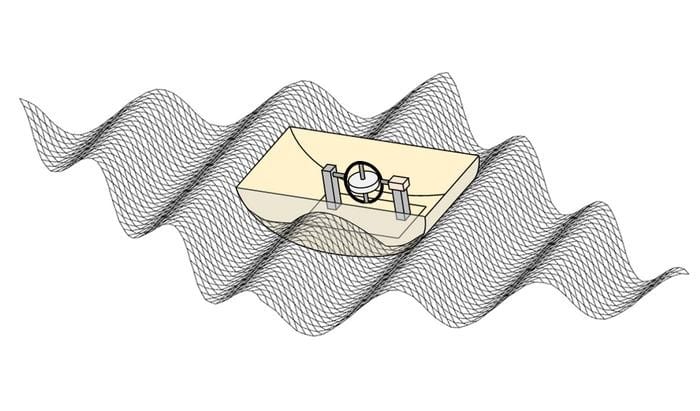
The Core Principle: Gyroscopic Precession
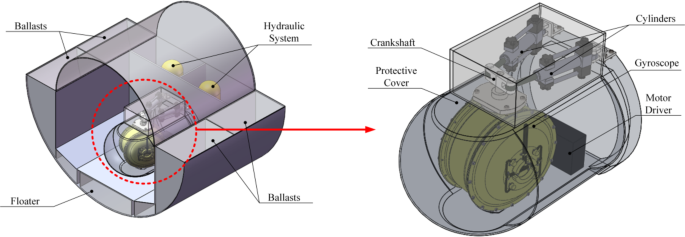
At the heart of the GWEC is a high-speed spinning flywheel, acting as a gyroscope, housed within a buoyant platform moored at sea. The system's genius lies in its exploitation of gyroscopic precession—a phenomenon where an applied force to a spinning object causes it to react at a right angle to that force. As ocean waves cause the floating structure to pitch and roll, this motion is transferred to the gyroscope. Instead of simply resisting the movement, the gyroscope undergoes a controlled precessional wobble. This predictable rotational shift is mechanically linked to a generator, directly converting the gyroscopic motion into electrical current.
"Wave energy devices often struggle because ocean conditions are constantly changing," explains study author Takahito Iida. "However, a gyroscopic system can be controlled in a way that maintains high energy absorption, even as wave frequencies vary." This tunability is the GWEC's key advantage. By adjusting the flywheel's rotational speed and the generator's control parameters, the system can be optimized to resonate with—and efficiently harvest energy from—a wide range of wave patterns, moving beyond the limitations of single-frequency resonance.
Reaching Theoretical Efficiency Limits
The University of Osaka research employed linear wave theory to model the complex interactions between the ocean waves, the floating platform, and the internal gyroscope. This analytical framework allowed the team to identify the ideal operational settings for the device. The findings, as detailed in the study published by ScienceDaily, are particularly promising. The analysis indicates that a properly tuned GWEC can reach the fundamental theoretical maximum for energy absorption efficiency—capturing up to half of the incoming wave energy—across a broadband of frequencies.
"This efficiency limit is a fundamental constraint in wave energy theory," Iida notes. "What is exciting is that we now know that it can be reached across broadband frequencies, not just at a single resonant condition." This breakthrough suggests the GWEC design could fundamentally change the performance expectations for wave energy technology, offering a path to devices that work effectively in diverse sea states rather than ideal conditions alone.
Validation and Future Implications
The theoretical findings were bolstered by comprehensive numerical simulations. These tests, conducted in both frequency and time domains, confirmed the device's ability to maintain strong performance, especially near its resonance frequency. The research provides a crucial blueprint for engineers, clarifying how to fine-tune the gyroscope's operating parameters to maximize energy yield in real-world oceanic environments.
As the global community intensifies its search for reliable and abundant renewable energy sources to meet climate goals, innovations like the GWEC are critical. The oceans represent one of the planet's largest untapped energy reservoirs. By offering a more flexible and efficient method to harness wave power, gyroscopic converter technology could play a significant role in diversifying the clean energy mix, contributing to energy security and a sustainable future.