Bangladesh's Political Crossroads: The Uncertain Future of the Awami League
Bangladesh approaches its February parliamentary election under unprecedented circumstances, with the long-ruling Awami League banned from the ballot. The party, which held power for 15 years under former Prime Minister Sheikh Hasina, faces an existential crisis following a 2024 student-led uprising that forced Hasina into exile in India. This article examines the divided sentiments among former supporters, the party's struggle for relevance, and expert analysis on whether this political dynasty can survive its most severe challenge since the 1975 assassination of its founder. The election marks a pivotal moment in Bangladesh's democratic trajectory, raising questions about political legitimacy and the future of dynastic politics in South Asia.
Bangladesh stands at a historic political juncture as it prepares for parliamentary elections in February, marking the first vote since the dramatic ouster of former Prime Minister Sheikh Hasina. The Awami League, the party that ruled the nation with an iron fist for 15 years, finds itself in unprecedented territory—banned from political activities and absent from the ballot. This development represents not just an electoral shift but a potential reconfiguration of Bangladesh's political landscape, raising fundamental questions about the survival of one of South Asia's most enduring political dynasties.

The Fall from Power
The Awami League's current predicament stems directly from the 2024 student-led uprising that toppled Hasina's government and forced her into exile in India, Bangladesh's close ally. The party's decline has been swift and dramatic. Once omnipresent political symbols—the large posters and banners featuring local Awami League politicians that plastered neighborhoods across the country—have disappeared, leaving little trace of the party's former dominance. The physical manifestations of this decline are stark: the Awami League's head office in Dhaka's Gulistan area now stands abandoned, vandalized and set on fire during the uprising, currently serving as shelter for homeless people and, in sections, as a public toilet.
The legal mechanisms that sealed the party's fate carry particular irony. A special tribunal, originally founded by Hasina herself in 2010 to try political opponents, sentenced her to death in absentia for her role in the killing of more than 1,400 people during the 2024 protests. This represents a profound reversal for a leader who systematically persecuted her political opponents throughout her tenure. Under Hasina's rule, the Jamaat-e-Islami party was banned with some of its leaders executed, while the Bangladesh Nationalist Party (BNP) saw thousands of its leaders arrested, including former Prime Minister Khaleda Zia, who died in December 2025.

Divided Sentiments Among Former Supporters
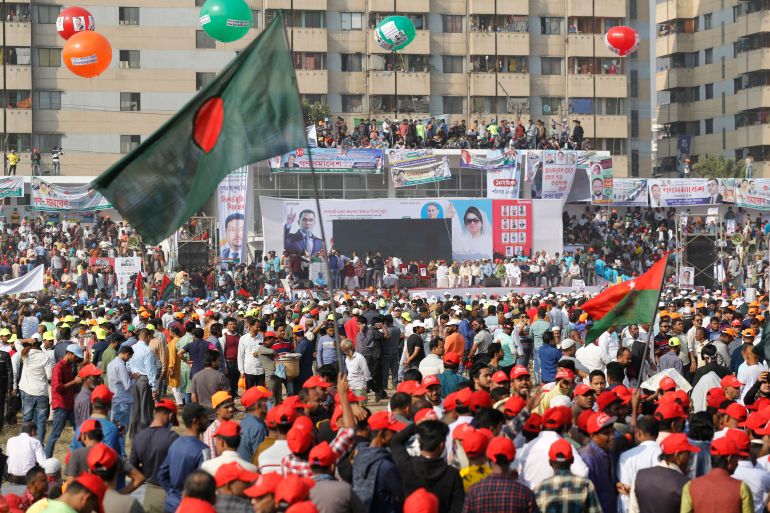
Conversations with longtime Awami League voters reveal a deeply divided electorate facing difficult choices. In areas where the party once dominated, supporters express conflicting emotions about the upcoming election. Ripon Mridha, a boatman from Rajbari district and lifelong Awami League voter, exemplifies this dilemma. He feels little enthusiasm for an election without his party's boat symbol on the ballot, yet fears the consequences of not voting. "If we don't vote, we risk being singled out," Mridha told Al Jazeera, reflecting widespread anxiety among former supporters in a country where Hasina and her party now draw widespread anger for decades of alleged killings, forced disappearances, torture, and political crackdowns.
Other former supporters have adopted more defiant positions. Solaiman Mia, a rickshaw puller in Gopalganj—the Hasina family's bastion and hometown of Bangladesh's founder Sheikh Mujibur Rahman—represents this sentiment. "An election without the boat on the ballot is not an election," Mia declared, a perspective shared by many residents in this region where Hasina won huge victories in every election since 1991. This division among the party's base complicates any potential revival strategy and suggests the Awami League's support structure has fractured along multiple lines.
Expert Perspectives on Survival Prospects
Political analysts offer varied assessments of the Awami League's chances for recovery. Rezaul Karim Rony, a Dhaka-based political analyst and editor of Joban magazine, presents a pessimistic outlook. He believes surviving the February election will be extremely difficult for the party. "If an election takes place without the Awami League, its voters will gradually go through a form of reconciliation at the local level," Rony explained to Al Jazeera. "They will be absorbed locally—aligning themselves with whichever influential forces or parties dominate their areas—and begin rebuilding their everyday lives that way."
Michael Kugelman, senior fellow for South Asia at the Atlantic Council, offers a more nuanced perspective that acknowledges both the party's current weakness and the volatile nature of South Asian politics. He argues that, by strict democratic standards, an election in Bangladesh without the Awami League cannot be considered fully credible, calling the vote "an election with an asterisk." However, Kugelman also notes that the Awami League had—in the eyes of many Bangladeshis—forfeited its rights to be treated as a legitimate party because of the repression Hasina oversaw and earlier efforts to manipulate elections. The 2014, 2018, and 2024 elections—all won by Hasina with landslides—were widely seen as manipulated, with opposition boycotts and crackdowns on rivals.
Historical Parallels and Potential Pathways
The Awami League's current crisis invites comparison with historical challenges faced by both the party itself and its political rivals. Some analysts point to the Jamaat-e-Islami's survival despite two bans and the execution and imprisonment of its top leaders during Hasina's rule as a potential reference point for Awami League revival. The party, which supported Pakistan during Bangladesh's 1971 war of independence—a role repeatedly used by critics including Hasina to challenge its credibility—has not only survived but, according to polls, stands on the cusp of its best ever performance in the February elections.
Anu Muhammad, a retired economics professor at Jahangirnagar University, suggests this paradox might ultimately benefit the Awami League. "Jamaat's current level of activism, influence and assertiveness—what might even be described as a show of dominance—can paradoxically be seen as a kind of blessing for the Awami League," Muhammad told Al Jazeera. He argues that the Awami League's appeal extends far beyond its formal political structure, making its total political erasure unlikely. "The Awami League is not just its leadership," Muhammad noted. "It is connected to cultural, social and other forces."
The Dynastic Question and Waiting Strategy
A critical factor in the Awami League's future involves the question of dynastic succession and leadership strategy. Some supporters, like former Bangladesh Chhatra League leader Arman, remain optimistic about the party's resurgence and believe it will return with Sheikh Hasina at the helm. However, Kugelman suggests the party is likely to adopt a "waiting strategy" similar to what its bitter rival, the BNP, employed during Hasina's regime when the main opposition party struggled to mount meaningful political challenges—only to re-emerge now as the most likely contender for power.
This waiting strategy might involve Hasina announcing her US-based son Sajeeb Wazed as her dynastic successor while she remains politically active from exile. Hasina's continued engagement was demonstrated recently through her controversial prerecorded audio address at a "Save democracy in Bangladesh" event at New Delhi's Foreign Correspondents Club—her first public address since her ouster. In her message, she called for overthrowing what she termed "the foreign-serving puppet regime" and urged Bangladeshis to "defend and restore the Constitution written in the blood of martyrs, reclaim our independence, safeguard our sovereignty, and revive our democracy."
Conclusion: A Political Watershed Moment
As Bangladesh approaches its February election, the absence of the Awami League from the ballot represents more than just an electoral development—it marks a potential watershed in the nation's political history. The party faces its most severe crisis since the 1975 assassination of its founder, Sheikh Mujibur Rahman, with supporters like boatman Ripon Mridha describing the current situation as feeling "like a political wipeout." Yet, as Kugelman reminds us, "Political circumstances can change very quickly" in South Asia, and dynastic political parties in the region rarely die completely.
The coming months will test whether the Awami League can navigate this unprecedented challenge through strategic silence, potential leadership transition, and leveraging its deep connections to cultural and social forces. What remains certain is that Bangladesh's political landscape has undergone a fundamental transformation, with the February election serving as both a consequence of past political practices and a determinant of future democratic trajectories. The Awami League's survival—or lack thereof—will provide crucial insights into the resilience of political dynasties and the evolving nature of democracy in South Asia.