Read on the Guardian
Uganda Election Crisis: Bobi Wine Detained Amid Allegations of Violence and Electoral Fraud
Uganda's 2026 general election has descended into crisis with opposition leader Bobi Wine reportedly detained by security forces and taken to an unknown location. The incident follows allegations that security forces killed 10 of his campaigners and comes as President Yoweri Museveni appears headed for a landslide re-election. This article examines the unfolding political crisis, the allegations of electoral fraud, the violent crackdown on opposition supporters, and the broader implications for democracy in Uganda under Museveni's long-standing rule.
The 2026 Ugandan general election has escalated into a full-blown political crisis, marked by the reported detention of opposition leader Bobi Wine and allegations of lethal violence against his supporters. As President Yoweri Museveni closes in on what appears to be a landslide re-election, the country faces serious questions about democratic integrity, human rights, and political stability. This unfolding situation represents a critical test for Uganda's democratic institutions and highlights the challenges facing opposition movements in authoritarian-leaning regimes.

The Detention of Bobi Wine
On Friday, January 16, 2026, Bobi Wine's National Unity Platform (NUP) party announced that security forces had taken the opposition leader from his Kampala home to an unknown location. According to party statements on social media platform X, an army helicopter landed in Wine's compound and "forcibly taken him away to an unknown destination." This development followed earlier reports that military and police had surrounded his house, effectively placing him under house arrest. The Ugandan government and military spokespeople did not immediately respond to requests for comment regarding these allegations.
Bobi Wine, whose real name is Robert Kyagulanyi, has emerged as the primary challenger to Museveni's long-standing rule. The 43-year-old former singer, who styles himself the "ghetto president" after the informal settlements of Kampala where he grew up, has faced increasing pressure from authorities throughout the election campaign. His detention represents a significant escalation in the government's response to opposition activities and raises serious concerns about political freedoms in Uganda.
Allegations of Electoral Violence
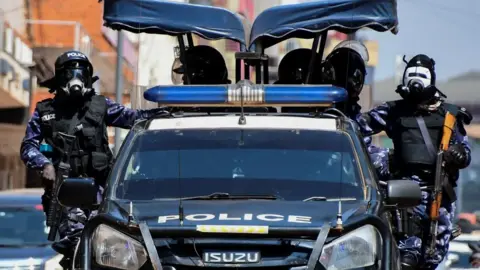
The reported detention of Bobi Wine follows disturbing allegations of violence against his supporters. According to Muwanga Kivumbi, a senior NUP member, security forces stormed his house early Friday morning and shot dead 10 members of his campaign team. Kivumbi described the incident as occurring around 3am local time when security forces "broke the front door and began shooting" inside a garage where people were waiting for parliamentary election results. "It was a massacre," he told Reuters.
Local police spokesperson Lydia Tumushabe offered a conflicting account, stating she was unaware of an incident at Kivumbi's house but alleging that machete-wielding opposition "goons" organized by Kivumbi had attacked a police station and vote-tallying center. Tumushabe claimed security personnel were forced to shoot in self-defense, resulting in "an unspecified number" of people being "put out of action" and 25 arrests. The contradictory narratives highlight the polarized nature of Uganda's political landscape and the challenges in establishing factual accounts amid the crisis.
Electoral Context and Allegations of Fraud
The election was conducted under an internet blackout that authorities claimed was necessary to prevent "misinformation." Bobi Wine has alleged mass fraud during the voting process and called on supporters to protest what he characterizes as a rigged election. His party has condemned what they describe as systematic efforts to undermine democratic processes and suppress opposition voices.
As of Friday evening, electoral commission results showed Museveni holding a commanding lead with nearly 74% of the vote, while Wine trailed with 23%. The remaining votes were split among six other candidates. Final results were scheduled for release by 0200 GMT on Saturday. Museveni, a former guerrilla fighter who seized power in 1986, told reporters after casting his ballot that he expected to win with 80% of the vote if there was "no cheating."
Broader Political Implications
This election crisis occurs within the context of Museveni's 40-year rule, during which he has maintained total control over state institutions and security apparatus. Analysts have long viewed election outcomes in Uganda as formalities given the government's extensive control mechanisms and history of suppressing political opposition. The United Nations has documented widespread repression and intimidation during the election campaign, including clashes at opposition rallies and systematic efforts to undermine opposition activities.
The current situation raises significant questions about Uganda's democratic trajectory and the space for political opposition. The reported violence against campaigners and detention of the main opposition leader suggest a hardening of the government's approach to political dissent. These developments have implications not only for Uganda's domestic politics but also for regional stability and international relations, particularly with Western democracies that have expressed concerns about democratic backsliding in the region.

International Response and Future Outlook
The international community is closely monitoring developments in Uganda, with particular attention to human rights violations and democratic processes. The reported violence and detention of opposition figures are likely to draw condemnation from human rights organizations and democratic governments. However, Museveni's government has historically demonstrated resilience in the face of international criticism, maintaining power through a combination of security control, patronage networks, and strategic positioning in regional politics.
Looking forward, the situation presents several potential scenarios. The government may continue its crackdown on opposition activities, potentially leading to further violence and instability. Alternatively, international pressure or domestic unrest could force some concessions or modifications to the government's approach. The resilience of Uganda's opposition movement, despite significant challenges, suggests that political tensions are likely to persist regardless of the immediate election outcome.
The crisis underscores the broader challenges facing democracy in Africa, where long-serving leaders often maintain power through control of state institutions, security forces, and electoral processes. Uganda's experience serves as a case study in the difficulties of political transition in authoritarian-leaning regimes and the complex dynamics between incumbent governments, opposition movements, and international actors.