Beachy Head Woman: DNA Analysis Rewrites the Story of a Roman-Era Skeleton
The long-standing mystery of the Beachy Head Woman, a Roman-era skeleton discovered in southern England, has been resolved by new, high-quality DNA analysis. Once speculated to have origins in sub-Saharan Africa or the Mediterranean, the latest research indicates she was most likely a local woman from Roman Britain. This article explores the decade-long scientific journey, from the skeleton's rediscovery in a town hall basement to the advanced genetic techniques that finally clarified her ancestry, diet, and appearance, offering a clearer picture of life in Roman Britain.
For over a decade, the origins of a young woman buried in Roman-era Britain have captivated archaeologists and the public alike. Known as the Beachy Head Woman, her skeleton sparked theories of long-distance migration from Africa or the Mediterranean. Now, cutting-edge DNA analysis has provided definitive answers, rewriting her story and offering a more nuanced understanding of the local population in Roman Britain. This scientific resolution highlights how evolving technology can clarify historical narratives that were once based on fragmentary evidence.
The Rediscovery and Initial Theories
The story of the Beachy Head Woman began not at an archaeological dig, but in a basement. In 2012, during the Eastbourne Ancestors Project, a box was opened in the basement of Eastbourne Town Hall, revealing the skeleton of a young woman from the Roman period. A handwritten label indicated she had been found near the Beachy Head headland sometime in the 1950s, but no further records existed. This rediscovery ignited scientific curiosity.
Early research suggested the woman may have had recent ancestry from sub-Saharan Africa. If confirmed, this would have represented rare, early evidence of African ancestry in Roman Britain, a significant finding for understanding migration patterns in antiquity. Later, unpublished research proposed an alternative Mediterranean origin, possibly from Cyprus. However, these conclusions were based on poorly preserved DNA, leaving her true background shrouded in uncertainty and debate for years.
Advanced DNA Analysis Provides Clarity
The turning point came with significant advancements in ancient DNA sequencing technology. By 2024, researchers returned to the remains with vastly improved analytical tools. According to Dr. William Marsh, one of the scientists who analyzed the DNA, the new results provide much greater precision. "By using state-of-the-art DNA techniques and newly published genomes, we were able to determine the ancestry of the Beachy Head Woman with much greater precision than before," Marsh explained. The analysis showed her genetic ancestry was most similar to other individuals from the local population of Roman-era Britain, with no evidence of recent African or Mediterranean ancestry.

Dr. Selina Brace, an ancient DNA specialist and senior author of the study published in the Journal of Archaeological Science, emphasized how this reflects scientific progress. "Our scientific knowledge and understanding is constantly evolving, and as scientists, it's our job to keep pushing for answers," she stated. The research demonstrates the importance of revisiting historical questions with new technological capabilities to achieve more accurate conclusions.
Life and Times of the Beachy Head Woman
The new genetic data, combined with other archaeological analyses, paints a detailed portrait of this individual's life. Radiocarbon dating places her death between 129 and 311 AD, squarely within the period of Roman occupation in Britain. Physical analysis of her skeleton indicates she was between 18 and 25 years old at death, stood just over 1.5 meters tall, and had survived a serious, healed injury to her leg.
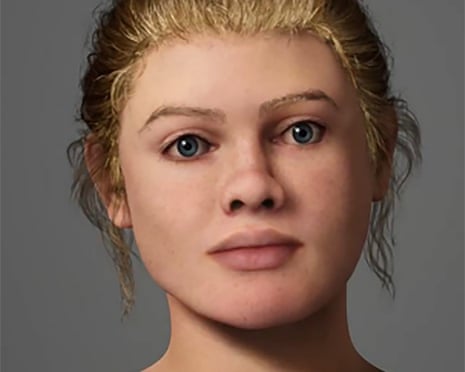
Chemical analysis of her bones, examining carbon and nitrogen isotopes, revealed that she regularly consumed seafood. This dietary insight aligns with her coastal burial location near Beachy Head, an area dotted with Roman-era settlements, a villa at Eastbourne, and a fort at Pevensey. The improved DNA also enabled forensic predictions about her appearance, suggesting she likely had light skin pigmentation, blue eyes, and fair hair—traits used to update her digital facial reconstruction.
Context of Roman Britain
Understanding the Beachy Head Woman requires situating her within the broader context of Roman Britain. Britain's encounter with Rome began with Julius Caesar's campaigns in 55 BCE, with the province of Roman Britain formally established under Emperor Claudius nearly a century later. The empire built extensive networks of forts, roads, and towns, connecting the island to Europe, North Africa, and beyond.

While travel and movement across the empire were common, the case of the Beachy Head Woman underscores that the local population remained predominant. Historical inscriptions and other ancient DNA studies confirm that people from diverse origins, including those with mixed European and sub-Saharan ancestry, were present in Britain during and after Roman rule. However, the Beachy Head Woman's story is now one of local origin, reminding us that not every skeleton tells a tale of long-distance migration.
Conclusion: A Story Revised by Science
The journey to understand the Beachy Head Woman is a powerful testament to the scientific process. What began with a mysterious box in a basement led to global speculation, followed by incremental research, and was finally resolved by technological breakthrough. The conclusion that she was a local woman from Roman Britain may be less sensational than earlier theories of African or Mediterranean origins, but it is arguably more valuable. It provides authentic insight into the indigenous population during a transformative period in British history.
As DNA technology continues to advance, researchers expect to recover even deeper insights into ancient lives, allowing forgotten individuals to be understood within their true historical context. The story of the Beachy Head Woman, now clarified, closes one chapter of mystery while highlighting the relentless pursuit of accuracy that defines modern archaeology and science.