Unearthing a Dinosaur Graveyard: Romania's Hațeg Basin Reveals Europe's Densest Fossil Site
A groundbreaking paleontological discovery in Romania's Hațeg Basin has revealed the K2 site, one of Europe's densest dinosaur fossil deposits. This 72-million-year-old location, formed by ancient flood-fed lakes, contains thousands of bones lying almost on top of each other, including the first well-preserved titanosaur skeletons ever found in Transylvania. The discovery provides unprecedented insights into Late Cretaceous European ecosystems and how dinosaur communities evolved in the final chapter before their extinction.
The Hațeg Basin in Transylvania, Romania, has long captivated paleontologists with its rich fossil record. A recent discovery, however, has elevated its significance to new heights. Scientists from the Valiora Dinosaur Research Group have identified the K2 site, an area of less than five square meters containing over 800 vertebrate fossils. This makes it the densest and most productive dinosaur bonebed ever documented in the region, offering a rare, concentrated snapshot of life 72 million years ago.
The K2 Site: A Paleontological Treasure Trove
For over five years, a collaborative team of Hungarian and Romanian paleontologists has conducted fieldwork in the western Hațeg Basin. The rocks here date to the Upper Cretaceous, capturing the final few million years of the dinosaur era. Among the numerous sites explored, the K2 location stands out as exceptional. Researchers documented more than 100 vertebrate fossils per square meter, with large dinosaur bones lying almost directly on top of one another. As described in the journal PLOS ONE, the site's richness was immediately apparent during the initial 2019 survey, with dozens of large, well-preserved black dinosaur bones visible in the grey clay layers of a streambed.
How Ancient Floods Created a Natural Bone Trap
The extraordinary density of fossils at K2 is not a random occurrence but the result of specific ancient environmental conditions. Approximately 72 million years ago, the Hațeg Basin experienced a warm, subtropical climate with temporary river systems. During periods of heavy rainfall, these rivers would flood, surging downstream and gathering animal carcasses, skeletal remains, and even living creatures in their path.
Detailed geological analysis indicates that a small lake once existed at the K2 site, periodically fed by these flash floods. As the fast-moving floodwaters entered the calm lake, their flow slowed rapidly. This caused the transported animal bodies and bones to accumulate in a deltaic environment along the shore, creating the exceptionally high bone concentration researchers found. This process effectively turned the lake into a natural bone trap, preserving a cross-section of the local ecosystem.
Significant Fossil Finds and Scientific Breakthroughs
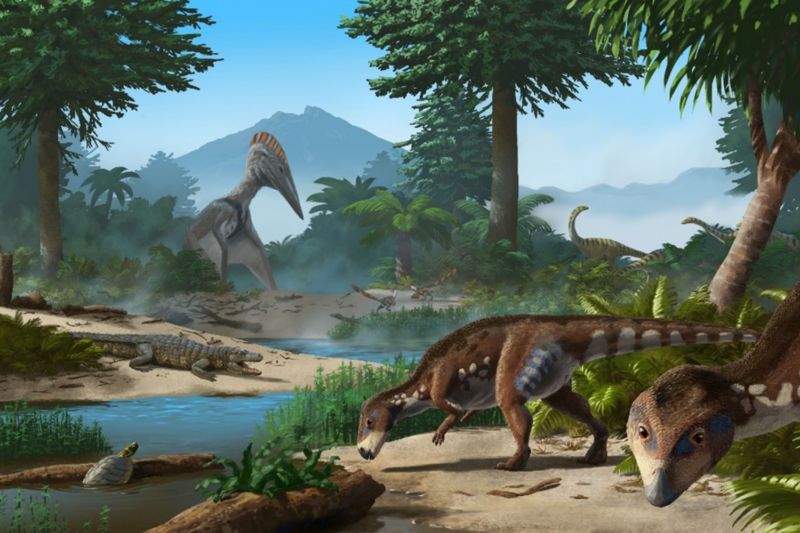
The K2 site yielded more than just scattered bones. Researchers identified several partial dinosaur skeletons that remained associated, providing much more valuable scientific data than isolated finds. The fossils represent two distinct plant-eating dinosaur species. One group belongs to a roughly two-meter-long dinosaur from the Rhabdodontidae family, a species commonly found in the Hațeg Basin that was likely bipedal.
The second group of skeletons marks a major paleontological breakthrough for the region. These remains belong to a titanosaurian sauropod, a long-necked, massive dinosaur. No comparably well-preserved titanosaur skeletons had ever been discovered in Transylvania prior to this find. The ongoing analysis of these fossils is expected to clarify how this particular dinosaur fits into the broader evolutionary family tree of sauropods in Europe.
Implications for Understanding Late Cretaceous Europe
Beyond the remarkable bone concentration, the K2 site holds critical chronological significance. It represents the oldest known vertebrate accumulation in the Hațeg Basin. Studying this fossil assemblage allows scientists to peer into the earliest composition of the Hațeg dinosaur fauna. By comparing these fossils with those from younger sites in Transylvania, researchers can trace evolutionary directions and ecological processes. This work reveals how these Late Cretaceous ecosystems were similar or different from one another over time, providing clues about how dinosaur communities formed, changed, and responded to environmental forces in the final chapter of their reign.
The fossils from K2, along with ongoing excavations in the Hațeg Basin, are helping scientists refine the narrative of dinosaur evolution in Eastern Europe. This discovery underscores the region's importance as a unique window into a prehistoric world, offering invaluable data on ecosystem dynamics just before one of Earth's most famous extinction events.