Cosmic Synchrony: Discovery of a Rotating Galaxy Filament Rewrites Galactic Formation Theories
Astronomers have discovered a colossal, rotating cosmic filament—one of the largest spinning structures ever observed in the Universe. This razor-thin chain of 14 galaxies, embedded within a larger filament spanning 50 million light-years, exhibits a synchronized spin that defies random chance. The finding, led by the University of Oxford, suggests that the rotation of galaxies may be inherited directly from the large-scale cosmic web, offering profound new insights into how galaxies acquire their spin, gather gas, and evolve over cosmic time.
In a discovery that challenges our understanding of cosmic structure, an international team of astronomers has identified a colossal filament of galaxies that is not only spinning but also imparting that rotation to the galaxies within it. This finding, published in the Monthly Notices of the Royal Astronomical Society, reveals a level of coordinated motion across tens of millions of light-years far stronger than predicted by existing models. It suggests that the spin of a galaxy is not an isolated property but may be a direct inheritance from the vast, thread-like architecture of the Universe itself, fundamentally altering our view of galactic formation and evolution.
The Discovery: A Spinning Thread in the Cosmic Web
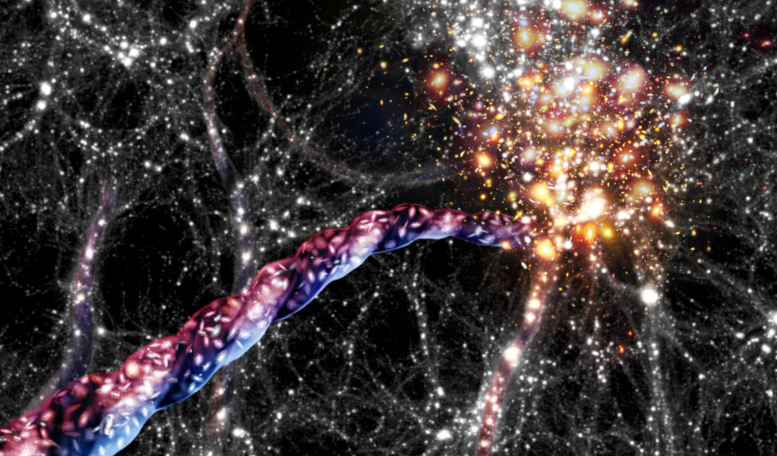
The research, led by scientists from the University of Oxford and detailed in a ScienceDaily release, centers on a specific filament located approximately 140 million light-years from Earth. Within this vast structure, which stretches about 50 million light-years, researchers pinpointed an exceptionally thin, dense strand. This "razor-thin" chain measures roughly 5.5 million light-years in length but only 117,000 light-years across and contains 14 hydrogen-rich galaxies. The critical observation was that the spin axes of these galaxies are aligned with the orientation of the filament itself, a correlation too significant to be coincidental.
Furthermore, the team detected motion indicating that the entire filament is rotating as a cohesive unit. Galaxies on opposite sides of the filament's central spine were found to be moving in opposite directions, a clear signature of bulk rotation. By modeling this dynamics, the researchers estimated the filament's rotation speed to be about 110 kilometers per second. The dense core of this structure has a radius of approximately 50 kiloparsecs, or 163,000 light-years. This dual phenomenon—aligned galaxy spins within a rotating larger structure—makes this object exceptionally rare and informative.
Implications for Galaxy Formation and Spin
This discovery provides a tangible link between the largest structures in the Universe and the properties of individual galaxies. Cosmic filaments are the backbone of the cosmic web, immense networks of dark matter and galaxies that funnel gas and angular momentum across the cosmos. The synchronized spin observed in this filament strongly suggests that galaxies do not develop their rotation in isolation. Instead, their spin may be "seeded" or directly influenced by the rotational dynamics of the filamentary environment in which they form and reside.
As co-lead author Dr. Lyla Jung from the University of Oxford explained, the system can be likened to a theme park ride: "Each galaxy is like a spinning teacup, but the whole platform—the cosmic filament—is rotating too. This dual motion gives us rare insight into how galaxies gain their spin from the larger structures they live in." This analogy perfectly captures the hierarchical transfer of angular momentum from the macro scale of the cosmic web down to the scale of individual galaxies.
Methodology: A Multi-Observatory Triumph
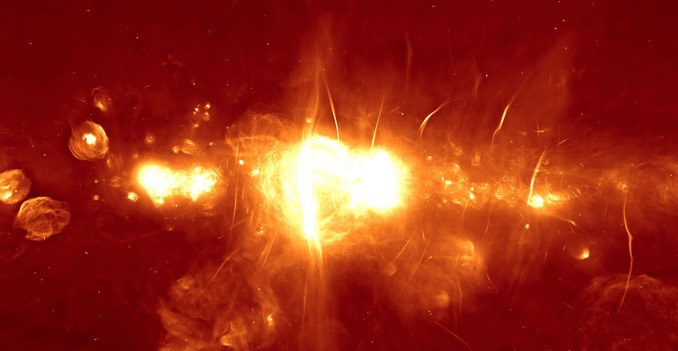
The breakthrough was made possible by synthesizing data from some of the world's most powerful astronomical instruments. The initial detection of the hydrogen-rich galaxies came from the MeerKAT radio telescope in South Africa, as part of the MIGHTEE (MeerKAT International Gigahertz Tiered Extragalactic Exploration) survey. MeerKAT's sensitivity to atomic hydrogen allowed researchers to trace the gas content and motion within the galaxies.
This radio data was then combined with optical observations from the Dark Energy Spectroscopic Instrument (DESI) and the Sloan Digital Sky Survey (SDSS). This multi-wavelength approach was essential for confirming the galaxies' membership in the larger filament and for mapping its three-dimensional structure and dynamics. Professor Matt Jarvis, who leads the MIGHTEE survey, emphasized that such discoveries "really demonstrate the power of combining data from different observatories to obtain greater insights into how large structures and galaxies form in the Universe."
Future Impact and Research Directions
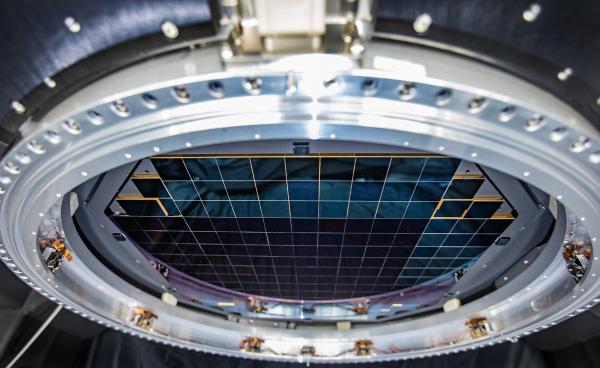
The implications of this discovery extend beyond galaxy formation. Understanding these large-scale alignments is crucial for upcoming cosmological surveys. Missions like the European Space Agency's Euclid spacecraft and the Vera C. Rubin Observatory in Chile will conduct weak gravitational lensing studies to map dark matter. Intrinsic alignments of galaxies, such as those caused by spinning filaments, can create a systematic signal that mimics the lensing effect. This discovery provides vital data to refine models and subtract this contamination, ensuring more accurate measurements of dark energy and cosmic expansion.
Additionally, the filament is described as "dynamically cold" and relatively undisturbed, suggesting it is a young structure. Its abundance of gas-rich galaxies makes it a pristine laboratory for studying the early phases of galaxy assembly and how gas flows along cosmic highways to fuel star formation. As co-lead author Dr. Madalina Tudorache noted, this filament acts as a "fossil record of cosmic flows," helping scientists piece together the evolutionary history of galaxies over billions of years.
Conclusion: A New Window on Cosmic Dynamics
The identification of a rotating cosmic filament represents a paradigm shift in extragalactic astronomy. It moves us from seeing galaxies as isolated island universes to understanding them as integral components of a dynamic, spinning cosmic web. This research opens a new window into the fundamental processes that govern how structure and angular momentum are distributed across the Universe, from the largest filaments down to individual spinning galaxies. It underscores the importance of international collaboration and multi-facility observation in pushing the boundaries of our cosmic knowledge, promising to reshape textbooks on galaxy evolution for years to come.