Quasar Discovery Challenges Fundamental Assumptions About Black Hole Evolution
A groundbreaking astronomical study reveals that the relationship between ultraviolet and X-ray light in quasars has shifted over billions of years, suggesting the structure around supermassive black holes evolves with time. This finding challenges a foundational assumption in astrophysics that has guided research for nearly five decades, potentially impacting how scientists use quasars to map the universe and understand dark energy.
For nearly half a century, a fundamental principle has guided our understanding of the universe's most powerful engines: the relationship between ultraviolet and X-ray light emitted by quasars was considered a universal constant. This assumption underpinned models of supermassive black hole behavior and even influenced cosmological measurements. However, new research led by the National Observatory of Athens and published in the Monthly Notices of the Royal Astronomical Society presents compelling evidence that this relationship is not fixed. Observations suggest the very structure of matter around these cosmic giants may have evolved over the last 6.5 billion years, forcing astronomers to reconsider long-held beliefs about black hole physics and cosmic evolution.

The Engine of a Quasar: A Primer
Quasars, first identified in the 1960s, are among the most luminous objects in the cosmos. Their immense brightness originates from supermassive black holes actively consuming surrounding matter. As this material spirals inward, it forms a hot, rotating accretion disk. The intense friction within this disk heats the matter to extreme temperatures, causing it to emit staggering amounts of ultraviolet light—sometimes 100 to 1,000 times the light of an entire galaxy. This ultraviolet radiation is fundamental to the quasar's energy output. According to established theory, this ultraviolet light then interacts with a region of highly energized particles very close to the black hole, known as the corona. Through this interaction, the light gains energy and is transformed into the powerful X-ray radiation that space telescopes detect. The close correlation between these two types of emission has been a cornerstone of astrophysics since its identification decades ago, offering a window into the extreme physics near the event horizon.
Uncovering a Cosmic Shift
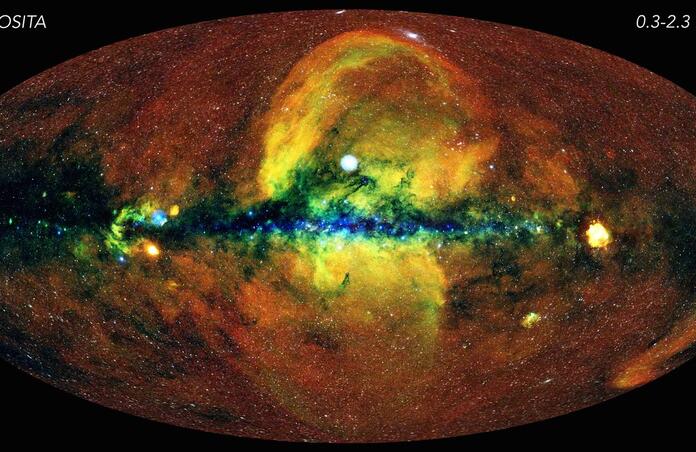
The international research team, led by Maria Chira, made their discovery by combining new X-ray observations from the eROSITA telescope with archival data from the European Space Agency's XMM-Newton observatory. This approach allowed them to analyze an exceptionally large sample of quasars across cosmic time. The key finding was that the relationship between ultraviolet and X-ray luminosity in quasars from when the universe was roughly half its current age is noticeably different from the relationship observed in quasars existing in the more recent, nearby universe. "Confirming a non-universal X-ray-to-ultraviolet relation with cosmic time is quite surprising and challenges our understanding of how supermassive black holes grow and radiate," said study co-author Dr. Antonis Georgakakis. The team employed a robust Bayesian statistical framework to analyze the vast but relatively shallow eROSITA data, uncovering this subtle trend that would have otherwise remained hidden.
Implications for Astrophysics and Cosmology
This discovery has profound implications that extend beyond black hole physics. The assumption of a universal ultraviolet-X-ray relationship has been instrumental in certain cosmological methods. Astronomers sometimes use quasars as "standard candles" to measure cosmic distances and map the expansion history of the universe, which is vital for studying dark energy and dark matter. If the intrinsic properties of quasars change over time, as this research suggests, it introduces a new layer of complexity and potential systematic error into these measurements. Scientists will now need to account for this possible evolution when using quasars to probe the large-scale structure of the cosmos. The findings point toward a dynamic model where the accretion disk, the corona, or the interaction between them is not static but evolves as the universe ages, possibly influenced by changes in the availability of fuel or the black hole's own growth history.
The Path Forward
The research marks a significant methodological advance, demonstrating the power of combining large-scale survey data with sophisticated statistical analysis. The work is not yet conclusive; the next step is to determine whether the observed shift represents genuine physical evolution or is influenced by observational biases. Upcoming all-sky scans by eROSITA and future observations from next-generation X-ray and multiwavelength telescopes will be critical. By observing fainter and more distant quasars, astronomers hope to trace this evolutionary trend further back in time and solidify our understanding. This ongoing investigation promises to refine our models of how the universe's most energetic objects have transformed over billions of years, offering deeper insight into the lifecycle of supermassive black holes and their role in shaping the cosmos.