The Cosmic Christmas Tree: Exploring NGC 2264, a Festive Stellar Nursery
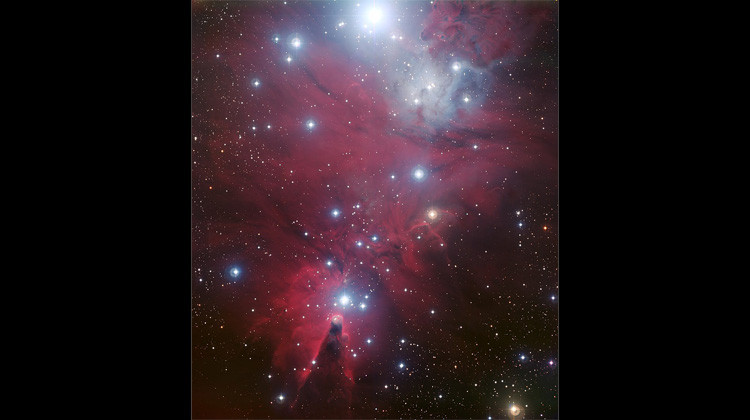
This Christmas, astronomers are showcasing a breathtaking celestial formation that resembles a glowing holiday tree. Known as NGC 2264, this star-forming region located 2,700 light-years away features the Christmas Tree star cluster, the dramatic Cone Nebula, and the swirling Fox Fur Nebula. Spanning nearly 80 light-years, this cosmic spectacle demonstrates how young stars illuminate and shape vast clouds of interstellar gas and dust, creating a festive scene on a galactic scale.
This holiday season, the universe offers its own spectacular decoration: a glowing Christmas tree formed from newborn stars and cosmic dust. Astronomers are highlighting NGC 2264, a distant star-forming region that presents a remarkable celestial spectacle resembling festive holiday imagery. Located approximately 2,700 light-years from Earth, this active stellar nursery showcases how the fundamental processes of star creation can produce patterns that resonate with human imagination.
NGC 2264: A Stellar Nursery in Monoceros
NGC 2264 resides within the faint constellation Monoceros, which represents a unicorn in traditional star maps. This designation follows the New General Catalogue system that astronomers use to identify and study deep space objects composed of gas, dust, and young stars. Positioned near the celestial equator and close to the flat disk of the Milky Way galaxy, this region becomes visible from many locations on Earth during specific seasons, offering amateur and professional astronomers alike a view into stellar birth processes.
The Composition of Cosmic Clouds
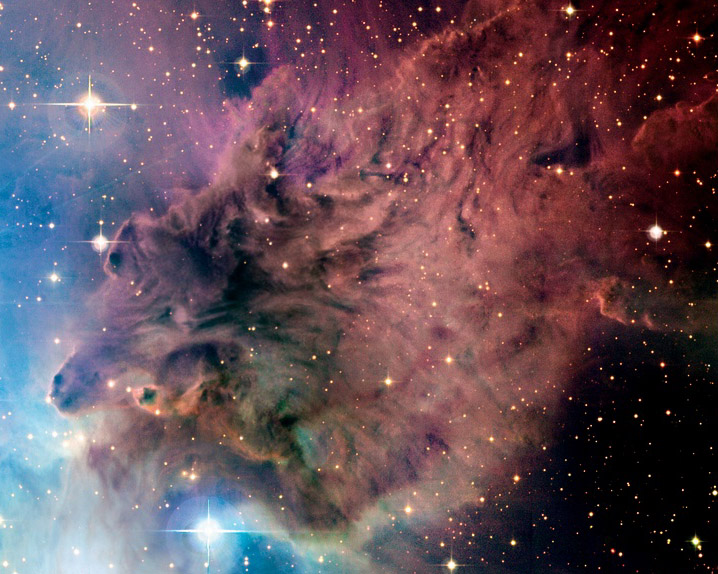
The scene within NGC 2264 consists of enormous clouds of interstellar gas and dust—the essential raw materials for star formation. As young stars ignite within these clouds, they release intense energy that causes surrounding hydrogen gas to glow with a distinctive red hue, creating what astronomers term emission nebulae. Dark dust clouds thread through the area as well, blocking light from background stars and creating dramatic shadows against the glowing backdrop. Where this dust lies in close proximity to hot, newly formed stars, it reflects their light instead of absorbing it, producing soft blue regions known as reflection nebulae.
The Christmas Tree Star Cluster
At the heart of NGC 2264 lies S Monocerotis, a bright variable star whose luminosity fluctuates over time. This central star is surrounded by a noticeable blue glow caused by reflected starlight from nearby dust particles. Above S Monocerotis, a grouping of young stars arranges itself into a distinctive triangular pattern. This geometric formation has earned the cluster its popular name: the Christmas Tree star cluster. The cluster's shape, combined with the surrounding glowing nebulae, creates the overall impression of a decorated holiday tree when viewed through telescopes equipped with appropriate filters.
Notable Features: Cone and Fox Fur Nebulae
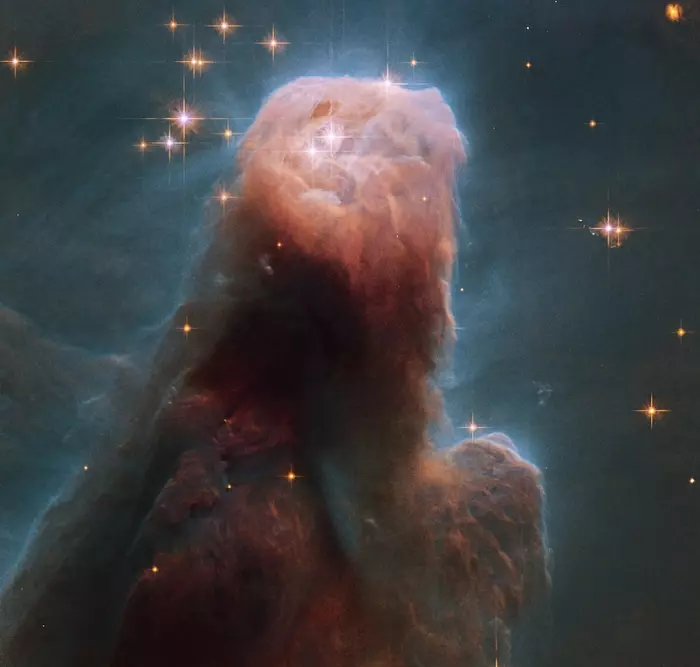
Crowning the Christmas Tree cluster sits the dramatic Cone Nebula, a tall pillar of gas and dust sculpted by powerful radiation emanating from nearby young stars. This structure demonstrates how stellar winds and radiation pressure can shape interstellar material into striking formations. Beneath the cluster spreads the Fox Fur Nebula, named for its textured, fur-like appearance created by intricate patterns of glowing gas and dark dust lanes. According to NASA's observations, these features undergo constant reshaping as energetic starlight pushes and sculpts the surrounding material, creating an ever-evolving cosmic landscape.
Immense Scale and Galactic Significance
The true magnitude of NGC 2264 becomes apparent when considering its physical dimensions. When viewed through a telescope, the entire region stretches approximately 1.5 degrees from top to bottom—equivalent to about three full moons lined up in the night sky. At its distance of 2,700 light-years from Earth, this angular size corresponds to an actual span of nearly 80 light-years. This immense scale highlights the vastness of this stellar nursery and emphasizes how star formation operates on truly galactic proportions. The region serves as a natural laboratory for studying how young stars influence their surroundings and how massive clouds of gas and dust collapse to form new stellar systems.
NGC 2264 represents more than just a seasonal curiosity; it provides valuable insights into fundamental astrophysical processes. By studying regions like this, astronomers can better understand the life cycle of stars, the dynamics of interstellar material, and the conditions that lead to planetary system formation. The Christmas Tree cluster and its surrounding nebulae remind us that the universe operates on scales both unimaginably vast and intricately beautiful, creating patterns that occasionally mirror familiar shapes from our earthly experience while revealing the profound mechanisms that govern cosmic evolution.