The Geometric Universe: How Hidden Dimensions Could Explain Mass and Cosmic Forces
A groundbreaking theoretical framework suggests the universe's fundamental properties—mass, forces, and even cosmic expansion—may not arise from separate fields or particles but from the intrinsic geometry of hidden extra dimensions. This new research explores how compact, seven-dimensional shapes called G2-manifolds, when allowed to evolve and twist over time, can form stable structures that spontaneously generate phenomena like symmetry breaking and particle mass. The theory proposes a purely geometric origin for physical reality, potentially extending Einstein's vision and predicting a new particle called the 'Torstone.' This article examines the implications of a universe built entirely from the fabric of spacetime itself.
The quest to unify the fundamental forces of nature and explain the origin of mass has long been a central pursuit in theoretical physics. While the Standard Model successfully describes particles and three forces through quantum field theory, gravity remains stubbornly separate in Einstein's geometric framework of general relativity. A provocative new theory, detailed in a recent paper in Nuclear Physics B, proposes a radical synthesis: that all forces and particle properties, including mass, may not be separate entities at all but emergent features arising directly from the geometry of hidden extra dimensions. This perspective suggests we may live in a universe built entirely from the twisting, evolving fabric of spacetime itself.
Beyond Four Dimensions: The Geometry of G2-Manifolds
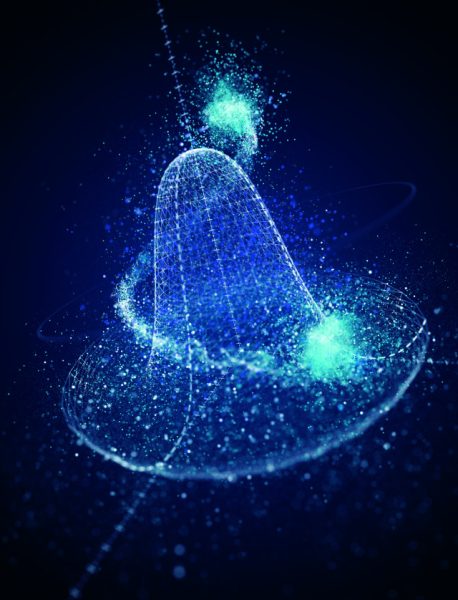
The theory, developed by physicist Richard Pincak and collaborators, posits that our observable four-dimensional universe is embedded within a higher-dimensional reality. Specifically, the research focuses on compact, complex seven-dimensional shapes known as G2-manifolds. Traditionally in string theory and M-theory, such extra dimensions are considered fixed and static. The novel contribution of this work is to allow these geometric structures to evolve dynamically over time through a mathematical process known as the G2-Ricci flow. This evolution gradually alters the internal curvature and structure of the hidden dimensions, much like a landscape slowly changing shape.
Torsion and Stable Solitons
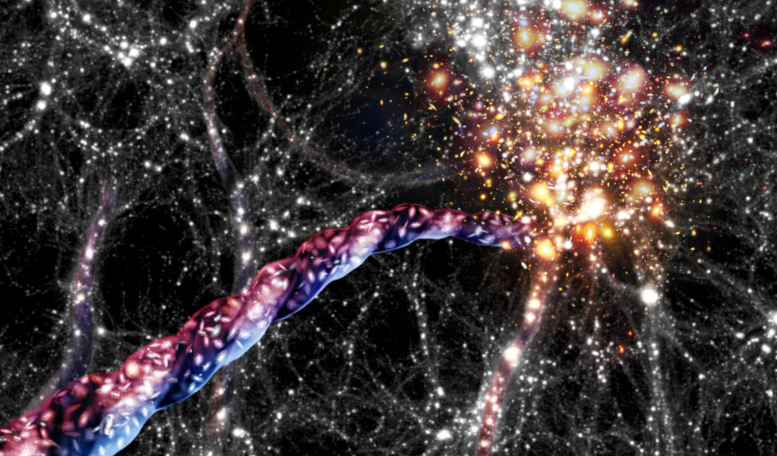
A key feature introduced is torsion—an intrinsic twist within the geometry, analogous to the chirality found in organic molecules like DNA. "As in organic systems, such as the twisting of DNA or the handedness of amino acids, these extra-dimensional structures can possess torsion," explains Pincak. When these twisted shapes evolve, they can naturally settle into stable, self-reinforcing patterns called solitons. These geometric solitons are not particles in the conventional sense but persistent configurations of spacetime itself. The researchers propose that such solitons could provide a purely geometric mechanism for spontaneous symmetry breaking, a cornerstone phenomenon in particle physics that gives rise to distinct forces and particle masses.
A Geometric Origin for Mass
In the established Standard Model, particles like the W and Z bosons acquire mass through their interaction with the omnipresent Higgs field. The new geometric theory offers a compelling alternative. It suggests that mass may instead emerge from the resistance or inertia of the twisted geometry itself. "In our picture," Pincak states, "matter emerges from the resistance of geometry itself, not from an external field." In this view, what we perceive as mass is a reflection of how the fabric of spacetime—extended into hidden dimensions—responds to its own internal structure. This elegantly extends Einstein's insight that gravity is geometry to propose that perhaps all mass is geometric in origin.
Cosmological Implications and the 'Torstone'
The implications of this geometric framework extend beyond particle physics into cosmology. The researchers found a connection between the torsion within the extra dimensions and the large-scale curvature of our observable universe. This relationship offers a potential geometric explanation for the positive cosmological constant, which is the driving force behind the observed accelerating expansion of the cosmos. Furthermore, the theory speculates on the existence of a new fundamental particle linked directly to the torsion of spacetime, dubbed the "Torstone." If this particle exists, it could open a new window into experimental physics, potentially detectable in future high-energy experiments.
Conclusion: Toward a Unified Geometric Reality
This research represents a bold step toward a more unified understanding of physics. By asking whether all fundamental forces share a common geometric origin, it pushes Einstein's vision to its logical extreme. "Nature often prefers simple solutions," Pincak remarks. "Perhaps the masses of the W and Z bosons come not from the famous Higgs field, but directly from the geometry of seven-dimensional space." While highly theoretical, this framework challenges our deepest assumptions about what is fundamental. It invites us to consider a universe where particles, forces, and the expansion of space itself are not ingredients added to the stage of spacetime but are the stage—a dynamic, multidimensional geometry writing the laws of its own existence.