Rogue Black Hole Discovery Rewrites Cosmic Understanding
Astronomers have made a groundbreaking discovery of a rogue black hole located far from its galaxy's center, tearing apart a star and producing the fastest-changing radio signals ever recorded. The event, designated AT 2024tvd, revealed delayed energy bursts months after the initial stellar destruction, suggesting episodic black hole activity. This unprecedented observation challenges existing theories about where supermassive black holes reside and how they evolve, opening new avenues for understanding these mysterious cosmic phenomena.
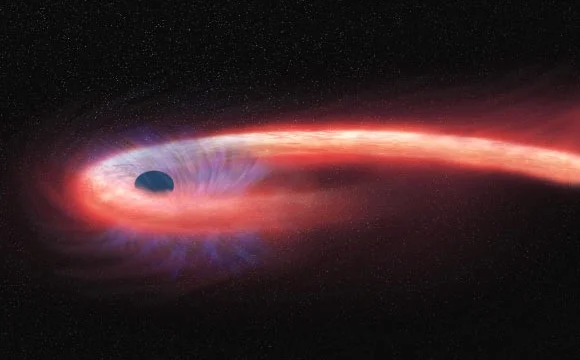
In a discovery that challenges fundamental assumptions about cosmic behavior, astronomers have observed a rogue black hole located far from its galaxy's center tearing apart a passing star. This unprecedented event, designated AT 2024tvd, produced the fastest-changing radio signals ever recorded from such a phenomenon, revealing new insights into black hole behavior and evolution.
Unprecedented Location and Behavior
The discovery marks the first time scientists have observed a tidal disruption event (TDE) occurring outside a galaxy's central region. The black hole was found approximately 2,600 light-years from the center of its host galaxy, providing compelling evidence that supermassive black holes can exist and remain active in locations previously considered unlikely. This finding fundamentally reshapes our understanding of where these cosmic giants reside and how they evolve over time.
Record-Breaking Radio Signals
What makes AT 2024tvd particularly extraordinary is the nature of the radio emissions detected. The event exhibited the fastest-changing radio emission ever recorded from a black hole consuming a star. According to research published in The Astrophysical Journal Letters, the data revealed two distinct radio flares evolving at unprecedented speeds, indicating powerful outflows of material launched from the vicinity of the black hole.

Delayed Energy Bursts
Perhaps the most surprising aspect of the discovery was the timing of the energy releases. Rather than occurring immediately after the stellar destruction, intense radio bursts appeared months later, suggesting delayed and complex processes in the aftermath of the disruption. Detailed modeling points to at least two separate ejection events occurring months apart, providing clear evidence that black holes can episodically "reawaken" after periods of apparent inactivity.
Research Methodology and Collaboration
The discovery was made possible through high-quality observations from several of the world's premier radio telescopes, including the Very Large Array (VLA), ALMA, ATA, SMA, and the Arcminute Microkelvin Imager Large Array (AMI-LA) in the UK. An international team led by Dr. Itai Sfaradi and Prof. Raffaella Margutti of the University of California, Berkeley, together with collaborators from around the world, identified this groundbreaking phenomenon.
Implications for Astrophysics
This discovery has profound implications for our understanding of black hole behavior and distribution throughout the universe. The presence of an active supermassive black hole so far from its galactic center suggests that previous surveys may have overlooked similar objects in unexpected locations. The episodic nature of the energy releases also indicates that black hole activity may be more complex and variable than previously understood.
The AT 2024tvd event represents a significant milestone in astrophysical research, demonstrating that even well-established scientific concepts can be challenged by new observations. As astronomers continue to monitor this and similar events, we can expect further revelations about the mysterious behavior of these cosmic giants and their role in shaping the universe around us.