Black Hole Breakthrough: Gravitational Wave Detection Confirms Hawking and Einstein
A remarkably clear gravitational-wave signal from the merger of two black holes, designated GW250114, has provided unprecedented confirmation of long-standing theoretical predictions. This detection, made by the LIGO-Virgo-KAGRA collaboration, offers the sharpest observational proof yet for Stephen Hawking's area theorem and Albert Einstein's predictions about black hole ringdown. Furthermore, the data provides the strongest evidence to date that real black holes in the universe conform to the Kerr model, a mathematical solution to Einstein's equations. This discovery marks a significant milestone in gravitational-wave astronomy, validating decades of theoretical work with direct observational data.
The detection of gravitational waves has revolutionized our understanding of the cosmos, providing a new lens through which to observe the universe's most violent events. A recent observation, the exceptionally clear signal from the black hole merger known as GW250114, represents a landmark achievement. Captured by the LIGO-Virgo-KAGRA collaboration in January 2025, this event has delivered the sharpest proof yet of how black holes truly behave, putting fundamental theories to the test with unprecedented precision. This detection not only confirms predictions made over half a century ago but also strengthens our confidence in the mathematical models that describe these enigmatic objects.
Testing Hawking's Area Theorem
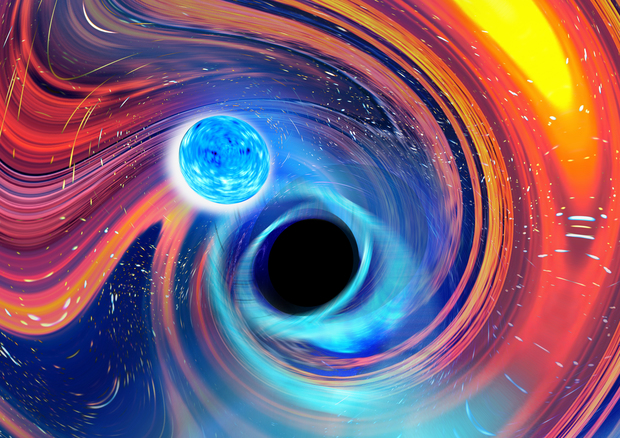
In 1971, physicist Stephen Hawking proposed a fundamental law for black holes: the total surface area of a black hole's event horizon—the boundary beyond which nothing can escape—can never decrease. This principle, known as the area theorem, suggests that when two black holes collide and merge, the area of the resulting black hole must be at least as large as the sum of the areas of the two original black holes. While this was a cornerstone of theoretical physics, direct observational proof remained elusive.
The analysis of the GW250114 signal has now provided this proof with far greater accuracy than ever before. By measuring the gravitational waves emitted during the merger, researchers determined the masses and spins of the initial and final black holes. Their calculations showed conclusively that the surface area of the final merged black hole was indeed larger than the combined areas of its progenitors. This finding reinforces an earlier, less precise confirmation from 2021 and offers robust observational support for Hawking's conjecture, a validation that strengthens a key pillar of black hole thermodynamics.
Observing Einstein's Ringdown Prediction
Albert Einstein's general theory of relativity predicts that a newly formed black hole, disturbed by a violent event like a merger, does not settle quietly. Instead, it vibrates or "rings down," emitting gravitational waves in a specific pattern as it reaches a stable state. This behavior is analogous to the way a struck bell emits sound waves of a particular pitch and decay. Isolating and analyzing these post-merger gravitational waves has been a major challenge due to their faintness.
The clarity of the GW250114 signal allowed the research team, including Columbia University astronomer Maximiliano Isi, to successfully separate and study these ringdown waves. By analyzing their frequency and decay rate, scientists could infer the size and internal properties of the final black hole. This process confirmed that the object's vibrations matched the expectations derived from Einstein's equations, providing a direct observational test of this relativistic behavior. As Isi noted, this "unprecedentedly clear signal" puts our most important conjectures to the test.
The Strongest Evidence for Kerr Black Holes
Perhaps the most profound implication of this discovery is the evidence it provides for the nature of black holes themselves. In the 1960s, mathematician Roy Kerr found a solution to Einstein's field equations that describes the geometry of space-time around a rotating, uncharged black hole. Physicists have long assumed that all astrophysical black holes are "Kerr black holes," but obtaining definitive proof has been extraordinarily difficult.
The analysis of the ringdown phase of GW250114 has yielded the most compelling evidence to date. The specific vibrational modes observed in the gravitational waves match the unique signature predicted for a Kerr black hole. This means the final object created by the merger behaves exactly as Kerr's solution dictates. This finding is crucial because it confirms that the elegant mathematical model developed decades ago accurately describes the real objects we observe in the universe, ruling out alternative theoretical models.

The Future of Gravitational Wave Astronomy
This discovery underscores the rapid advancement of gravitational-wave astronomy since the first direct detection in 2015. The signal from GW250114 was observed almost four times more clearly than that historic first event, thanks to continuous improvements in the sensitivity of detectors like LIGO. This enhanced clarity opens a new window into the detailed physics of black holes.
Looking ahead, as detector technology continues to improve over the next decade, scientists anticipate an even sharper view of cosmic collisions. Each new, clearer signal will allow for more stringent tests of general relativity, probes of black hole interiors, and investigations into the nature of gravity itself. As Maximiliano Isi expressed, researchers "can't wait to see what we find out" as this observational frontier expands. The era of precision black hole physics has truly begun, with GW250114 serving as a definitive benchmark.