Read on Global News
The U.S. Accusation Against Venezuela: Narco-Terrorism and Escalating Tensions
The Trump administration's designation of Venezuela under Nicolás Maduro as a 'narco-terrorist' state marks a significant escalation in U.S. foreign policy, framing drug trafficking as a national security threat to justify potential military action. This article examines the core accusations, the legal justifications being employed, and the international response, including Canada's cautious distancing from U.S. operations. The situation raises profound questions about the use of military force against sovereign nations under counter-terrorism laws and the potential for regional destabilization.
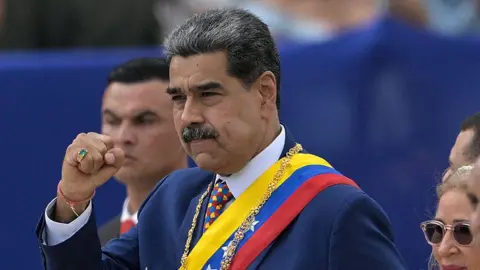
The geopolitical landscape between the United States and Venezuela has entered a perilous new phase, defined by a stark accusation from the Trump administration. The characterization of the Venezuelan government under President Nicolás Maduro as a 'narco-terrorist' state is not merely rhetorical; it serves as a foundational legal and political justification for an escalating campaign of military pressure and potential intervention. This framing shifts the issue from one of criminal narcotics enforcement to a matter of national security, invoking authorities originally designed for the post-9/11 war on terror. The situation presents a complex crisis involving allegations of state-sponsored crime, unilateral military maneuvers, and deep international divisions over the appropriate response.

The Core Accusation: Venezuela as a Narco-Terrorist State
The central charge levied by the U.S. is that the Maduro regime systematically facilitates and profits from international drug trafficking, specifically allowing cocaine to be shipped into the United States and Europe. This accusation was formalized in a 2020 indictment by U.S. prosecutors, which charged Maduro and several top officials with narco-terrorism and conspiracy to distribute cocaine. The indictment alleges Maduro leads the 'Cártel de Los Soles' (Cartel of the Suns), described as a drug trafficking organization that has deeply infiltrated Venezuela's government, military, and judiciary.
According to the U.S. narrative, this cartel collaborates with transnational criminal groups, including Mexico's Sinaloa Cartel and the Venezuelan gang Tren de Aragua, to 'flood' international markets. In a significant escalation, the U.S. State Department recently designated the Cártel de Los Soles as a Foreign Terrorist Organization (FTO). This designation is critical, as it allows the administration to employ military force against the group under the expansive 2001 Authorization for Use of Military Force (AUMF), a law passed to target al-Qaeda but used since against various terrorist entities globally.
Military Escalation and Legal Justifications
The 'narco-terrorist' label has been paired with a visible military buildup. The U.S. has deployed an armada of warships, including aircraft carriers, to the Caribbean region and stationed thousands of troops nearby. More concretely, the Pentagon has conducted over 20 military strikes on vessels in the eastern Pacific Ocean suspected of smuggling drugs, operations it claims target cartels colluding with Maduro's government. These strikes, reported to have killed more than 80 people, are justified under the AUMF due to the terrorist designations of the involved groups.
President Trump has explicitly threatened to expand these operations 'by land' into Venezuela itself, stating knowledge of cartel routes and leadership locations. This move has sparked intense debate within the U.S. about the legality of using military force for drug interdiction and the constitutional requirement for Congressional approval for war. Critics, including some Republican lawmakers like Senator Rand Paul, argue that attacking a sovereign nation's territory under these pretexts sets a dangerous precedent and constitutes an unauthorized war.
International Reaction and Canada's Position
The U.S. campaign has placed allies, including Canada, in a difficult position. While Canada, alongside other G7 nations, does not recognize Maduro's presidency due to electoral irregularities and has sanctioned regime members, it has explicitly distanced itself from the U.S. military strikes. Reports indicate that both the United Kingdom and Canada have halted intelligence sharing related to Caribbean drug trafficking to avoid complicity in operations they view as potentially illegal.
Canadian Foreign Affairs Minister Anita Anand stated that Canadian efforts, under Operation CARIBBE, focus on supporting the U.S. Coast Guard in narcotics interception but involve 'no involvement' in the unilateral strike operations. This careful delineation highlights the international unease with the Trump administration's strategy. Experts like University of British Columbia professor Max Cameron warn that the approach represents a return to 'gunboat diplomacy' and risks triggering a devastating civil war in Venezuela by attempting to force regime change through military pressure.
Potential Consequences and Regional Stability
The accusation of narco-terrorism and the accompanying military threats carry severe implications for regional stability. A U.S. military incursion into Venezuela could provoke violent resistance from the national military and pro-regime armed civilian groups, known as 'colectivos.' Experts caution that ousting Maduro could create a power vacuum leading to a protracted, generation-defining civil conflict in a deeply divided and heavily armed society, drawing parallels to the long-term destabilization seen in Iraq after 2003.
Furthermore, the strategy complicates any potential diplomatic resolution. While Secretary of State Marco Rubio has downplayed immediate regime change goals, the aggressive posture undermines negotiation efforts. Maduro, for his part, has denied all accusations and used the U.S. pressure to rally nationalistic support, confirming a recent 'cordial' phone call with Trump while steadfastly refusing to relinquish power. The situation remains a volatile standoff with the potential to escalate into a broader regional crisis.