Federal Court Showdown Over Trump's National Guard Deployments to Democratic Cities
The Trump administration faces mounting legal challenges over plans to deploy National Guard troops to Democratic-led cities, with federal courts blocking deployments to Oregon and Illinois challenging similar actions. Oregon Governor Tina Kotek calls the moves 'an abuse of power and threat to our democracy' as states assert their authority over National Guard forces. The legal battles center on whether the president has constitutional authority to deploy state National Guard units without gubernatorial consent during domestic situations.
The Trump administration's efforts to deploy National Guard troops to Democratic-led cities have sparked a constitutional showdown in federal courts, testing the limits of presidential authority over state military forces. Recent court rulings have temporarily blocked deployments while governors challenge what they characterize as federal overreach into state affairs.

Legal Challenges Mount Against Federal Deployments
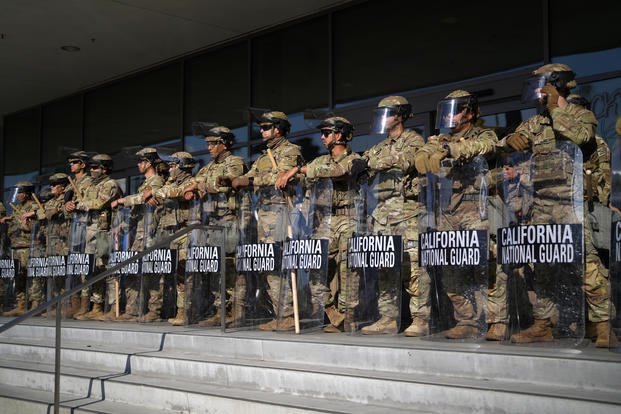
Federal courts have become the primary battleground in this constitutional conflict. A federal judge blocked the Trump administration from sending California's National Guard to Oregon, marking the second such ruling against the administration's deployment plans. The legal basis centers on whether the president has authority under Title X to deploy state National Guard units without gubernatorial consent for domestic law enforcement purposes.
Illinois officials have followed Oregon's lead, filing their own lawsuit to stop plans to send 400 Texas National Guard troops to Chicago. The Illinois lawsuit characterizes the deployment as both unlawful and dangerous, though a federal judge has thus far declined to issue an immediate injunction blocking the Texas troops' movement.
State Governors Push Back Against Federal Authority
Oregon Governor Tina Kotek has emerged as a leading voice against what she describes as presidential overreach. In an interview with PBS NewsHour, Kotek emphasized that local law enforcement maintains control of the situation in Portland and characterized the federal intervention as unnecessary. According to Kotek, the administration appears to be operating on outdated information about conditions in Portland.

The governor revealed she had a direct conversation with President Trump about the situation, describing it as cordial but firm. Kotek stated she made clear that military intervention was unwarranted and that local authorities had the situation under control. Despite this communication, the administration continued to pursue deployment options, leading to the current legal standoff.
Constitutional Questions About National Guard Authority
The core legal question revolves around the president's authority to federalize state National Guard units. Typically, National Guard forces operate under state control unless federalized for specific purposes. Governors traditionally maintain command over their state's Guard units for domestic emergencies, while the president can federalize them for national defense missions.
Kotek and other governors argue that the current situation doesn't meet the legal threshold for federal intervention. They maintain that local law enforcement agencies are fully capable of handling protests and that the administration hasn't demonstrated sufficient justification for military deployment under existing statutes.
Broader Implications for Federal-State Relations
This conflict extends beyond individual state concerns to fundamental questions about federal-state power dynamics. Kotek has emphasized that this isn't a partisan issue but rather a constitutional one affecting all governors, regardless of political affiliation. She has called on Republican governors to resist volunteering their National Guard units for what she characterizes as inappropriate domestic deployments.
The situation represents what legal scholars might view as a test case for the boundaries of executive authority during times of domestic unrest. Previous court rulings have generally favored state control over National Guard units for domestic law enforcement purposes, but the current administration's aggressive approach challenges these precedents.
Administration's Justification and State Counterarguments
The White House has defended its actions by pointing to ongoing protests outside an immigration detention facility in Portland. White House Press Secretary Karoline Leavitt described the facility as being "under siege by these anarchists" and emphasized the administration's duty to protect federal buildings and assets.
However, state officials counter that these characterizations dramatically overstate the actual situation. Kotek noted that while protests continue in a confined area around the ICE facility, the rest of Portland functions normally, with recent events like the Portland Marathon proceeding without incident. This disparity between federal characterization and local reality forms a key part of the legal challenge.
Looking Forward: Legal and Political Ramifications
The outcome of these legal battles could have significant implications for future federal-state relations and emergency response protocols. If courts consistently rule against the administration's deployment authority, it would reinforce state control over National Guard units for domestic purposes. Conversely, any rulings favoring federal authority could expand presidential power during domestic disturbances.
Beyond the immediate legal questions, the conflict highlights deepening tensions between federal and state governments regarding emergency management and law enforcement priorities. As these cases proceed through the courts, they're likely to establish important precedents about the balance of power between state and federal authorities during domestic crises.
The resolution of these constitutional questions will affect not only current deployment plans but also establish guidelines for future administrations facing similar domestic challenges. The principle of federalism itself undergoes testing as courts weigh state autonomy against federal emergency powers.