A Glimpse of May's Best Science Images: From Mars Helicopters to Bioluminescent Shapes
May offers a stunning collection of science images, featuring a helicopter destined for Mars undergoing flight tests, a spectacular flowery frame for the Milky Way, a new species of box jellyfish discovered at a Singapore tourist spot, and bioluminescent shapes that could power future gadgets. This article explores these captivating visuals, providing context and insights into the science behind them.
May brings a rich harvest of science imagery, offering a window into the universe's wonders and our planet's hidden marvels. From a helicopter designed for Mars undergoing rigorous flight tests to a breathtaking photograph of the Milky Way framed by lupine flowers, this month's collection showcases the breadth of scientific exploration. These images not only captivate the eye but also tell stories of technological innovation, biological discovery, and the sheer beauty of the cosmos. Here, we delve into some of the most remarkable science images from May, exploring their significance and the stories they convey.

Celestial Vistas and Stellar Nurseries
The Milky Way Photographer of the Year
One of the standout images of the month is a surreal, fish-eye perspective from New Zealand, where a field of blooming lupines appears to enclose the Milky Way. Captured by photographer Alvin Wu, this image was selected among 25 finalists in the ninth Milky Way Photographer of the Year contest, founded in Spain. The contest celebrates the artistry and technical skill required to capture the night sky, and Wu's work exemplifies how terrestrial and celestial beauty can intertwine. This shot not only highlights the dramatic arc of our galaxy but also the vibrant colors of Earth's flora, creating a microcosm within the macrocosm of the universe.
Hubble's 36th Birthday: A New Look at the Trifid Nebula
To celebrate its 36th birthday, the Hubble Space Telescope revisited a region of the Trifid Nebula, a stellar nursery located about 5,000 light-years away. Comparing the new image with a 1997 shot, astronomers have detected subtle changes in the cloud of gas and dust. For instance, a jet of plasma, known to be ejected periodically by a still-forming star, has expanded. This observation demonstrates that even objects of astronomical size can evolve over just a few decades, offering valuable insights into star formation and the dynamic nature of the universe. As noted in Nature's coverage, such comparisons allow scientists to track changes in celestial structures with unprecedented clarity.
Innovations in Space Exploration: Mars Helicopter Tests

NASA's Ingenuity helicopter made history by becoming the first aircraft to fly on another celestial body, operating from 2021 to 2024 as part of the Mars 2020 mission. While Ingenuity was not able to carry heavy payloads, its success has paved the way for more advanced designs. Engineers at NASA's Jet Propulsion Laboratory in Pasadena, California, are now testing helicopter blades that rotate at 240 meters per second—faster than the speed of sound on Mars—inside a chamber that replicates the red planet's conditions. These next-generation helicopters aim to carry heavier instruments, fly for longer periods, and potentially assist future astronauts traveling to Mars. The test images, provided by NASA, show the intense engineering behind making flight on another world a reality.
Bioluminescent Breakthroughs: Lighting Up the Dark
Bioengineers at the University of Colorado Boulder have achieved a remarkable feat by coaxing Pyrocystis lunula, a single-celled dinoflagellate, to glow continuously in response to chemical stimuli. Under normal conditions, these organisms produce light only in brief flashes. By impregnating gel shapes with these bioluminescent organisms, the researchers created glowing forms that could have applications in battery-free gadgets and undersea robots. The images show the shapes under both natural and dark conditions, highlighting the potential for living light sources to replace electronic components in certain environments.
New Species Discoveries and Natural Phenomena
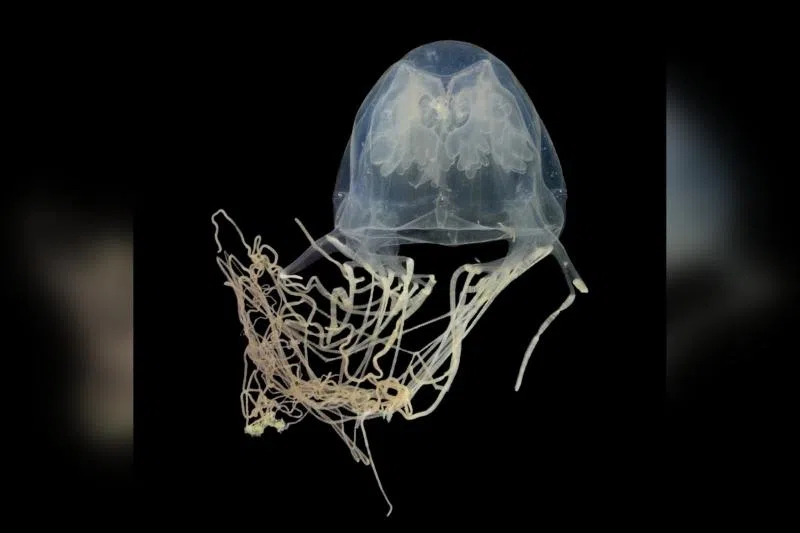
A New Box Jellyfish at a Singapore Tourist Spot
Biologists have identified a new species of box jellyfish at Sentosa Island, a popular tourist destination in Singapore. Named Chironex blakangmati, after the old name for Sentosa (Pulau Blakang Mati, meaning 'Island of Death Behind'), this species closely resembles the highly venomous Chironex yamaguchii. However, anatomical and genetic analysis revealed it to be a separate species. Box jellyfish are among the most venomous creatures in nature, and this discovery underscores the importance of biodiversity studies in even the most frequented areas.
Stranded Icebergs and Blood Rivers
Other striking images from May include a massive iceberg stranded near Pouch Cove, Canada, where Newfoundland's 'iceberg alley' draws tourists each spring as icebergs break off from Greenland's glaciers. Additionally, the vivid red color of the Betsiboka River Estuary in Madagascar, caused by iron-rich silt from erosion, highlights the environmental impact of deforestation. These images serve as powerful reminders of the dynamic and often fragile nature of our planet.
From the depths of space to the microcosm of a cell, May's best science images remind us of the relentless curiosity and ingenuity that drive scientific discovery. Whether it's a new perspective on the Milky Way or a potential new power source from a glowing organism, these visuals inspire wonder and deepen our understanding of the world around us.