Hidden in Goethe's Cabinet: 40-Million-Year-Old Ant Revealed by Modern Science
Scientists examining amber from Johann Wolfgang von Goethe's personal collection have discovered three hidden fossil insects, including an extinct ant preserved in extraordinary detail. Using synchrotron micro computed tomography at DESY in Hamburg, researchers were able to visualize not only the ant's outer features but also internal structures, offering unprecedented clues about life in ancient forests. The findings highlight the value of historical museum collections and demonstrate how modern imaging techniques can unlock secrets that have remained hidden for centuries. The ant, identified as the extinct species Ctenobethylus goepperti, is now one of the best-studied amber fossils, with a full 3D reconstruction available online for researchers worldwide.
In a remarkable intersection of literature and paleontology, scientists have uncovered hidden fossil insects inside pieces of amber that once belonged to the famed German writer Johann Wolfgang von Goethe. Using advanced imaging technology at the German Electron Synchrotron (DESY) in Hamburg, researchers from the University of Jena were able to reveal creatures that had remained trapped inside the fossilized tree resin for tens of millions of years, without ever being noticed by the polymath who owned them. The discovery, published in Scientific Reports, underscores how centuries-old museum collections can still yield groundbreaking scientific insights.
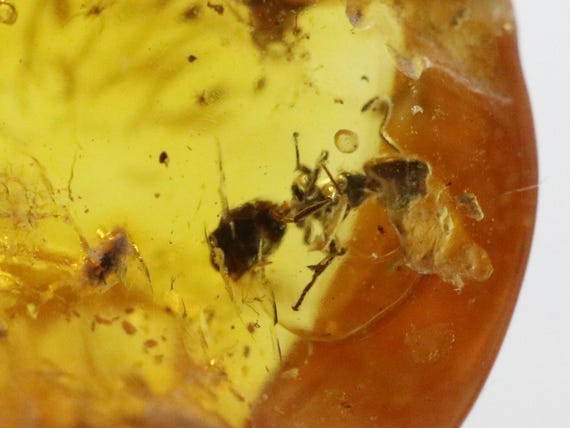
Goethe's amber collection, now housed at the Goethe National Museum and managed by the Klassik Stiftung Weimar, contains 40 pieces of Baltic amber. Two of those specimens turned out to contain fossilized animals that were nearly impossible to see with the naked eye because the amber pieces were never polished. To investigate further, the research team turned to synchrotron micro computed tomography, a cutting-edge 3D imaging technique that uses high-energy X-rays to create detailed digital models of objects without damaging them. The scans revealed three insects: a fungus gnat, a black fly, and an ancient ant belonging to the extinct species Ctenobethylus goepperti.
An Ancient Ant in Extraordinary Detail
Among the discoveries, the ant attracted the most attention from the scientific community. As Bernhard Bock from the Phyletisches Museum of the University of Jena explained, the ant belongs to a species that is very common in amber, but its preservation in Goethe's specimen allowed researchers to describe it in greater detail than ever before. Because the specimen is so exceptionally well-preserved, scientists were able to examine features that had never been documented in such detail, including fine body hairs on the worker ant and even internal skeletal structures within the head and thorax.
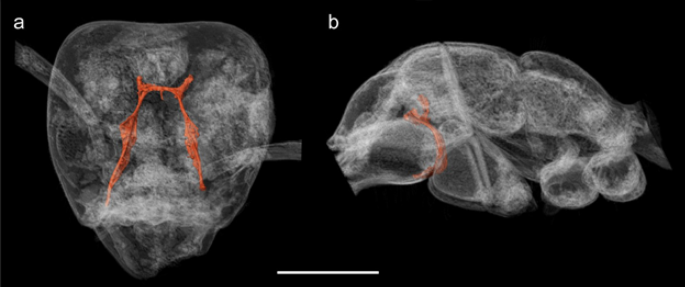
The research team also produced a complete digital reconstruction of the fossil, which is now available online for colleagues worldwide. Daniel Tröger from the University of Jena noted that this open-access model helps researchers identify and compare further fossils of this species, advancing the study of ant evolution. Comparisons with the modern ant genus Liometopum, found today in North America and warmer parts of Europe, offer clues about how the extinct species may have lived. Researchers believe these ancient ants likely built large nests in trees, which may help explain why they are so commonly preserved in amber, as tree resin would have frequently trapped them.
Goethe's Surprising Connection to Amber
Although Goethe owned the amber specimens, he showed relatively little interest in amber beyond its optical properties. He famously ground lenses from fossilized resin to study color effects as part of his pioneering work on color theory. By Goethe's time, scientists had already begun studying amber and the fossils preserved inside it, and early scientific publications on the subject were available in his personal library. However, the broader scientific importance of these fossils had not yet become clear, and the discoveries being made today were far beyond what researchers of that era could have imagined.
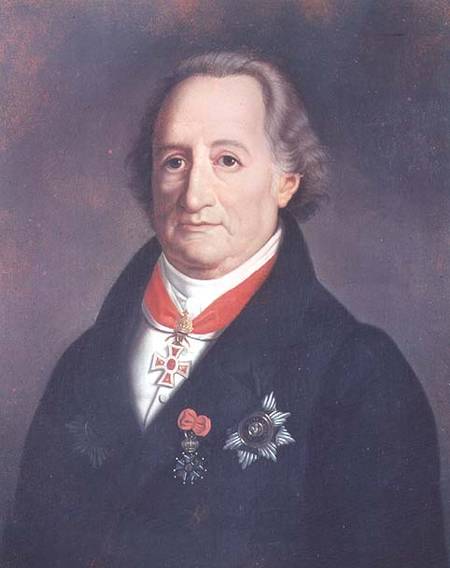
Bernhard Bock reflected on this connection: "Goethe is regarded as the founder of morphology and would likely have been delighted to see how we were able to gain valuable insights in this field using entirely new methods. At the same time, the results demonstrate the value of such historical collections. It is truly fascinating that an object originating from his hand and his era, when this science was just beginning, can still enrich us so much today."
The Importance of Historical Collections
This discovery highlights a broader truth about museum collections assembled centuries ago: they continue to yield important scientific discoveries thanks to modern technology. Objects that once seemed ordinary can still reveal hidden stories from Earth's distant past. The findings from Goethe's amber offer a vivid example of how paleontology benefits from interdisciplinary collaboration, combining the resources of the humanities with cutting-edge physics and biology. As researchers continue to probe historical collections with new tools, they are bound to uncover more secrets that even the original collectors never knew existed.