Capturing the Invisible: The New Camera That Films Trillionth-of-a-Second Events
A revolutionary imaging technique developed by scientists can now capture ultrafast phenomena in stunning detail, revealing both brightness and structural changes in a single shot. This method, known as compressed spectral-temporal coherent modulation femtosecond imaging (CST-CMFI), allows researchers to create 'movies' of events like plasma formation and electron movement that occur in mere femtoseconds. The breakthrough promises to transform research in physics, chemistry, materials science, and biology by providing unprecedented insights into the fundamental behavior of matter.
For decades, scientists have struggled to observe the most fleeting events in nature—processes that unfold in trillionths of a second, far too fast for conventional cameras or even the human mind to comprehend. These ultrafast phenomena, from chemical reactions to electron movements, hold the keys to understanding fundamental physics and developing next-generation technologies. Now, researchers have achieved a monumental breakthrough: a new imaging method that captures these invisible events in stunning detail, revealing not just what happens, but how it happens at the most fundamental level.

This article explores this groundbreaking technology, explaining how it works, what it can reveal, and why it represents such a significant leap forward for scientific discovery. We'll examine the technical innovations behind the method and consider its potential applications across multiple scientific disciplines.
The Challenge of Ultrafast Imaging
Ultrafast events occur on timescales measured in femtoseconds—one quadrillionth of a second. To put this in perspective, a femtosecond is to a second what a second is to about 31.7 million years. Traditional imaging methods simply cannot capture events this brief. Previous techniques could only record changes in light intensity (brightness) and required multiple measurements or repeated experiments, which wasn't feasible for events that couldn't be reproduced exactly.
As research team leader Yunhua Yao from East China Normal University explains, "In the fields of physics, chemistry, biology and materials science, many important phenomena happen incredibly fast. Our new technique can capture the complete evolution of both the brightness and internal structure of an object in a single measurement. This is a big step forward for understanding the fundamental nature of matter, designing new materials and even uncovering the mysteries of biological processes."
How the New Technique Works
The breakthrough method, described in the journal Optica, is called compressed spectral-temporal coherent modulation femtosecond imaging (CST-CMFI). It represents a sophisticated integration of three existing approaches: time-spectrum mapping, compressive spectral imaging, and coherent modulation imaging. Each contributes specific advantages that, when combined, create a system far more powerful than its individual components.
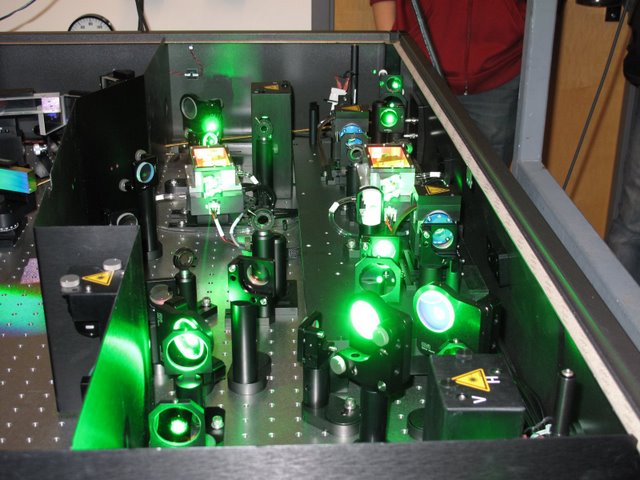
At its core, CST-CMFI uses a chirped laser pulse containing multiple wavelengths that arrive at slightly different times. This clever setup effectively links specific moments in time to specific wavelengths of light. When this pulse interacts with a rapidly changing event—like plasma forming or electrons moving—the scattered light carries detailed spatial, spectral, and phase information about what's happening.
The system then compresses this wealth of information into a single image through a process called dispersion-encoded coherent modulation imaging. A physics-informed neural network processes this data, separating the wavelengths and reconstructing both intensity and phase over time. Since each wavelength corresponds to a specific moment, the result is essentially a sequence of frames that forms an ultrafast movie—all captured in a single shot.
What the Camera Can Reveal
The researchers tested their technique on two particularly challenging ultrafast phenomena. First, they examined plasma created in water by a femtosecond laser—a process relevant to laser-based medical procedures. The imaging results revealed both brightness and phase changes within the plasma channel, including the formation of a dense free-electron plasma that affects how light is absorbed and travels through water.
Second, they studied carrier dynamics in zinc selenide (ZnSe), a material used in optical and electronic devices. Understanding how electrical charges move after being excited by light is crucial for improving device efficiency and speed. "Using CST-CMFI, we were able to see phase variations associated with the carrier dynamics, even when there were no significant changes in intensity," said Yao. "This highlights a key advantage of our method: Phase measurements can be much more sensitive than intensity measurements in detecting subtle ultrafast processes."

Potential Applications and Future Developments
The implications of this technology extend across numerous scientific and technological domains. Beyond fundamental research into matter and energy, CST-CMFI could help improve high-power laser technologies used for clean energy research, advanced manufacturing, and scientific instrumentation. It might also contribute to developing more efficient electronics, improved solar cells, and faster devices by enabling a better understanding of how materials behave at extremely fast timescales.
Looking ahead, the researchers plan to apply their method to study additional phenomena including interface dynamics and ultrafast phase transitions—areas that require detecting extremely small changes in the phase of light. They also acknowledge current limitations: CST-CMFI converts spectral information into temporal information, which limits its ability to study processes highly sensitive to spectral changes.
To address this, the team aims to combine CST-CMFI with compressive ultrafast photography. This next step would allow spectral and temporal information to be captured separately, significantly expanding the range of applications and improving the overall versatility of the technology.
A New Era of Scientific Observation
The development of compressed spectral-temporal coherent modulation femtosecond imaging represents more than just another technical improvement—it marks a fundamental shift in how scientists can observe and understand the natural world. By capturing both intensity and phase information in a single shot, researchers now have a tool that reveals previously invisible details about how matter behaves at the most fundamental levels.
As this technology continues to evolve and finds applications across physics, chemistry, materials science, and biology, we can expect new discoveries that were previously beyond our observational capabilities. The ability to film what happens in a trillionth of a second opens doors to understanding everything from the behavior of exotic materials to the fundamental processes of life itself—all captured in stunning detail that was once thought impossible to achieve.