Read on nature.com
MOSAIC: The AI System Revolutionizing Chemical Synthesis and Accelerating Discovery
Researchers have developed an artificial intelligence system called MOSAIC that dramatically simplifies and accelerates chemical synthesis. By generating complete, actionable laboratory instructions, this AI has already helped chemists synthesize 35 new compounds with potential applications in pharmaceuticals, agrochemicals, and cosmetics. Unlike traditional approaches that require chemists to manually search through millions of reactions, MOSAIC uses a network of specialized expert models to provide precise synthesis conditions, potentially removing a major bottleneck in drug discovery and materials science.
The discovery of new chemical compounds—from life-saving pharmaceuticals to advanced materials—has traditionally been a slow, labor-intensive process. Chemists must navigate an ever-expanding universe of known reactions, testing countless possibilities to determine viable synthesis pathways. Now, a breakthrough artificial intelligence system called MOSAIC is transforming this landscape by providing chemists with precise, actionable instructions for creating previously non-existent molecules.
How MOSAIC Transforms Chemical Discovery
MOSAIC represents a significant advancement in AI-assisted chemistry by addressing what study co-author Timothy Newhouse, a chemist at Yale University, identifies as "the slow step in drug discovery and a number of other important areas." The system's unique architecture enables it to generate complete laboratory instructions—detailed enough for chemists to follow directly—to create molecules that have never existed before. This capability could fundamentally accelerate the pace of discovery across multiple industries.
A Novel Approach to AI in Chemistry
Unlike previous AI tools in chemistry, MOSAIC employs a distinctive methodology that avoids what materials scientist Martin Seifrid describes as "throwing the largest possible model at a problem." Instead, the system utilizes a carefully designed network of smaller, specialized expert models. The researchers first used an AI system to cluster approximately one million reactions extracted from patents into 2,285 subsets. Using these subsets, they trained Meta's partially open-source Llama large language model to create 2,498 separate expert models, each specialized in one combination of chemical transformation starting from one type of molecule.

Technical Architecture and Advantages
This modular approach offers several significant advantages. First, each specialized model achieves greater accuracy within its specific domain compared to generalized models. Second, the system can run on local computers because it uses fewer parameters than major large language models, making it more accessible to research institutions without massive computational resources. Third, by focusing on specialized expertise rather than generalized knowledge, MOSAIC provides more reliable and precise synthesis recommendations.
Comparison with Existing AI Chemistry Tools
MOSAIC differs fundamentally from other prominent AI chemistry tools like IBM's RXN for Chemistry, which is based on a large language model that uses simplified molecular-input line-entry system (SMILES) notation to translate 3D chemical structures into language-like formats. While these systems have made important contributions, MOSAIC's approach of "listening to the language of experimental procedures and quickly turning that collective voice into a practical suggestion," as Newhouse describes it, represents a more direct and practical application of AI to laboratory work.
Practical Applications and Impact
The system has already demonstrated its practical value by recommending conditions that researchers successfully used to synthesize 35 new compounds. These compounds have potential applications across multiple industries, including pharmaceuticals, agrochemicals, and cosmetics. What makes MOSAIC particularly valuable is that these compounds were created without requiring chemists to perform additional searching or tweaking of the AI-generated instructions—the recommendations were immediately actionable.

Future Directions and Integration
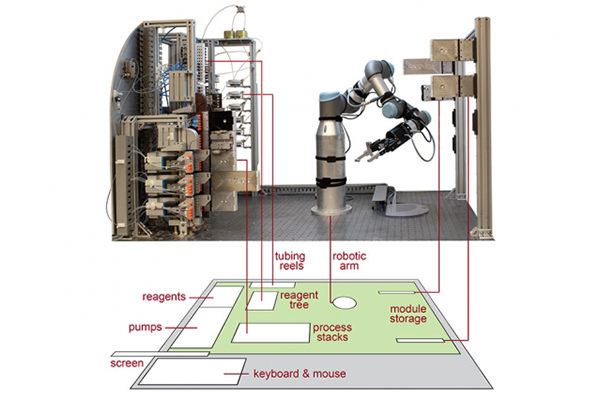
The researchers envision natural next steps for MOSAIC, including integrating its step-by-step instructions into automated laboratory systems. This integration could create fully automated discovery pipelines where AI not only designs synthesis pathways but also directs robotic systems to execute them. Such developments could dramatically accelerate the pace of chemical discovery while reducing costs and resource requirements.
Broader Implications for Scientific Discovery
Beyond its immediate applications in chemistry, MOSAIC represents an important model for how AI can be applied to complex scientific problems. By combining specialized expertise rather than relying on generalized models, the system demonstrates how targeted AI applications can overcome specific bottlenecks in scientific research. This approach could inspire similar applications in other scientific domains where specialized knowledge is distributed across numerous sub-disciplines.
The development of MOSAIC marks a significant milestone in the convergence of artificial intelligence and experimental science. As Newhouse notes, the system's ability to remove synthesis bottlenecks could lead to "more and better products" across multiple industries. With its proven ability to generate actionable synthesis instructions for novel compounds, MOSAIC represents not just a tool for chemists, but a paradigm shift in how we approach chemical discovery—one that could accelerate innovation in medicine, materials, and beyond for years to come.