Astronomers Witness Rare Planetary Collision 11,000 Light-Years Away
Astronomers have potentially observed a violent planetary collision around a distant sun-like star, an event that may mirror the impact that formed Earth's moon. The star Gaia20ehk, located 11,000 light-years away, exhibited erratic flickering and dimming, which analysis revealed was caused by vast clouds of hot dust and debris from a catastrophic impact. This discovery, detailed in a recent study, offers a rare real-time glimpse into the chaotic processes that shape planetary systems and could inform our understanding of how habitable worlds like our own come to be.
In the vast, quiet expanse of the cosmos, astronomers have potentially captured a moment of spectacular violence—a planetary collision unfolding in real-time around a distant star. This rare observation offers a direct window into the chaotic processes that forge and reshape solar systems, including our own. The event, centered on the star Gaia20ehk, provides compelling evidence of two worlds smashing together, scattering a glowing cloud of debris that temporarily obscured the star's light from our view. This article explores the discovery, the scientific methods that revealed it, and its profound implications for understanding planetary formation and the potential for life elsewhere in the galaxy.

The Discovery of an Erratic Star
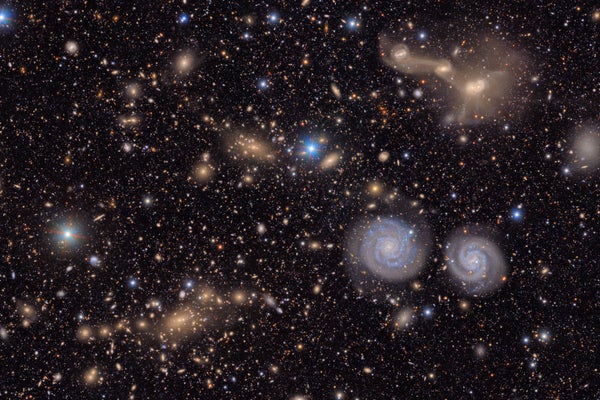
The story begins with a routine review of archived telescope data. Doctoral candidate Anastasios "Andy" Tzanidakis from the University of Washington was examining observations from 2020 when he noticed the peculiar behavior of a star named Gaia20ehk. Located about 11,000 light-years from Earth near the constellation Puppis, this star is a stable "main sequence" star, fundamentally similar to our Sun. Such stars are known for their steady, predictable brightness. Gaia20ehk, however, defied expectations.
"The star's light output was nice and flat, but starting in 2016 it had these three dips in brightness. And then, right around 2021, it went completely bonkers," Tzanidakis explained. "I can't emphasize enough that stars like our sun don't do that. So when we saw this one, we were like 'Hello, what's going on here?'" The erratic flickering and dimming presented a significant astronomical puzzle, prompting a deeper investigation into its cause.
Unraveling the Cosmic Mystery
Researchers quickly determined that the strange light variations were not originating from the star itself. Instead, the data pointed to an external cause: massive amounts of material passing in front of the star, partially blocking its light as it traveled toward Earth. The key breakthrough came when the team, including senior author James Davenport, decided to examine the star's behavior in infrared light, as reported in their study published in The Astrophysical Journal Letters.
"The infrared light curve was the complete opposite of the visible light," Tzanidakis noted. "As the visible light began to flicker and dim, the infrared light spiked. Which could mean that the material blocking the star is hot—so hot that it's glowing in the infrared." This signature pointed directly to a source of intense heat, and the most plausible explanation for such an event in a planetary system is a violent, catastrophic collision between two planetary bodies.
The Violent Event and Its Aftermath
The analysis suggests a dramatic sequence of events. The initial dips in brightness observed in 2016 likely represented "grazing impacts" as two planets spiraled closer and closer to each other. These preliminary encounters would not generate significant infrared heat. The catastrophic, final collision, however, would have unleashed enormous energy, vaporizing rock and scattering incandescent debris throughout the system, explaining the subsequent spike in infrared emissions.
Intriguingly, the debris cloud appears to orbit the star at about one astronomical unit—the same distance between Earth and the Sun. This positioning raises the tantalizing possibility that the collision around Gaia20ehk may be a cosmic replay of the event that formed the Earth-Moon system roughly 4.5 billion years ago. The scattered material could eventually cool and coalesce into new planetary bodies, potentially forming a similar binary system. However, scientists note that observing the final outcome could take anywhere from a few years to millions of years.
Implications for Planetary Science and Astrobiology
Witnessing such an event is extraordinarily rare. Planetary collisions are thought to be common during the early, chaotic stages of solar system formation, but detecting them requires a precise alignment where the resulting debris passes directly between the star and Earth. This discovery, therefore, provides an invaluable data point.
"How rare is the event that created the Earth and moon? That question is fundamental to astrobiology," said James Davenport. He elaborated that the Moon plays a crucial role in making Earth habitable by stabilizing its axial tilt, generating ocean tides that mix chemistry globally, and potentially driving tectonic activity. Understanding how often such moon-forming collisions occur is key to assessing the likelihood of finding other life-bearing worlds. Future observatories, particularly the Vera C. Rubin Observatory, are expected to detect many more of these events, helping scientists build a statistical understanding of planetary evolution.
Conclusion: A New Window on Cosmic Catastrophes
The detection of a potential planetary collision around Gaia20ehk marks a significant milestone in astronomy. It transforms a theoretical process—planetary smash-ups—into an observed phenomenon. This event not only sheds light on the violent birth and evolution of planets but also serves as a potential analog for our own solar system's history. As next-generation telescopes come online, astronomers anticipate discovering dozens of similar collisions, each adding a piece to the puzzle of how planetary systems, including those capable of hosting life, are built from chaos and catastrophe.