The 'Ghost' Great White: A Rare Juvenile Shark Sparks Hope for Mediterranean Population
A rare juvenile great white shark caught off the Spanish coast in 2023 has reignited scientific debate about the species' presence in the Mediterranean Sea. By analyzing over 160 years of records, researchers confirm these apex predators have not vanished but persist as a mysterious, elusive 'ghost' population. The discovery of a young shark raises the critical possibility that active reproduction may still be occurring in the region, challenging assumptions about their local extinction and highlighting the need for enhanced conservation monitoring.
The Mediterranean Sea, a cradle of ancient civilizations, holds a modern marine mystery: the fate of its great white shark population. For decades, sightings of these iconic apex predators have been so rare that many assumed they had vanished from the region. However, a remarkable event in April 2023 has dramatically shifted this narrative. The accidental capture of a juvenile great white shark by Spanish fishermen has not only provided tangible evidence of their continued presence but has also sparked a profound scientific reassessment. This article explores the implications of this discovery, drawing on a comprehensive historical review published in Acta Ichthyologica et Piscatoria, which suggests these legendary 'ghost' sharks have been quietly persisting all along.
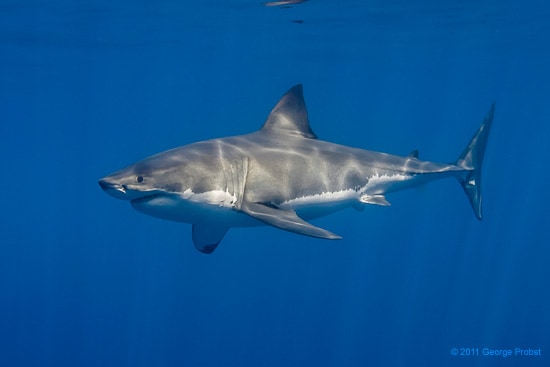
The 2023 Discovery: A Juvenile 'Ghost'
On April 20, 2023, a routine fishing operation off the eastern Spanish coast yielded an extraordinary catch. Local fishermen inadvertently captured a juvenile great white shark (Carcharodon carcharias), measuring approximately 210 cm in length and weighing 80-90 kg. This encounter, detailed in a 2026 study, was immediately recognized as a significant scientific event due to its extreme rarity. The shark's size and age classification as a juvenile are of particular importance. Unlike adult sharks that may wander vast distances, the presence of a younger individual strongly suggests it was born relatively nearby, raising the tantalizing question of local reproduction.
Revisiting 160 Years of History
Prompted by the 2023 catch, a team of researchers led by Dr. José Carlos Báez embarked on a meticulous review of historical records dating back to 1862. Their goal was to determine whether the juvenile was a complete anomaly or part of a broader, overlooked pattern. The resulting analysis, compiling sightings and reports over more than a century and a half, paints a clear picture: great white sharks have never fully disappeared from the Spanish Mediterranean. Instead, they form what scientists describe as a 'ghost' population—elusive, rarely seen, but persistently present. The records show sporadic but consistent appearances over time, debunking the myth of their complete regional extinction.

Why Juvenile Sharks Are a Game-Changer
The ecological significance of finding a juvenile specimen cannot be overstated. As Dr. Báez emphasized in the study, "Determining the presence of juvenile individuals is of particular importance... The occurrence of juvenile specimens raises the question whether active reproduction may be occurring in the region." For a highly migratory species like the great white shark, adults can travel thousands of miles. Therefore, an adult sighting alone does not confirm local breeding grounds. A juvenile, however, with its more limited range, is a much stronger indicator that mating, birthing, or nursery areas may exist within the Mediterranean basin. This shifts the scientific conversation from merely confirming presence to actively searching for breeding sites.
Conservation Status and Ecological Role
Globally, the great white shark is classified as Vulnerable on the IUCN Red List, with populations believed to be in decline. Their precarious status makes understanding and protecting any remaining populations, especially cryptic ones like in the Mediterranean, a conservation priority. Beyond their fearsome reputation, great whites play a fundamental role in marine ecosystems. As Dr. Báez explains, they are highly migratory pelagic species that help redistribute energy and nutrients across vast oceanic distances. They act as apex predators, regulating prey populations, and as nature's scavengers, consuming carrion to keep ecosystems clean. Even in death, their bodies sinking to the seafloor provide a vital nutrient pulse for deep-sea communities.
From Fear to Understanding
The great white shark is often a victim of its own mythos, inspiring deep-seated fear. The research team addressed this by referencing H.P. Lovecraft's observation that "the oldest and strongest emotion of mankind is fear, and the oldest and strongest kind of fear is fear of the unknown." The study posits that scientific research is the antidote to this fear. By shedding light on the biology, ecology, and true status of great white sharks in the Mediterranean, science can replace sensationalized myths with factual understanding. This shift in public perception is crucial for garnering support for conservation measures aimed at protecting these misunderstood animals.

The Path Forward: Monitoring and Protection
The discovery underscores a critical need for enhanced, long-term monitoring programs in the Mediterranean. Combining traditional methods like fishery reports and sightings with modern technologies—such as environmental DNA (eDNA) sampling, satellite tagging, and acoustic telemetry—could help scientists finally map the movements and habitats of this ghost population. Developing evidence-based conservation strategies is essential. This may involve identifying and protecting potential breeding or nursery grounds, mitigating bycatch in fisheries, and fostering international cooperation across Mediterranean nations. Protecting the great white shark is not just about saving a single species; it is about preserving the health and balance of the entire marine ecosystem it inhabits.
In conclusion, the juvenile great white shark caught in 2023 is more than a rare specimen; it is a beacon of hope and a call to action. It proves that the Mediterranean's 'ghost' population of great whites endures, however precariously. The possibility of active reproduction in the region opens a new chapter for marine conservation. By replacing fear with knowledge and inaction with dedicated monitoring, we can ensure these majestic predators continue to play their vital role in the Mediterranean Sea for generations to come.