Read on bbc.com
Spain's Sánchez Rejects Trump Trade Threat, Affirms 'No to War' Stance
Spanish Prime Minister Pedro Sánchez has delivered a firm rebuttal to US President Donald Trump's threat to sever all trade with Spain, reaffirming his government's opposition to military conflict and commitment to international law. In a televised address, Sánchez linked the current tensions over US access to Spanish military bases to broader principles of peace, referencing conflicts in Ukraine, Gaza, and the legacy of the Iraq War. The dispute highlights a significant diplomatic rift within NATO and raises questions about the economic and political consequences of Spain's independent foreign policy stance.
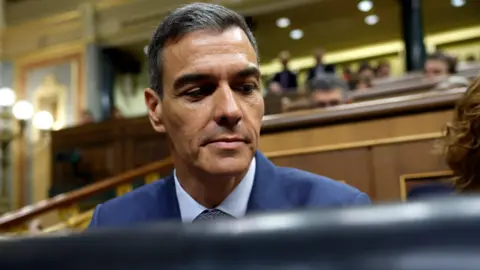
Spanish Prime Minister Pedro Sánchez has issued a strong, principled response to US President Donald Trump's threat to impose a full trade embargo on Spain, framing the dispute as a fundamental choice between war and peace. The confrontation erupted after Spain refused a US request to use the jointly operated military bases at Morón and Rota for strikes against Iran, prompting Trump to declare Spain a "terrible partner" and vow to "cut off all trade." Sánchez's rebuttal, delivered in a solemn televised address, transcends the immediate bilateral friction, positioning Spain's foreign policy within a broader ethical and historical context opposed to military interventionism.
The Core of the Diplomatic Dispute
The immediate catalyst for the crisis was Spain's denial of US access to its strategic airbases for potential operations against Iran. President Trump's reaction was swift and severe, accusing Spain of failing to meet NATO defense spending targets and being a "terrible" ally. He stated unequivocally, "We're going to cut off all trade with Spain. We don't want anything to do with Spain," during a meeting with German Chancellor Friedrich Merz. This threat represents an unprecedented economic pressure tactic against a NATO ally, moving beyond diplomatic criticism to a direct confrontation with significant potential repercussions for both economies.
Sánchez's "No to War" Doctrine
In his address from the Moncloa Palace, Prime Minister Sánchez avoided a direct tit-for-tat response to Trump, instead elevating the discussion to a matter of principle. He stated that the Spanish government's position could be summarized as "no to war," and emphasized a commitment to international legality. "The question is not if we are on the side of the ayatollahs - nobody is. The question is whether we are in favour of peace and international legality," Sánchez asserted. He warned that responding to one illegality with another sets a dangerous precedent, echoing his government's consistent criticism of military actions in Gaza and its support for a Palestinian state.

Historical Parallels and Domestic Resonance
A significant portion of Sánchez's address was devoted to drawing historical parallels, particularly to the 2003 invasion of Iraq. He invoked the memory of the "Azores trio"—George W. Bush, Tony Blair, and Spain's then-conservative Prime Minister José María Aznar—whose meeting preceded the war. Sánchez argued that intervention in Iraq failed in its objectives and worsened conditions for civilians, suggesting a similar outcome could follow strikes on Iran. This historical reference carries deep political weight in Spain, where Aznar's support for the Iraq War was massively unpopular and is widely believed to have contributed to the Socialist Party's election victory in 2004 following the Madrid train bombings.
European Solidarity and Diverging Responses
The crisis has triggered a show of European Union solidarity with Spain. French President Emmanuel Macron expressed his "solidarity" with Sánchez in a phone call, while European Council President António Costa affirmed the EU's "full solidarity" with Madrid. However, a clear divergence has emerged among European leaders. German Chancellor Friedrich Merz, while stating he could not agree to a trade deal excluding Spain, also suggested that regime change in Iran could leave the world "a little better off." This contrast underscores the lack of a unified European stance on how to address the Iran issue and how to respond to US pressure.
Political and Economic Implications
Standing up to a US president may offer domestic political advantages for Sánchez. According to a BBC report, a CIS poll found that 77% of Spaniards hold a negative view of Trump, suggesting Sánchez's stance could resonate across the political spectrum. However, his government faces immense internal pressure, grappling with a fragile parliamentary coalition and corruption allegations. The ultimate economic impact remains uncertain. While the Spanish government is reportedly studying countermeasures, the threat of a US trade embargo—which would sever a critical economic relationship—looms as a serious concern for Spanish businesses and citizens.
The confrontation between Madrid and Washington represents more than a bilateral spat; it is a clash between a transactional, pressure-based foreign policy and a principles-driven approach rooted in pacifism and multilateralism. Sánchez has anchored Spain's position in a historical narrative of opposition to war, from Iraq to Gaza, betting that domestic and European support will outweigh the risks of American retaliation. As the situation develops, the world watches to see whether Trump's threats will materialize and how a midsize European power navigates the storm of great power politics while holding firm to its declared values.