Read on PBS News
Iran's Strait of Hormuz Closure: A Strategic Show of Force Amid Nuclear Talks
In a significant geopolitical maneuver, Iran announced the temporary closure of the Strait of Hormuz for live-fire military drills on February 17, 2026, coinciding with indirect nuclear negotiations with the United States. This rare action, targeting a waterway vital to global oil transit, represents a calculated show of force. The move underscores the heightened tensions in the region, juxtaposed against diplomatic efforts in Geneva. This article analyzes the strategic implications of the closure, the context of the U.S.-Iran talks, and the potential impact on regional stability and global energy markets.
On Tuesday, February 17, 2026, Iran executed a bold geopolitical maneuver by announcing the temporary closure of the Strait of Hormuz for live-fire military drills. This rare show of force was timed precisely as Iranian negotiators engaged in another round of indirect talks with the United States regarding Tehran's disputed nuclear program. The strategic closure of a chokepoint for 20% of the world's oil shipments sent a clear message of military capability and regional defiance, even as diplomats sought a path to de-escalation in Geneva.

The Strategic Significance of the Strait of Hormuz
The Strait of Hormuz is arguably the world's most important maritime oil transit chokepoint. According to reports, approximately 20% of globally traded oil passes through this narrow waterway connecting the Persian Gulf with the Gulf of Oman and the Arabian Sea. Iran's announcement marked the first declared closure since the United States began threatening Iran and augmenting its military presence in the region. While it was not immediately clear if the strait was physically blocked to traffic, the declaration itself was an unprecedented escalation, raising fears of a potential spark for broader conflict in an already volatile Middle East.
Military Drills and Diplomatic Talks: A Dual-Track Approach
As talks commenced in Geneva, Iranian state media announced that forces had fired live missiles toward the strait and would close it for several hours, citing "safety and maritime concerns." This military activity served as a powerful backdrop to the diplomatic proceedings. Experts, such as Danny Citrinowicz of Israel's Institute for National Security Studies, noted that Iran had not closed the strait since mining it during the 1980s war with Iraq. The clear intent was to signal to the international community that any military strike on Iran would have immediate and severe global economic repercussions, particularly on energy markets.
The Nuclear Negotiations: Stakes and Statements
The indirect talks, held in the residence of the Omani envoy in Geneva, involved U.S. envoys Steve Witkoff and Jared Kushner and were led on the Iranian side by Foreign Minister Abbas Araghchi. Despite the threatening military posture, Araghchi later expressed diplomatic optimism, telling a U.N. conference that "a new window has opened" for a sustainable agreement. He emphasized Iran's readiness to defend itself, warning that the consequences of any attack "would not be confined to its borders." A U.S. official, speaking anonymously, indicated progress was made, though many details remained unresolved, with Iran expected to present more detailed proposals in the following weeks.
Escalating Rhetoric and Military Posturing
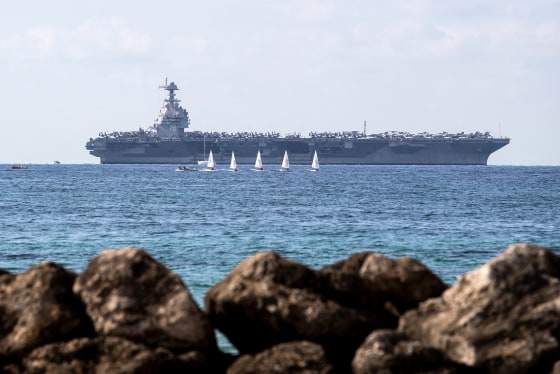
The period leading up to the drills was marked by escalating rhetoric and military movements. U.S. President Donald Trump, who had scrapped an earlier nuclear deal, had repeatedly threatened to use force to constrain Iran's nuclear program and had bolstered the U.S. military presence. This included deploying the USS Gerald R. Ford—the world's largest aircraft carrier—to join the USS Abraham Lincoln carrier group already in the region. Incidents such as the U.S. shooting down an Iranian drone near the Lincoln and Iran's attempt to stop a U.S.-flagged ship in the strait highlighted the daily risk of miscalculation.
Supreme Leader's Warnings
Iran's Supreme Leader Ayatollah Ali Khamenei framed the confrontation in stark terms. He warned that "the strongest army in the world might sometimes receive such a slap that it cannot get back on its feet," and stated that a weapon capable of sinking a warship was more dangerous than the warship itself. These statements reinforced the message that Iran's response to any attack would be asymmetric and devastating.
Global and Economic Repercussions
The immediate financial markets reacted to the interplay of force and diplomacy. Oil prices, which had risen due to the U.S. military buildup, fell after the talks concluded—with U.S. crude down 1.3% and Brent crude off 2.3%. This reflected market anticipation that a diplomatic deal could eventually be reached, averting a major supply disruption. However, the incident underscored the persistent fragility of global energy security, tethered to the stability of the Strait of Hormuz.

Conclusion: A Precarious Balance Between Force and Diplomacy
Iran's temporary closure of the Strait of Hormuz represents a masterclass in coercive diplomacy. By flexing its military muscle at the world's most sensitive energy artery during nuclear talks, Tehran aimed to strengthen its bargaining position and remind global powers of the high costs of conflict. While the diplomatic channel remains open, with both sides acknowledging progress, the shadow of military escalation looms large. The episode highlights the precarious balance in U.S.-Iran relations, where the path to a nuclear agreement is paved with live-fire drills, carrier deployments, and the ever-present threat that a single incident could ignite a wider regional war. The international community will watch closely to see if the "new window" for diplomacy can remain open amidst the sound of missile fire.