Harnessing the Gyroscope: A Breakthrough in Wave Energy Conversion
Researchers at The University of Osaka have developed a novel gyroscopic wave energy converter (GWEC) that promises to overcome the long-standing challenges of harnessing ocean power. By utilizing a spinning flywheel inside a floating platform, the system exploits gyroscopic precession to convert wave motion into electricity efficiently across a broad spectrum of wave conditions. This innovation could unlock the vast, consistent energy potential of the world's oceans, offering a more adaptable and reliable renewable energy source to support global climate goals.
The relentless motion of the ocean represents one of the planet's most powerful and consistent untapped energy reservoirs. For decades, engineers have grappled with the challenge of efficiently converting this kinetic energy into a reliable power source, often hindered by the ocean's variable and harsh conditions. A groundbreaking study from The University of Osaka, published in the Journal of Fluid Mechanics, presents a compelling solution: a gyroscopic wave energy converter (GWEC). This innovative design leverages the physics of a spinning flywheel to potentially revolutionize how we capture energy from the sea.
The Challenge of Conventional Wave Energy
Traditional wave energy devices often face a critical limitation: they are highly efficient only within a narrow band of specific wave frequencies. The open ocean, however, is characterized by constantly shifting conditions—wave heights, periods, and directions change continuously. This mismatch means many existing technologies cannot maintain optimal performance, leading to inconsistent power output and reduced economic viability. The search has been on for a system that can adapt to this broadband environment, absorbing energy efficiently across a wide range of wave states.
How the Gyroscopic Converter Works
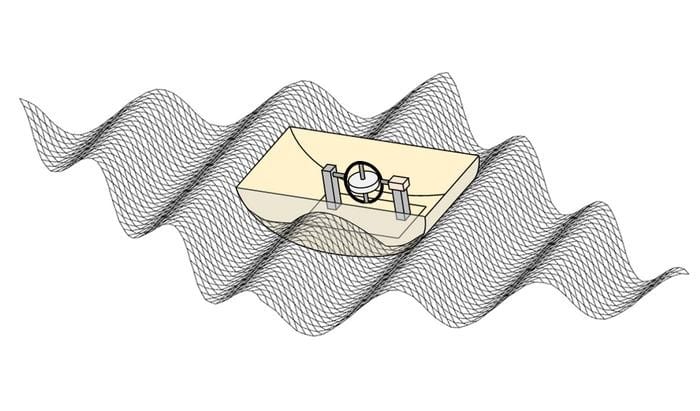
The core innovation of the GWEC lies in its use of a high-speed spinning flywheel, which acts as a gyroscope, housed within a buoyant floating structure. As ocean waves cause the platform to pitch and roll, they exert forces on this spinning mass. The system capitalizes on a fundamental physical principle known as gyroscopic precession. This is the phenomenon where a force applied to a spinning object causes it to react by shifting its axis of rotation in a perpendicular direction.
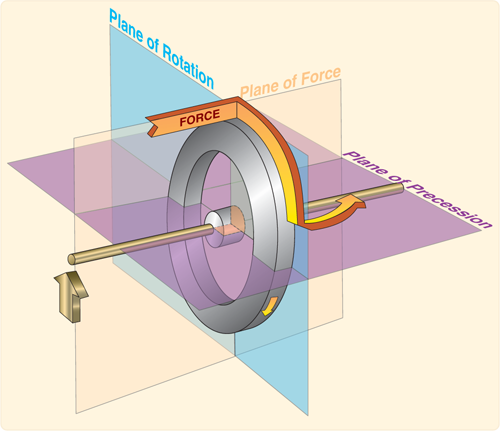
In the GWEC, the wave-induced motion of the platform forces the spinning flywheel to precess. This controlled precessional motion is mechanically linked to a generator, which converts the rotational energy into electrical power. The key advantage is that the gyroscope's response can be actively tuned by adjusting the flywheel's rotational speed and the generator's control parameters. This tunability allows the device to be optimized for maximum energy absorption at different wave frequencies, effectively broadening its operational range.
Achieving Theoretical Efficiency Limits
The research, led by Takahito Iida, employed advanced linear wave theory to model the complex interactions between the ocean waves, the floating structure, and the internal gyroscope. This analysis yielded a significant finding: when properly calibrated, the GWEC can achieve the theoretical maximum energy absorption efficiency for a wave energy device. This limit, known as the "half" limit in wave energy theory, means the device can absorb up to 50% of the energy from an incoming wave.
"What is exciting is that we now know that this limit can be reached across broadband frequencies, not just at a single resonant condition," Iida explained. This contrasts sharply with traditional systems that peak in efficiency only at their specific resonant frequency. The study's numerical simulations, conducted in both frequency and time domains, confirmed that the device maintains robust performance, particularly when tuned to operate near its resonance with the prevailing waves.
Implications for Renewable Energy
The development of a practical and efficient GWEC holds profound implications for the global renewable energy landscape. Ocean waves offer a dense and predictable power source, far more consistent than solar or wind. A technology that can reliably tap into this resource, regardless of shifting sea states, moves wave energy closer to becoming a commercially viable pillar of a clean energy grid. It represents a crucial step toward diversifying our renewable portfolio and enhancing energy security.

By providing a clear framework for tuning the system's operational parameters, the research offers a practical blueprint for engineers. The next steps involve scaling the technology, testing full-scale prototypes in real ocean environments, and integrating the generated power into existing electrical grids. As nations strive to meet ambitious climate targets, innovations like the gyroscopic wave energy converter could be instrumental in unlocking the immense power of our oceans, providing a steady, sustainable flow of electricity for future generations.