Read on nature.com
Cosmic Map Reveals Universe is Less Clumpy Than Predicted
Astronomers have unveiled the most ambitious cosmic map to date, based on observations of approximately 150 million galaxies. This landmark survey from the Dark Energy Survey collaboration confirms a significant cosmological puzzle: the distribution of matter in the Universe is less 'clumpy' than what the leading theoretical model, the standard cosmological model, predicts. The findings, which challenge our understanding of cosmic structure formation, are detailed in a recent preprint and reported by Nature. This discovery adds to growing evidence that our current theories of the Universe may be incomplete, potentially pointing to new physics or a need to refine fundamental cosmological parameters.
A groundbreaking new cosmic map has provided astronomers with an unprecedented view of the large-scale structure of the Universe, revealing a surprising discrepancy with established theory. The findings, derived from the Dark Energy Survey (DES), confirm that matter is distributed more smoothly and is less clustered than scientists had anticipated based on the standard model of cosmology.

The Dark Energy Survey's Ambitious Map
The research is based on data collected by the Dark Energy Survey, which meticulously observed around 150 million galaxies visible from Earth's southern hemisphere. By analyzing the positions and shapes of these distant galaxies, scientists can trace the underlying distribution of dark matter—the invisible scaffolding that makes up about 85% of all matter in the cosmos. This immense dataset represents the most comprehensive map of cosmic structure assembled to date, offering a powerful test for our cosmological models.
The Clumpiness Problem
The standard cosmological model, often called the Lambda-Cold Dark Matter (ΛCDM) model, has been remarkably successful at explaining a wide range of cosmic phenomena, from the afterglow of the Big Bang to the accelerating expansion of the Universe. A key prediction of this model concerns how matter should have clumped together under the force of gravity over billions of years. According to theory, the Universe should exhibit a certain level of "clumpiness," with matter concentrated in dense filaments and clusters separated by vast voids.
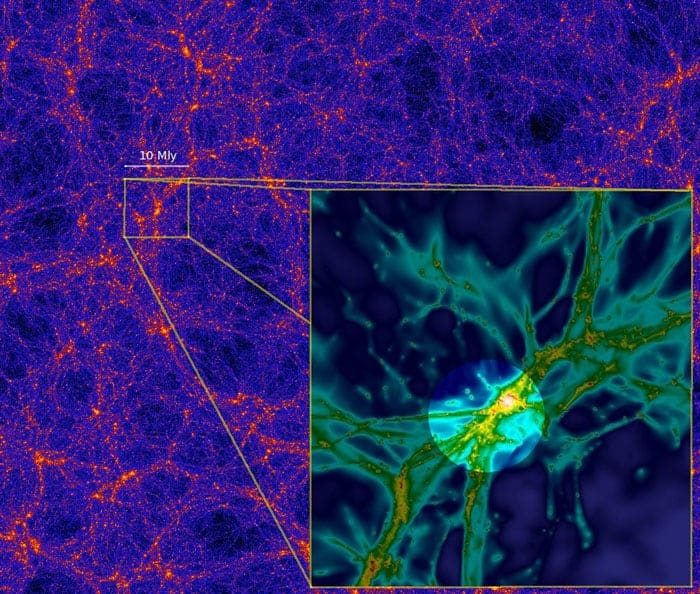
The new DES results, however, indicate that the observed Universe is smoother. The matter is less concentrated into dense knots and more evenly distributed than the ΛCDM model predicts. This is not the first hint of such a discrepancy; earlier, smaller surveys had suggested a similar trend. The sheer scale and precision of the DES map now provide much stronger, more statistically robust confirmation of this cosmic anomaly.
Implications and Future Directions
The confirmation that the Universe is less clumpy than expected presents a significant challenge to cosmologists. It suggests that our understanding of the fundamental ingredients and forces that shaped the cosmos may be incomplete. Several possibilities could explain the finding. It might indicate that properties of dark energy—the mysterious force driving cosmic acceleration—are different than assumed. Alternatively, it could point to unknown properties of neutrinos, revisions to Einstein's theory of gravity on cosmic scales, or other new physics beyond the standard model.
Resolving this tension is a major goal for next-generation observatories. Projects like the Vera C. Rubin Observatory's Legacy Survey of Space and Time (LSST) and the European Space Agency's Euclid space telescope will map billions of galaxies with even greater precision. These future surveys will provide the data needed to determine whether the solution lies in refining existing parameters or requires a more radical overhaul of cosmological theory. As reported by Nature, this work marks a critical step in our ongoing quest to understand the fundamental architecture of the Universe.