Distant Entangled Atoms Unlock New Era of Precision Measurement
A groundbreaking study from the University of Basel and Laboratoire Kastler Brossel demonstrates how quantum entanglement can link atoms across space to create ultra-precise sensors. By splitting entangled atoms into separate clouds, researchers achieved unprecedented accuracy in measuring electromagnetic fields. This technique, which leverages the mysterious quantum connections described by the Einstein-Podolsky-Rosen paradox, promises to revolutionize precision instruments including atomic clocks and gravity sensors, opening new frontiers in quantum metrology and fundamental physics research.
The quest for ever-greater precision in measurement has entered a new quantum era. Researchers have successfully harnessed one of quantum physics' most enigmatic phenomena—entanglement—to create sensors of remarkable accuracy that operate across physical space. This breakthrough, detailed in a recent Science publication, demonstrates that atoms entangled and then separated into distinct clouds can act as a single, coordinated sensor, dramatically improving the measurement of spatially varying fields like electromagnetism.
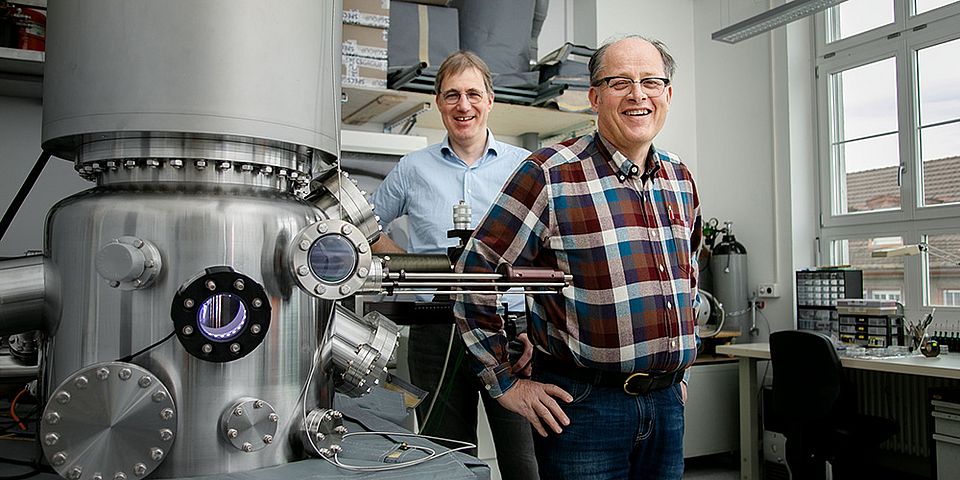
The work builds directly on the 2022 Nobel Prize-winning confirmation of the Einstein-Podolsky-Rosen (EPR) paradox, which describes the "spooky action at a distance" between entangled particles. Where previous quantum metrology efforts entangled atoms in a single location, this research extends the concept into the spatial domain, distributing entangled atomic spins across multiple clouds. This spatial separation is key to measuring how physical quantities change from one point to another, a capability with profound implications for both fundamental science and advanced technology.
The Quantum Leap: From Single Location to Distributed Sensing
Quantum metrology has established itself as a powerful field that exploits quantum effects to surpass classical measurement limits. For approximately fifteen years, researchers including Prof. Dr. Philipp Treutlein of the University of Basel have been pioneering methods to entangle the spins of ultracold atoms—imagine aligning microscopic compass needles with quantum linkage. This entanglement within a single cloud allowed measurements with precision unattainable by independent atoms.
"However, those atoms were all in the same location," explains Treutlein. The recent breakthrough, a collaboration with Prof. Dr. Alice Sinatra's team at the Laboratoire Kastler Brossel in Paris, involved distributing these entangled atoms into up to three spatially separated clouds. "We have now extended this concept... As a result, the effects of entanglement act at a distance, just as in the EPR paradox." This spatial distribution transforms the system from a precise point sensor into a tool for mapping field variations across space.

Mapping Electromagnetic Fields with Quantum Precision
The experimental protocol developed by the team, including postdoc Yifan Li and PhD student Lex Joosten, begins with creating entanglement among atomic spins within a single cloud of ultracold atoms. This cloud is then carefully divided into multiple parts—in their demonstration, three separate clouds—that maintain their quantum entanglement despite physical separation. These distant but connected clouds are then exposed to an electromagnetic field.
The entangled state allows the researchers to extract information about the field's spatial structure with significantly fewer measurements than would be required by classical methods or even by non-entangled quantum sensors. The entanglement reduces the fundamental quantum noise inherent in measurements and can cancel out common disturbances that affect all atoms similarly. "With only a small number of measurements, they were able to determine the field distribution with clearly higher precision than would be possible without entanglement across space," as noted in the research summary.
Transforming Precision Instruments: Clocks and Gravimeters
The implications of this distributed quantum sensing technique are immediate and practical for existing high-precision instruments. Optical lattice clocks, which use atoms trapped in laser beam lattices as exquisitely precise timekeepers, stand to benefit directly. "Our measurement protocols can be directly applied to existing precision instruments such as optical lattice clocks," says Lex Joosten. The method could mitigate specific errors related to how atoms are arranged within the optical lattice, potentially leading to even more accurate time standards crucial for navigation, telecommunications, and fundamental physics tests.
Similarly, atom interferometers—devices that measure gravitational acceleration by exploiting the wave-like nature of atoms—could see substantial improvements. These instruments, used as gravimeters to map subtle variations in Earth's gravity field for geological surveys and resource exploration, require extreme sensitivity. Using spatially separated entangled atoms allows scientists to measure gravitational gradients (how gravity changes across space) with enhanced precision, offering clearer insights into subsurface structures.
A New Framework for Quantum Measurement
Beyond the immediate applications, this research establishes a crucial theoretical and experimental framework. "So far, no one has performed such a quantum measurement with spatially separated entangled atomic clouds, and the theoretical framework for such measurements was also still unclear," notes Yifan Li. The team's work, documented in their paper "Multiparameter estimation with an array of entangled atomic sensors," provides a blueprint for how to minimize measurement uncertainty when using such distributed quantum systems.
This framework opens the door to measuring multiple physical parameters simultaneously with quantum-enhanced precision. It represents a significant step toward practical quantum sensor networks, where separate nodes, connected by entanglement, could collaboratively map environmental fields, monitor infrastructure, or conduct fundamental experiments on gravity and spacetime.
The Path Forward for Quantum-Enhanced Sensing
The successful demonstration of distant entanglement for practical sensing marks a pivotal moment in quantum technology. It moves quantum entanglement from a laboratory curiosity and a tool for secure communication and computing into the realm of advanced measurement science. The ability to exploit non-local quantum correlations for tangible precision gains validates years of theoretical work and experimental refinement in quantum optics and cold atom physics.
As research continues, we can anticipate further scaling of these systems—increasing the number of separated clouds, the distance between them, and the complexity of fields they can characterize. This progress will steadily transfer from controlled laboratory environments to field-deployable instruments, ultimately providing scientists and engineers with unprecedented windows into the physical world. The era of distributed quantum sensing has begun, promising to sharpen our view of everything from the fundamental constants of nature to the detailed topography of our planet.