Quantum Entanglement Breakthrough: Distant Atoms Unite for Unprecedented Measurement Precision
A groundbreaking study from the University of Basel and Laboratoire Kastler Brossel demonstrates how quantum entanglement can link atoms across space to create superior measurement sensors. By splitting entangled atomic clouds into separate locations, researchers achieved remarkable precision in measuring electromagnetic fields, surpassing traditional methods. This advancement leverages the mysterious Einstein-Podolsky-Rosen paradox for practical applications, potentially revolutionizing atomic clocks, gravity sensors, and quantum metrology tools. The research represents a significant step toward harnessing quantum phenomena for real-world technological improvements.
Quantum physics continues to push the boundaries of what's possible in measurement science, with a recent breakthrough demonstrating how the mysterious phenomenon of entanglement can be harnessed across space for unprecedented precision. Researchers from the University of Basel and Laboratoire Kastler Brossel have successfully shown that quantum entanglement—the strange connection between particles that Einstein famously called "spooky action at a distance"—can link atoms separated in space to function as a single, highly precise sensor. This development represents a significant advancement in quantum metrology, the field that uses quantum effects to improve measurements of physical quantities.
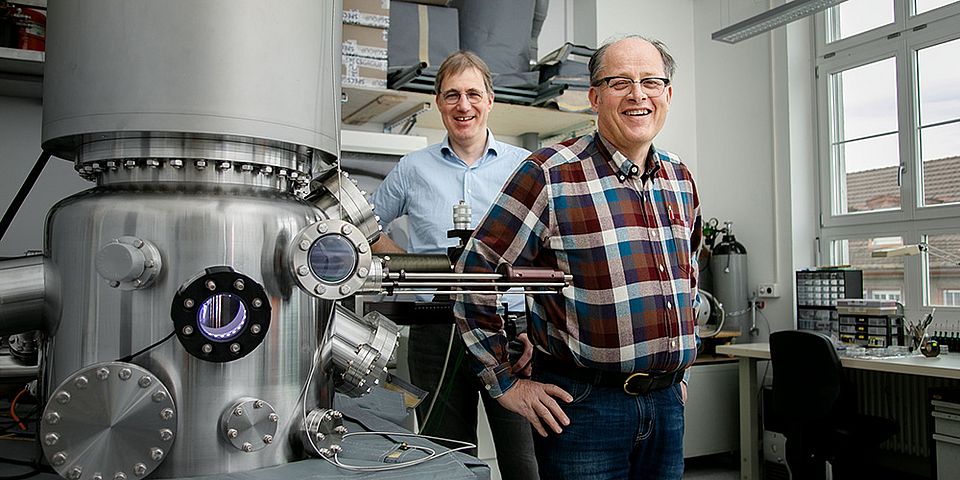
The research builds directly on the Einstein-Podolsky-Rosen (EPR) paradox, the phenomenon that earned the 2022 Nobel Prize in physics for its experimental confirmation. While entanglement has long fascinated physicists for its counterintuitive nature, this new work demonstrates its practical utility in measurement science. As described in their Science publication, the team led by Prof. Dr. Philipp Treutlein and Prof. Dr. Alice Sinatra has moved beyond theoretical curiosity to create functional measurement systems that outperform conventional approaches.
The Quantum Measurement Breakthrough
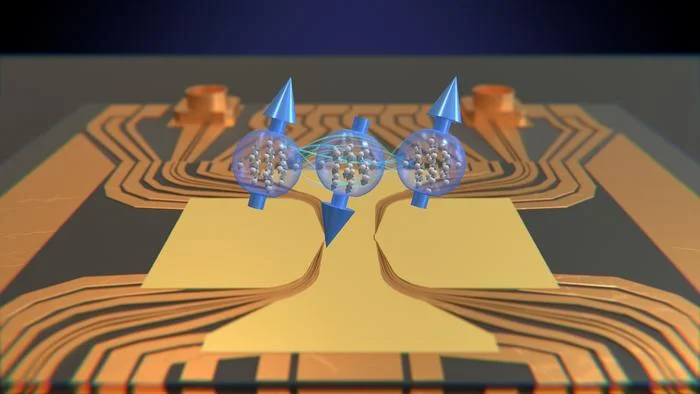
At the heart of this advancement is a novel approach to distributing entangled atoms across space. The researchers first created entanglement within a single cloud of extremely cold atoms, entangling their spins—which can be imagined as tiny quantum compass needles. They then divided this cloud into up to three spatially separated parts that maintained their quantum connections despite physical separation. This distribution allows the entangled system to measure quantities that vary across space with remarkable accuracy.
The technique specifically addresses a fundamental challenge in quantum measurement: reducing uncertainty that arises from quantum effects. When atoms are entangled, measurements performed on them exhibit statistical connections that have no classical explanation. By distributing these entangled atoms, the researchers can simultaneously measure multiple physical parameters while minimizing uncertainty. As Yifan Li, a postdoc in Treutlein's group, explains, "So far, no one has performed such a quantum measurement with spatially separated entangled atomic clouds, and the theoretical framework for such measurements was also still unclear."
Practical Applications and Technological Impact
The implications of this research extend far beyond laboratory demonstrations. One of the most immediate applications lies in improving optical lattice clocks, the world's most precise timekeeping devices. In these systems, atoms are held in place by laser beams arranged in a lattice pattern, serving as extremely accurate "clockworks." The new entanglement methods could reduce specific errors caused by how atoms are distributed within these lattices, potentially leading to even more precise timekeeping standards.
Equally promising is the application to atom interferometers used for measuring Earth's gravitational acceleration. These instruments, known as gravimeters, focus on how gravity changes across space. Using entangled atoms distributed in separate locations makes it possible to measure these gravitational variations with greater precision than previously achievable. As Lex Joosten, a PhD student in the Basel group, notes, "Our measurement protocols can be directly applied to existing precision instruments such as optical lattice clocks."
The Future of Quantum Metrology
This research represents a significant milestone in the practical application of quantum phenomena. For approximately fifteen years, researchers have been working to entangle the spins of extremely cold atoms to improve measurement precision. However, as Treutlein explains, "those atoms were all in the same location. We have now extended this concept by distributing the atoms into up to three spatially separated clouds. As a result, the effects of entanglement act at a distance, just as in the EPR paradox."
The ability to use distant entanglement for practical measurements opens new possibilities across multiple scientific and technological domains. From fundamental physics research to practical engineering applications, this approach demonstrates how quantum phenomena can be harnessed for tangible benefits. The research team's work provides both experimental validation and theoretical framework for future developments in quantum sensing technologies.
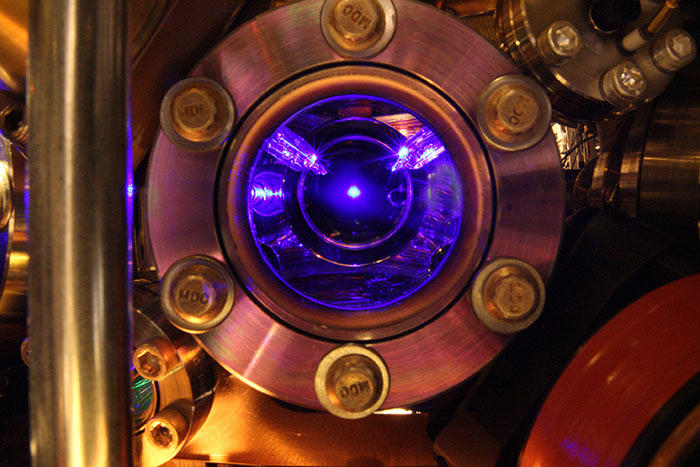
As quantum technologies continue to advance, the integration of entanglement-based measurement systems into existing instruments promises to push the boundaries of precision across multiple fields. From navigation systems that rely on precise timekeeping to geological surveys using gravity measurements, the practical applications are both broad and significant. This research not only advances our understanding of quantum phenomena but also demonstrates their increasing relevance to real-world technological challenges.