AMD Ryzen 7 9850X3D Review: A Minor Refresh for Gaming Dominance
The AMD Ryzen 7 9850X3D continues the legacy of its predecessor as a top-tier gaming processor, offering excellent performance with minimal upgrades. While technically faster than the 9800X3D, real-world gaming differences are negligible, making it a solid choice for new builds but not a compelling upgrade for existing owners. This review examines the chip's performance, cooling requirements, and straightforward overclocking capabilities through Ryzen Master.
For PC gamers seeking the pinnacle of performance, AMD's Ryzen 7 series with 3D V-Cache technology has become the benchmark. The Ryzen 7 9850X3D arrives as a subtle refresh of the already excellent 9800X3D, maintaining its position as a top choice for high-end gaming systems. While the improvements are minimal, the chip continues to deliver exceptional gaming performance with the ease of use that has become synonymous with AMD's recent offerings.
Technical Specifications and Design
The Ryzen 7 9850X3D represents what appears to be a binned version of its predecessor, with the primary technical difference being a modest increase in maximum boost clock speed. According to testing data from WIRED's review, the new chip reaches 5.6 GHz compared to the 9800X3D's 5.2 GHz boost. This practice of sorting chips based on performance testing is common in the industry, though typically seen across wider performance ranges rather than such incremental improvements late in a product cycle.
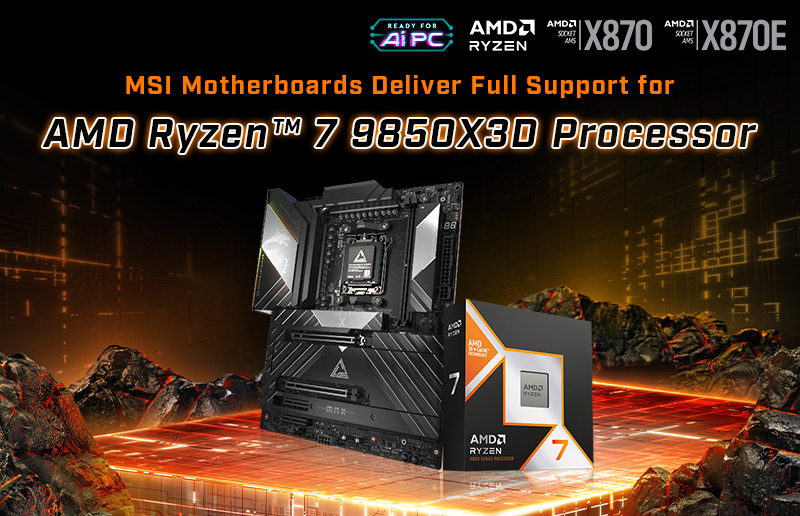
The chip maintains compatibility with the AM5 socket, which AMD has committed to supporting for at least another year. This provides users with a wide selection of motherboards and cooling solutions. During review testing, the processor was paired with an Asus ROG Crosshair X870E Hero motherboard, 32 GB of 6000 MHz G.Skill Trident Z5 Neo memory, and a Samsung 9100 Pro SSD, representing a balanced high-end gaming configuration.
Cooling and Overclocking
Thermal management remains a consideration with the 9850X3D, as with its predecessor. During demanding benchmarks, the chip operated between 79 and 80 degrees Celsius when cooled by a 360-mm Corsair Nautilus 360 RS AIO cooler. Under normal mixed usage, temperatures ranged from 59 to 65 degrees Celsius, indicating that most quality AIO coolers should adequately manage the heat output without triggering thermal throttling.
One of the standout features of AMD's recent processors has been the accessibility of overclocking through Ryzen Master software. The 9850X3D continues this tradition with a user-friendly interface that guides even inexperienced users through the process. The software offers automatic optimization, multiple presets, full manual control, and profile sharing capabilities, making it more approachable than competing solutions like Intel's XTU.
Performance Analysis
Synthetic benchmark results show the expected minor improvements. In Cinebench R23 single-core testing, the 9850X3D scored 2,240 compared to the 9800X3D's 2,138—approximately a 5 percent increase. Multi-core performance was virtually identical, with scores of 22,982 and 22,972 respectively, confirming the chips' fundamental similarity.
Gaming performance tells a more nuanced story. When paired with an Nvidia RTX 5080 Founders Edition graphics card, differences in actual gameplay were minimal. In Cyberpunk 2077 at 1440p with ultra settings and ray tracing enabled (but path tracing disabled), the 9850X3D delivered 71.19 FPS compared to the 9800X3D's 69.61 FPS—a difference of less than 2 percent. Other demanding titles including Marvel Rivals, Arc Raiders, and Counter-Strike 2 showed similarly negligible differences, typically amounting to 3-4 FPS when already exceeding 120 FPS.

Purchase Considerations
For current owners of the Ryzen 7 9800X3D, there's little justification for upgrading to the 9850X3D. The performance differences are too minor to be noticeable during actual gameplay. However, for those building new systems or upgrading from older processors, the decision comes down to pricing and availability.
At launch, the 9850X3D carries a modest $30 premium over the 9800X3D's $470 price point. When both are available at retail prices, the newer chip represents the better value. However, discounts or bundled games with the 9800X3D could easily tip the scales in favor of the older model. Both processors deliver exceptional 1440p gaming performance at high refresh rates when paired with appropriate high-end graphics cards.
The Ryzen 7 9850X3D successfully maintains AMD's position in the high-end gaming CPU market, though it represents evolution rather than revolution. Its continued support for the AM5 platform, accessible overclocking tools, and proven gaming performance make it a compelling option for new system builders, while existing 9800X3D owners can confidently stick with their current processors without missing meaningful performance gains.