Read on the Guardian
NSW Premier Seeks 'Extraordinary Powers' to Ban Protests, Linking Gaza Rallies to Bondi Terror Attack
New South Wales Premier Chris Minns has announced plans to seek unprecedented legislative powers to effectively ban protests for up to three months, directly linking recent pro-Palestine demonstrations to the Bondi terror attack that killed 15 people. The proposed 'public assembly restriction declaration' would allow police to prohibit gatherings in designated areas without judicial oversight, marking one of the most significant expansions of state power over protest rights in Australian history. The announcement has sparked immediate controversy, with civil liberties groups and protest organizers condemning the move as an opportunistic attack on democratic freedoms.
In a dramatic escalation of government response to recent social tensions, New South Wales Premier Chris Minns has proposed legislation granting his government unprecedented authority to restrict public assemblies for extended periods. The announcement comes in the wake of the devastating Bondi terror attack that claimed 15 lives, with Minns explicitly connecting the tragedy to previous mass demonstrations concerning the Gaza conflict. This move represents a significant shift in Australia's approach to balancing security concerns with democratic protest rights.

The Proposed Legislative Framework
The centerpiece of the government's proposal is what Minns describes as "extraordinary powers" that would fundamentally alter how protests are regulated in New South Wales. Under the planned legislation, when a terrorism designation is in place, police—with ministerial agreement—would gain authority to declare specific areas where public assemblies are restricted. According to The Guardian's reporting, these restrictions could apply to "any part of the state or all over the state" and would last for up to three months.
Perhaps most controversially, the proposed framework would strip the judiciary of oversight authority. "No public assemblies in a designated area will be able to be authorised, including by a court," Minns stated during his announcement. This represents a departure from traditional Australian legal principles where courts typically serve as arbiters of protest restrictions. The premier acknowledged the unprecedented nature of these powers, noting they are "not seen before in any jurisdiction in the country."
Connecting Protests to Terrorism
The political justification for these sweeping measures centers on Minns' explicit linking of pro-Palestine demonstrations to the Bondi attack. "When you see people marching and showing violent bloody images, images of death and destruction, it's unleashing something in our community that the organisers of the protest can't contain," Minns argued. He further stated that "the implications can be seen, in my view, on Sunday," directly referencing the Bondi tragedy.
This connection has been met with fierce criticism from multiple quarters. Josh Lees, a spokesperson for the Palestine Action Group, accused Minns of "a series of completely untrue and divisive accusations" and claimed the premier was "seeking to blame the mass movement against what the United Nations has confirmed is a genocide in Gaza for the horrific Bondi attack." The group emphasized that their movement "has always stood against antisemitism" and noted they have no protests currently planned.
Political and Community Reactions
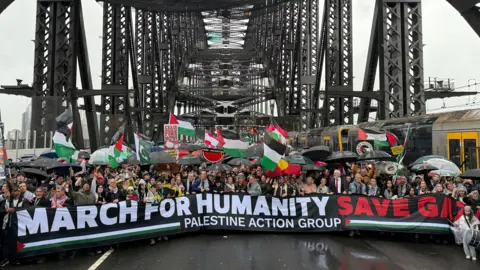
The proposal has exposed significant divisions within both the political establishment and affected communities. Notably, several Labor MPs—including Penny Sharpe, the leader of the government in the upper house—were among the estimated 225,000 to 300,000 people who participated in the August march across Sydney Harbour Bridge that Minns has specifically referenced. When questioned about his colleagues' participation, Minns responded that his concern is "Sydney right now," while acknowledging people have "genuine concerns about issues that are happening around the world."
Jewish community responses have been mixed. David Ossip, president of the NSW Jewish Board of Deputies, supported stronger measures, stating that "for two years, people have paraded in our streets and universities calling for the intifada to be globalised" and that "last night, the intifada was globalised and came to Bondi." However, Jewish Voices of Inner Sydney member Jesse McNicoll called it "outrageous" that community pain could be used to shut down a movement "opposing genocide," while Max Kaiser of the Jewish Council of Australia questioned the focus on pro-Palestine movements when "there exists very real sources of antisemitism on the far right."
Legal and Civil Liberties Concerns
Civil liberties organizations have raised alarm about the proposed legislation's implications for democratic rights. Tim Roberts, president of the NSW Council for Civil Liberties, stated that the changes represent "far too broad powers for the police commissioner" and that "the premier is wrong to disgracefully link years of peaceful protest to such a horrific and unrelated event."
The legislation would operate through a "public assembly restriction declaration" (PARD) power within a broader terrorism and other legislation amendment bill. According to Guardian Australia's understanding, a PARD could be made within 14 days of a terrorism designation if a public assembly would "cause fear of harassment, intimidation or violence, or cause a risk to community safety." The legislation reportedly includes a carve-out for industrial disputes but otherwise provides broad discretion to authorities.

Political Context and Next Steps
The proposal emerges amid broader national conversations about hate speech and community safety following the Bondi attack. Federal Labor MP Ed Husic, who was among those participating in the August bridge protest, has been a vocal critic of the government's approach to the Gaza conflict. Meanwhile, NSW Opposition Leader Kellie Sloane indicated the Coalition is "broadly willing to work in a bipartisan manner with the government," suggesting the legislation may receive cross-party support.
Minns has emphasized that the changes are "not directed at any one group," though his specific references to the bridge protest and pro-Palestine demonstrations have led many to question this assertion. The premier noted that he "opposed" the bridge protest, that "police opposed it," and that he "made it clear it wasn't consistent with community harmony."
As New South Wales grapples with the aftermath of the Bondi tragedy, the proposed legislation represents a potentially transformative moment in Australian democracy. The balance between security concerns and protest rights has shifted dramatically, with implications that extend far beyond current geopolitical conflicts. The coming parliamentary debate will determine whether these "extraordinary powers" become law and establish a new precedent for how Australia manages dissent during times of crisis.