Breakthrough Simulations Reveal the True Nature of Black Hole Accretion
A landmark study from the Institute for Advanced Study and the Flatiron Institute has produced the most detailed and complete simulations of black hole accretion to date. By solving the full equations of general relativity and radiation transport without approximations, researchers have created models that closely match real astronomical observations. This breakthrough reveals the chaotic, glowing disks and powerful outflows of matter falling into black holes, offering unprecedented insight into how these cosmic engines operate and opening a new window into extreme astrophysical environments.
For decades, the violent, luminous regions surrounding black holes have been shrouded in mystery, their extreme physics defying complete computational modeling. Now, a major turning point has been reached. Astrophysicists have unveiled the most realistic simulations ever created of luminous black hole accretion—the process by which black holes pull in and consume surrounding matter. This achievement, detailed in a new study published in The Astrophysical Journal, marks the first time such calculations have been performed in full general relativity under radiation-dominated conditions, offering a transformative view of these cosmic powerhouses.

The Computational Breakthrough: Beyond Simplifying Assumptions
Previous attempts to model black hole accretion relied on necessary but limiting approximations. To make the extraordinarily complex calculations manageable, earlier simulations often treated radiation as a simplified fluid, an approach that did not reflect its true behavior in the warped spacetime near a black hole. The new research, led by scientists from the Institute for Advanced Study and the Flatiron Institute's Center for Computational Astrophysics, discarded these shortcuts.
"This is the first time we've been able to see what happens when the most important physical processes in black hole accretion are included accurately," said lead author Lizhong Zhang. The team developed novel algorithms capable of solving the full equations governing Einstein's gravity and radiation transport simultaneously. "Ours is the only algorithm that exists at the moment that provides a solution by treating radiation as it really is in general relativity," Zhang explained. This allows the simulation to track how intense radiation moves through curved spacetime and interacts with infalling gas—a combination of effects previously out of reach.
What the Simulations Reveal
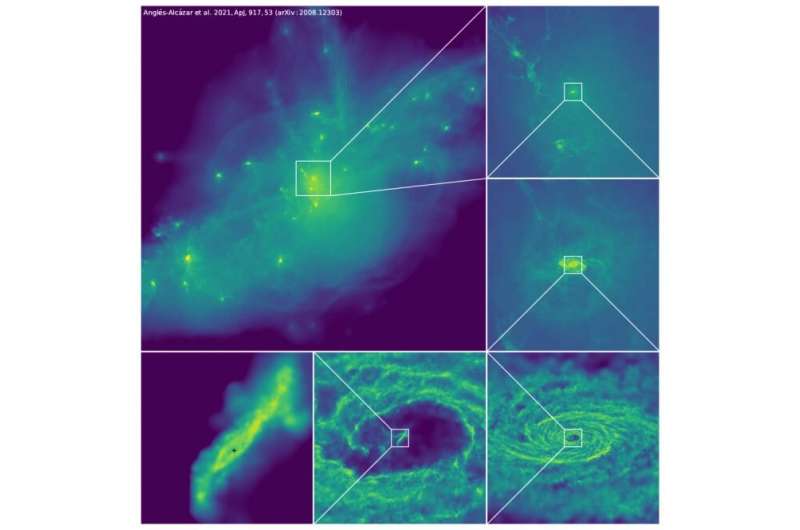
The new models focus on stellar-mass black holes, objects roughly ten times the mass of our Sun. As matter spirals inward, the simulations show it forming a turbulent, radiation-dominated accretion disk. The structure is complex: a dense, thin thermal disk is embedded within a magnetically dominated envelope that helps stabilize the entire system. Despite the highly chaotic and violent environment, this thermal disk remains remarkably stable.

Beyond the disk, the models capture the launch of powerful outflows. The simulations show strong winds flowing outward and, in some cases, the formation of focused jets of material blasted away at near-light speed. Crucially, the simulated spectra of light emitted from these systems show a strong agreement with actual observations from telescopes. This match between simulation and reality gives astronomers a powerful new tool to interpret the light from distant black holes and understand the physics driving their behavior.
The Engine Behind the Discovery: Exascale Supercomputing
This computational feat was only possible by harnessing some of the world's most powerful supercomputers. The research team was granted access to the exascale machines Frontier at Oak Ridge National Laboratory and Aurora at Argonne National Laboratory. These systems, capable of a quintillion calculations per second, provided the raw power needed to solve the unprecedentedly complex equations.
The software backbone was equally critical. Researchers integrated a new radiation transport algorithm into the AthenaK code, a platform optimized for these massive exascale systems. This continues a long tradition of computational advancement at the Institute for Advanced Study, hearkening back to the pioneering Electronic Computer Project led by John von Neumann.
The Path Forward for Black Hole Science
This study is the first in a planned series that will apply the new computational framework to different black hole systems. The immediate success with stellar-mass black holes paves the way for exploring supermassive black holes, like Sagittarius A* at our galaxy's center, which play a fundamental role in galactic evolution.
"Now the task is to understand all the science that is coming out of it," said co-author James Stone, Professor at the Institute for Advanced Study. Future work will refine how radiation interacts with matter across a broader range of conditions and test the universality of the models. By providing a reliable digital laboratory, these simulations will help decode the remaining mysteries of accretion, from the dynamics of jets to the variability in light output observed by astronomers.
In essence, scientists have built a new kind of observatory—not one that collects light from the cosmos, but one that generates it from first principles within a supercomputer. This breakthrough simulation doesn't just show what happens near a black hole; it provides a fundamental new lens through which to understand the universe's most extreme environments.