Hidden Carbon Pathway: How Orchids Use Wood-Decaying Fungi for Germination
Kobe University researchers have uncovered a remarkable ecological relationship where orchids rely exclusively on wood-decaying fungi to germinate and grow. Their study reveals that orchid seedlings only develop near decaying logs, forming precise fungal partnerships that provide essential carbon from rotting wood. This discovery not only explains the evolution of fully fungus-dependent orchid species but also reveals a previously unknown carbon pathway in forest ecosystems, highlighting the critical role of deadwood in supporting new plant life.
In a groundbreaking discovery that reshapes our understanding of forest ecology, researchers from Kobe University have revealed how orchids depend on wood-decaying fungi for their very survival. This intricate relationship, where tiny orchid seeds germinate exclusively near decaying logs, represents a hidden carbon pathway that sustains some of nature's most delicate and beautiful plants.

The Challenge of Orchid Germination
Orchid seeds present one of nature's most challenging germination scenarios. These microscopic seeds, often no larger than dust particles, contain virtually no nutritional reserves to support the young plant's growth. For decades, scientists have understood that adult orchids form symbiotic relationships with fungi through specialized root structures, but the mystery of how these tiny seeds successfully germinate in nature remained largely unsolved.
As Kobe University plant evolutionary ecologist Kenji Suetsugu explains, studying orchid germination in natural settings has been notoriously difficult due to the painstaking methods required to recover seedlings from soil. Most previous research focused exclusively on adult orchid roots, where fungi are more easily sampled and studied.
The Deadwood Connection
During extensive fieldwork, Suetsugu's research team observed a consistent and intriguing pattern that would eventually lead to their breakthrough discovery. They repeatedly found both orchid seedlings and adults with juvenile root structures clustered near decaying logs rather than randomly distributed throughout the forest. This recurring observation inspired the hypothesis that deadwood fungi might be fueling orchid beginnings.
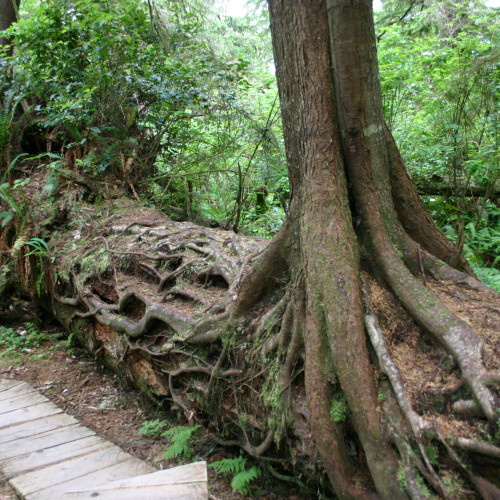
The research, published in Functional Ecology, demonstrated that among seeds from four model orchid species buried in various forest locations, germination occurred exclusively near decaying logs. The seedlings formed virtually exclusive associations with wood-decaying fungi, creating precise partnerships that mirrored those found in adult orchids with coral-shaped rhizomes.
Evolutionary Implications
This discovery provides crucial insights into the evolutionary pathways that led to fully mycoheterotrophic orchid species—plants that have abandoned photosynthesis entirely and rely on fungi for nutrition throughout their entire lifecycle. The propensity of certain orchids to maintain associations with wood-decaying fungi into adulthood likely facilitated the evolution of these completely fungus-dependent species.
As Suetsugu notes, the research reveals that deadwood is not dead but rather a cradle of new life, supporting the establishment of seedlings on dark forest floors where light penetration is limited. This hidden carbon route from deadwood to green plants represents an important ecological process that had previously gone unrecognized.
Conservation and Ecological Significance
The findings carry significant implications for both conservation efforts and ecological science. For conservation, the research demonstrates that protecting wild orchids is inseparable from protecting deadwood and its associated fungal communities. The removal of decaying logs from forest ecosystems could disrupt these delicate relationships and threaten orchid survival.
Ecologically, the discovery uncovers an important carbon flux within forest ecosystems. As woody debris represents a major carbon source in forests, associations with wood-decaying fungi may enhance carbon acquisition, particularly in warm, humid habitats where decomposition processes are most active. This research fundamentally changes our understanding of how carbon moves through forest systems and supports plant diversity.
The Kobe University study not only closes a critical gap in our understanding of wild orchid ecology but also highlights the complex interdependencies that sustain forest biodiversity. By revealing how orchids tap into the carbon resources of decaying wood through specialized fungal partnerships, this research underscores the importance of preserving entire ecosystem components—from the largest decaying logs to the smallest fungal networks—to maintain the rich tapestry of forest life.