Hubble's Stunning View of NGC 6000: A Galaxy of Blue and Gold
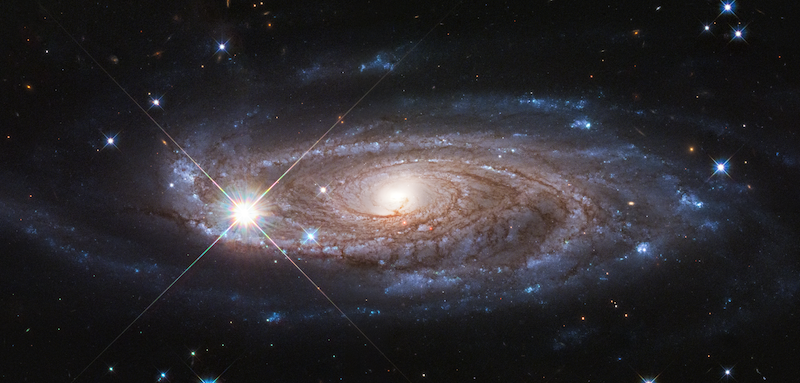
The Hubble Space Telescope has captured a breathtaking image of spiral galaxy NGC 6000, located 102 million light-years away in the constellation Scorpius. This stunning cosmic portrait reveals a galaxy glowing with blue newborn stars alongside golden, aging ones, creating a vivid color contrast that tells the story of stellar evolution. The image also captures the faint glow of ancient supernova remnants and features an unexpected photobomb from a passing asteroid, providing a unique snapshot of cosmic beauty and chance encounters in space exploration.
The Hubble Space Telescope continues to deliver extraordinary views of our universe, with its latest capture of spiral galaxy NGC 6000 standing as a testament to cosmic beauty and scientific discovery. Located 102 million light-years away in the constellation Scorpius, this galaxy presents a stunning visual narrative of stellar life cycles through its contrasting colors and features.
The Colorful Story of Stellar Evolution
NGC 6000 displays a remarkable color contrast that reveals the different stages of stellar evolution within the galaxy. The glowing yellow center contains older, smaller stars that have aged over time, while the brilliant blue outskirts feature young, massive stars in star clusters along the spiral arms. This color differentiation reflects fundamental astrophysical principles: cooler stars appear redder, while hotter, more massive stars shine with distinctive blue hues.
Supernova Remnants and Scientific Value
Beyond the visual spectacle, NGC 6000 holds significant scientific interest due to its history of supernova events. The galaxy has hosted two recent supernovae: SN 2007ch in 2007 and SN 2010as in 2010. Hubble's sensitive detectors can discern the faint glow of these supernova remnants years after the initial explosions, providing valuable data for researchers studying the masses of progenitor stars and potential stellar companions.
An Unexpected Cosmic Photobomb
Adding to the image's uniqueness, a passing asteroid from our Solar System drifted across Hubble's field of view during observations, creating four distinct yellow and blue streaks in the final composite. These streaks result from different exposures recorded sequentially with slight pauses, combined to create the final image. The separate exposures, each using specific wavelength filters, make such asteroid interlopers particularly obvious while enabling detailed stellar color analysis.
This celestial photobomb serves as a reminder of the dynamic nature of space observation and the unexpected discoveries that can emerge from routine scientific data collection. The combination of planned galactic observation and chance asteroid encounter creates a comprehensive snapshot of cosmic activity at multiple scales.

The NGC 6000 observation was part of Hubble's broader survey of recent supernova explosion sites in nearby galaxies. This ongoing research helps constrain our understanding of stellar life cycles and contributes to the broader mapping of cosmic phenomena. The ability to study such distant galaxies in detail demonstrates the continuing value of space-based telescopes in expanding our knowledge of the universe.
As Hubble continues its mission, images like this of NGC 6000 not only provide scientific data but also inspire wonder about the vast, beautiful cosmos we inhabit. They remind us that even in the systematic pursuit of scientific knowledge, there's always room for unexpected beauty and chance encounters that enrich our understanding of the universe.