How Easter Island's Moai Statues 'Walked' Across the Island
New research from Binghamton University has confirmed how the ancient Rapa Nui people moved their massive moai statues across Easter Island. Through 3D modeling and field experiments, scientists demonstrated that the iconic statues were 'walked' upright using a rocking motion with ropes and surprisingly few people. The study reveals how distinctive design features like forward-leaning posture and curved bases made this efficient transport method possible, celebrating the remarkable engineering intelligence of the ancient islanders.
For centuries, the mystery of how the massive moai statues were transported across Easter Island has captivated archaeologists and historians alike. Now, groundbreaking research from Binghamton University has provided definitive evidence that these iconic stone figures were literally 'walked' to their ceremonial platforms using an ingenious rocking motion method.
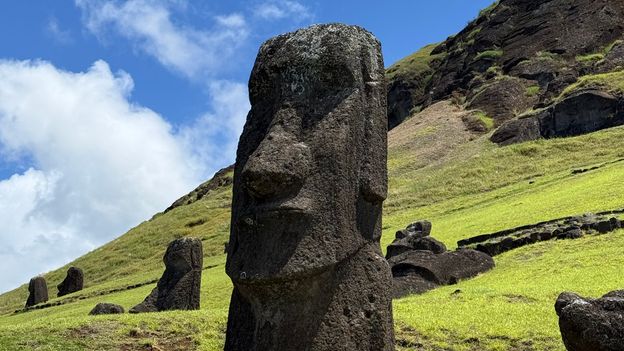
The Walking Moai Hypothesis
Led by Professor Carl Lipo of Binghamton University, the research team combined physics, advanced 3D modeling, and practical field experiments to validate the walking hypothesis. Their findings, published in the Journal of Archaeological Science, demonstrate that the moai were moved upright rather than lying prone on wooden devices as some previous theories suggested.
The research involved studying nearly 1,000 moai statues and creating high-resolution 3D models that revealed crucial design features. The statues' wide D-shaped bases and distinctive forward lean were specifically engineered to facilitate the rocking motion required for upright transport.

Experimental Validation
To test their theory, the team constructed a 4.35-ton replica moai with the characteristic forward-leaning design. Remarkably, with just 18 people using ropes, they were able to transport the massive statue 100 meters in only 40 minutes. This represented a significant improvement over previous vertical transport attempts and demonstrated the efficiency of the walking method.
Professor Lipo explained the process: "Once you get it moving, it isn't hard at all - people are pulling with one arm. It conserves energy, and it moves really quickly. The hard part is getting it rocking in the first place."
Engineering Intelligence
The research reveals the sophisticated engineering knowledge possessed by the Rapa Nui people. The concave roads measuring 4.5 meters wide across the island were specifically designed to stabilize the statues during transport. These roads weren't just pathways but integral components of the moving process.
"Every time they're moving a statue, it looks like they're making a road. The road is part of moving the statue," Lipo noted. "We actually see them overlapping each other, and many parallel versions of them. What they are probably doing is clearing a path, moving it, clearing another, clearing it further, and moving it right in certain sequences."

Scientific Validation and Legacy
The research represents a significant advancement in archaeological methodology by combining theoretical modeling with practical experimentation. Lipo emphasized that this approach contrasts with previous speculation about Rapa Nui that lacked scientific validation.
Most importantly, the findings honor the intelligence and resourcefulness of the Rapa Nui people. "It shows that the Rapa Nui people were incredibly smart. They figured this out," said Lipo. "They're doing it the way that's consistent with the resources they have. So it really gives honor to those people, saying, look at what they were able to achieve, and we have a lot to learn from them in these principles."
The study not only solves a 500-year-old mystery but also provides valuable insights into ancient engineering principles that continue to inform modern understanding of resource management and monumental construction techniques.