The Tangled Future: A New Material That Transforms from Strong to Soft in Seconds
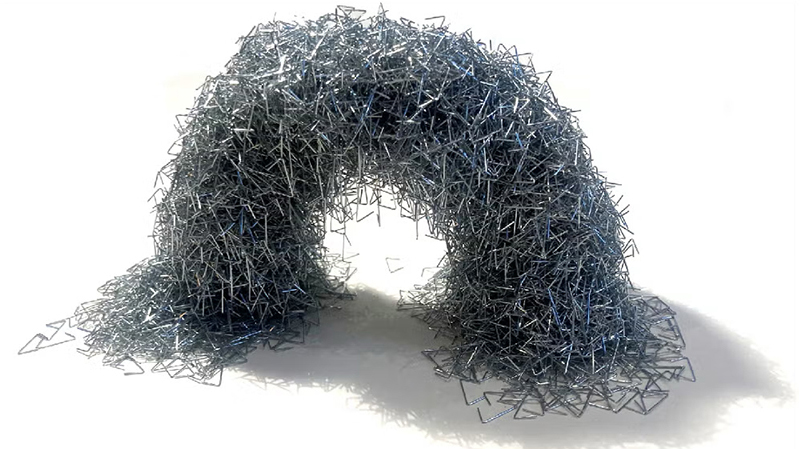
Inspired by the humble office staple, engineers at the University of Colorado Boulder have developed a new class of material that can switch between a rigid, solid-like state and a loose, easily separable collection of particles. This breakthrough relies on staple-shaped particles that physically entangle under gentle vibration, creating high strength and toughness simultaneously. By applying stronger vibrations, the entanglement reverses, allowing the material to fall apart rapidly. Potential applications include reconfigurable buildings, recyclable construction, and even swarm robotics where small units combine to perform tasks. The research, published in the Journal of Applied Physics, points toward a future where materials are not only stronger but also more adaptable and sustainable. This article explores the science behind entanglement, how particle shape drives this behavior, and the exciting possibilities for engineering and robotics.
Imagine a bridge that can be dismantled instantly and the same material reused for a new structure, or a swarm of tiny robots that link together to form a solid object, then separate when the task is done. This vision is moving closer to reality thanks to researchers at the University of Colorado Boulder, who have developed a material made from staple-shaped particles that can switch between being remarkably strong and falling apart in seconds.

This remarkable behavior, detailed in the Journal of Applied Physics, is a result of entanglement—a physical interlocking of particles that mimics the way twigs hold together a bird's nest. Unlike conventional materials, this new class of "entangled granular material" can be rapidly assembled and disassembled, offering a unique combination of properties that could revolutionize construction, robotics, and beyond.
The Science of Entanglement
Entanglement is a common phenomenon in nature. Bird nests, for example, rely on a network of interwoven twigs and fibers to maintain their structure. Bones also gain strength through the interaction of hard mineral components and softer proteins. The CU Boulder team wanted to understand how similar principles could be used to create manufactured materials. Their research, led by Professor Francois Barthelat, points to one crucial factor: the shape of the particles themselves.
"Let's take sand as an example. Sand is smooth and convex-shaped, meaning it cannot interlock from grain to grain," PhD student Youhan Sohn said. "However, we found that if we change the shape of a grain of sand, we can drastically affect its behavior and mechanical properties, including the particle's ability to link with other particles."

To investigate further, the researchers used Monte Carlo simulations, a computational technique that allowed them to study how different particle shapes interact. Their objective was to identify a geometry that would maximize entanglement. After identifying promising designs through simulation, the team conducted pickup tests to observe how the particles behaved in real-world conditions. The results revealed that a "two-legged" particle, resembling a staple, produced the highest degree of entanglement.
Key Properties: Strength and Toughness Combined
The staple-like particles offered several unexpected benefits. One of the most notable was their ability to combine tensile strength and toughness—two properties that are often difficult to achieve together in conventional materials. Typically, strong materials are brittle, and tough materials are weaker. This new material breaks that trade-off.
"Our entangled granular material using the staple-like particle demonstrates both high strength and toughness at the same time," said PhD student Saeed Pezeshki.
This combination opens the door for use in structural applications where both properties are critical. By applying different vibration patterns, the researchers were able to control how strongly the particles became entangled. Gentle vibrations encouraged the particles to interlock and strengthen the material, while stronger vibrations caused the network to unravel.
Potential Applications in Construction and Robotics
The researchers believe the technology could eventually support more sustainable approaches to construction. In the future, bridges, buildings, and other large structures might be built using entangled materials that can later be taken apart rather than demolished. Such materials could potentially be reused or fully recycled at the end of their service life.
The concept may also have applications in robotics. Swarm robotics, where small robots cooperate to accomplish tasks, could benefit from the ability to entangle and form larger, stronger structures when needed. As Pezeshki noted, "I was talking with other students who believe this technology can be used in swarm robotics—where small robots can entangle, do a task and then disentangle when they are done."
Professor Barthelat drew an even more futuristic parallel: "Yes, kind of like that liquid metal T-1000 in Terminator 2 who can change shape to slide under a door and then transform back to a human's size on the other side. It's expensive and scaling up is a challenge, but it's something that's on everybody's mind."
Next Steps: Even Stronger Entanglement
The team is now moving into the next stage of the research. Their latest experiments focus on a new particle design that includes additional protruding "legs." The researchers compare the shape to the spiky burrs that cling stubbornly to shoes and clothing outdoors. They believe these added features could create even stronger entanglement effects and unlock new possibilities for future materials.
This research is a clear step toward a new generation of adaptive, recyclable materials that could fundamentally change how we build and interact with the physical world. By taking inspiration from everyday objects like staples and burrs, scientists are proving that the future of materials is not just about stronger alloys or lighter composites, but about smart, reconfigurable structures that can adapt to our needs and then disappear when their job is done.