Strange New Material Can Become Strong or Fall Apart in Seconds
Researchers at the University of Colorado Boulder have developed a remarkable new material inspired by tangled staples. Composed of staple-shaped particles, this material can be locked into a sturdy, strong structure or rapidly unraveled into a loose collection of individual pieces using specific vibrations. This unique combination of high strength and reversibility could revolutionize construction, enabling recyclable buildings and reconfigurable structures, and may also find applications in futuristic swarm robotics. The findings, published in the Journal of Applied Physics, highlight how particle geometry, particularly a two-legged staple shape, maximizes entanglement to create a material that is simultaneously strong and tough.
Scientists at the University of Colorado Boulder have unveiled a groundbreaking material that can transition from a strong, solid-like state to a loose, disassembled collection in seconds. Inspired by the way office staples tangle together, this new material relies on the geometry of its constituent particles to achieve a unique combination of strength and reversibility, opening the door to applications in sustainable construction and advanced robotics.
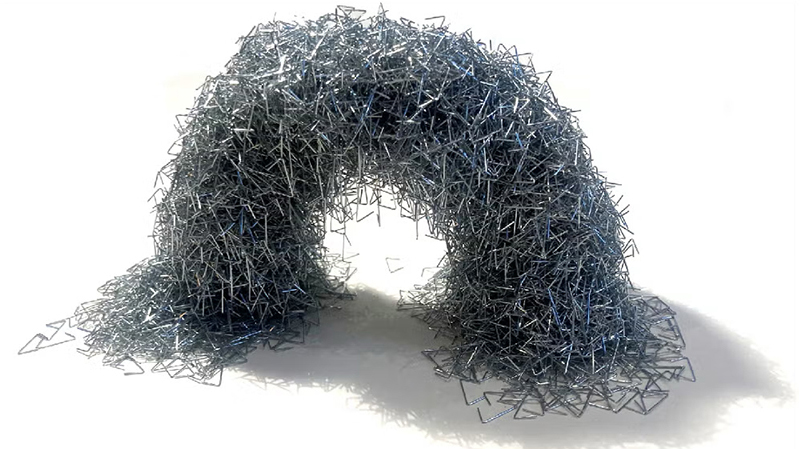
At the heart of this innovation is the phenomenon of entanglement. While common in nature—from bird nests to the structure of bones—entanglement in manufactured materials has been difficult to control. The CU Boulder team, led by Professor Francois Barthelat, focused on how the shape of individual particles influences their ability to interlock. Unlike smooth, convex grains of sand that cannot link together, a two-legged, staple-shaped particle was found to produce the highest degree of entanglement.
How Entanglement Creates Strength
Using Monte Carlo simulations and real-world pickup tests, the researchers discovered that the staple-like particles could be coaxed into a strong, interconnected network. Gentle vibrations encourage the particles to interlock, creating a material that is both strong and tough—properties that are typically difficult to achieve together. "Our entangled granular material using the staple-like particle demonstrates both high strength and toughness at the same time," said PhD student Saeed Pezeshki. This behavior is a direct result of the particles' geometry, which allows them to form multiple connections with their neighbors.
Controlling the Reversible Process
A key breakthrough was the ability to control the material's state using vibrations. Gentle vibrations promote entanglement and strengthen the mass, while stronger vibrations cause the network to unravel, returning the particles to a loose, individual state. This rapid reversibility distinguishes the material from conventional solids. As Professor Barthelat explains, "It's a strange material because it's obviously not a liquid. However, it's also not quite solid. This opens new and intriguing engineering possibilities."
Potential Applications in Construction and Robotics
The technology could revolutionize construction by enabling structures that are assembled and later disassembled without demolition. Bridges or buildings made from such entangled materials could be recycled or reused, reducing waste. In robotics, the concept could lead to swarm robots that temporarily entangle to perform a task and then separate. "I was talking with other students who believe this technology can be used in swarm robotics—where small robots can entangle, do a task, and then disentangle when they are done," said Pezeshki. Barthelat jokingly compared the material to the shape-shifting T-1000 robot from Terminator 2, noting the potential for reconfigurable structures.
Future Research and Stronger Designs
The team is now exploring particle designs with additional protruding legs, inspired by burrs that cling stubbornly to clothing. These spiky shapes could create even stronger entanglement. The research, published in the Journal of Applied Physics, represents a significant step toward materials that combine strength, flexibility, and recyclability. As the team continues to refine particle geometries, the potential for truly adaptable and sustainable materials grows ever closer.
Read the original study at ScienceDaily.