Read on foxsports.com
Navigating the Unique Challenges of the Acura Grand Prix of Long Beach
The Acura Grand Prix of Long Beach stands as one of the most prestigious and challenging events on the INDYCAR calendar. As a premier street circuit, it presents drivers with a unique combination of elevation changes, critical curb strikes, and complex corner geometry not found elsewhere. This analysis, drawing from expert insights by former winner James Hinchcliffe, breaks down the specific elements that make Long Beach a driver's favorite and a fan spectacle, from the physics of its hills to the strategic use of push-to-pass.
The Acura Grand Prix of Long Beach is more than just a race; it's a cornerstone of American motorsport. Held on the streets of Southern California, this event combines decades of history with a uniquely demanding circuit that tests every facet of a driver's skill. As six-time INDYCAR winner and analyst James Hinchcliffe notes, after the Indianapolis 500, it ranks among the races drivers most want to win, thanks to its incredible atmosphere and the distinct technical challenges of its 11-turn layout. For fans and aspiring experts alike, understanding what makes this track special provides a deeper appreciation for the spectacle.

The Distinctive Terrain of a Street Circuit
Unlike purpose-built road courses, street circuits are defined by their environment, and Long Beach leverages its urban landscape to create a distinctive driving experience. The most immediate challenge is elevation change, a rarity on street tracks typically confined to flat city grids.
Roller-Coaster Physics
The section from Turn 4 through Turn 8 acts as a mechanical roller coaster. As Hinchcliffe explains, exiting Turn 4, the track falls away, unsettling the car's front end and pushing drivers toward the outside wall. The subsequent climb into the braking zone for Turn 5 introduces a different dynamic: gravity assists braking, meaning drivers must recalibrate their usual pressure points to avoid stopping too early. The challenge compounds at Turn 6, where a sharp downhill entry makes the car resistant to slowing down, a common trap that leads to running wide.

Mastering the Critical Details
Success at Long Beach hinges on precision. Two elements stand out: the strategic use of curbs and the unconventional corner shapes that define the circuit's character.
The Art of the Curb Strike
Where most street curbs are to be avoided, Long Beach features key "curb-strike" opportunities at Turns 1 and 5. Hitting the Turn 5 curb correctly is a delicate balance. As Hinchcliffe details, too little contact fails to rotate the car enough, while too much causes the chassis to bottom out and lift the tires, both scenarios ending with a meeting with the wall. This precision becomes exponentially harder on cold or worn tires, separating the consistent front-runners from the rest.
Unconventional Corner Geometry
Freed from the strict 90-degree confines of many city streets, Long Beach boasts flowing corners like the 2-3 complex and Turn 10. However, its most famous corner is also its slowest: the Turn 11 hairpin. Taken at roughly 30 mph, it is the slowest corner on the entire INDYCAR calendar, slower than pit lane speed. For machines built for 230 mph, navigating this tight, slow corner is an unnatural and physically demanding task, adding to the track's unique character.
Strategic Warfare: The Push-to-Pass System
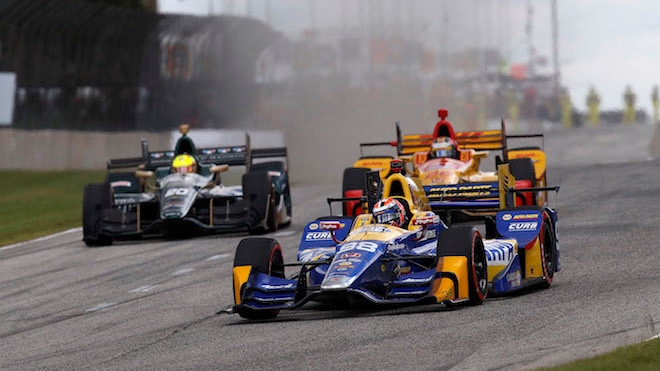
On a track where overtaking opportunities are limited, strategic use of the push-to-pass (P2P) system is paramount. Drivers have a finite 200 seconds of extra power per race, making its deployment a high-stakes tactical decision.
The classic use is for overtaking, with the long run from Turn 11 to Turn 1 being the prime opportunity. However, savvy drivers conserve this resource for other critical moments. Using P2P during in-laps and out-laps of green-flag pit stops can gain significant track position. It's also a vital tool for defense against an attacking car or for a final sprint after a late-race restart. The system works by increasing the engine's rev limit from 12,000 to 12,200 rpm and boosting turbo pressure, delivering an extra ~50 horsepower. The discipline to not use this tempting button is a key component of race strategy.
A Legacy Forged in Long Beach
The race's stature is inextricably linked to the people who built it. The recent passing of Jim Michaelian, the long-time President and CEO of the Grand Prix Association of Long Beach, marks the end of an era. As Hinchcliffe honors, Michaelian's over 50 years of dedication were instrumental in shaping the event's world-class status, atmosphere, and connection to the community. His legacy ensures that the race remains a highlight, challenging drivers and thrilling fans for generations to come.
In conclusion, the Acura Grand Prix of Long Beach earns its place as a crown jewel of INDYCAR through a perfect storm of history, atmosphere, and unique racing challenge. From its punishing elevation changes and precise curb strikes to the strategic battle over push-to-pass, it demands more from drivers than a typical street circuit. For the viewer, understanding these nuances transforms the race from a simple procession of cars into a high-speed chess match on one of motorsport's most distinctive stages.