SOHO at 30: The Solar Mission That Survived Disaster and Revolutionized Our View of the Sun
For three decades, the ESA/NASA Solar and Heliospheric Observatory (SOHO) has defied expectations from its stable perch 1.5 million kilometers from Earth. Originally planned for just two years, this resilient spacecraft has survived critical failures to deliver an unprecedented, nearly unbroken record of solar activity across three 11-year cycles. Its legacy includes groundbreaking discoveries like the Sun's single global plasma conveyor belt, precise measurements of solar brightness variations, and its unexpected role as the most prolific comet-hunter in history, with over 5,000 discoveries. SOHO's data has fundamentally reshaped solar science, pioneered real-time space weather forecasting, and laid the groundwork for a new generation of solar observatories.
Launched on December 2, 1995, the ESA/NASA Solar and Heliospheric Observatory (SOHO) embarked on what was intended to be a brief, two-year mission to study our nearest star. Thirty years later, it stands as one of the longest-operating and most transformative space missions in history. From its unique vantage point at the Lagrange 1 point, 1.5 million kilometers from Earth towards the Sun, SOHO has provided an almost continuous view of solar activity, surviving near-fatal crises to become a cornerstone of modern heliophysics. Its enduring operation is a testament to international collaboration and engineering ingenuity, having observed nearly three full solar cycles and fundamentally altering our understanding of the Sun's inner workings, its influence on space weather, and even the population of comets in our solar system.

A Mission of Resilience and Longevity
SOHO's journey has been anything but smooth. Approximately two-and-a-half years after launch, the spacecraft experienced a catastrophic malfunction that sent it into an uncontrolled spin and severed all communications with Earth. For three tense months, an international team worked around the clock to locate the drifting observatory and miraculously restore contact. The challenges continued in late 1998 when its stabilizing gyroscopes failed. Engineers responded with innovative software that allowed SOHO to operate without them, a breakthrough achieved by February 1999. These triumphs over adversity, as noted by ESA Director of Science Prof. Carole Mundell, turned SOHO into a symbol of perseverance, allowing it to gather the long-term, consistent data that has proven invaluable.
Revolutionizing Solar Science
The mission's primary goal was to study the Sun, and its contributions here are profound. SOHO became a leading instrument for helioseismology, the study of sound waves traveling through the solar interior. This technique, analogous to using seismic waves to probe Earth's core, allowed scientists to map plasma flows beneath the solar surface for the first time. A major discovery from its long dataset, detailed in a 2025 paper in Nature Astronomy, is the confirmation of a single, global plasma conveyor belt in each solar hemisphere. Plasma completes this massive circuit roughly every 22 years—matching the Sun's magnetic cycle—which explains the migration of sunspots toward the equator during each solar cycle.
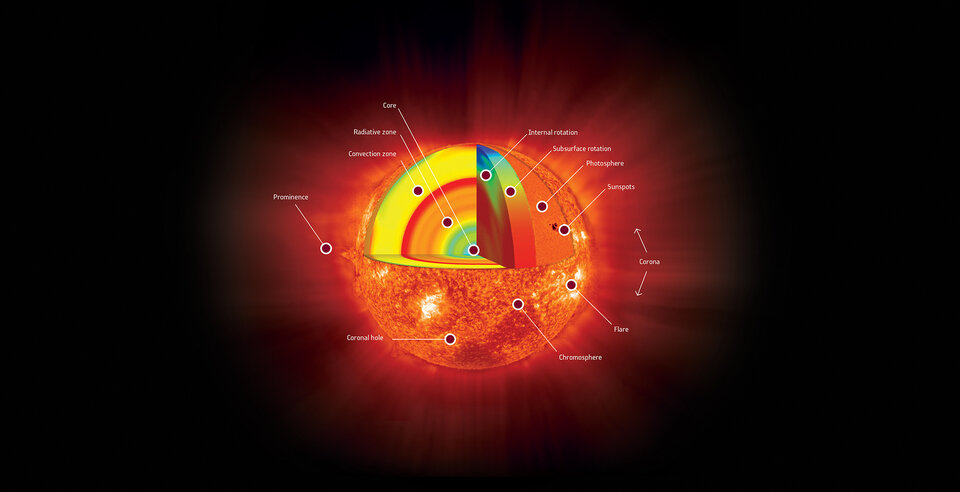
Furthermore, SOHO provided critical data on solar irradiance. By combining its observations with earlier records, scientists now have nearly fifty years of high-quality data. They found that while the Sun's total energy output varies by a mere 0.06% over a solar cycle, its extreme ultraviolet radiation can double. This finding is crucial for understanding the Sun's impact on Earth's upper atmosphere while clarifying that these cycles are not the driver of long-term surface climate warming.
The Accidental Comet Hunter and Space Weather Sentinel
In one of the most celebrated unplanned successes in space science, SOHO turned into the most prolific comet-discoverer in history. Its Large Angle and Spectrometric Coronagraph (LASCO) instrument, designed to study the Sun's outer atmosphere by blocking its direct light, serendipitously revealed thousands of "sungrazer" comets as they approached our star. In March 2024, SOHO discovered its 5,000th comet, with the majority found by dedicated citizen scientists through the Sungrazer Project. These observations have vastly expanded our knowledge of comet composition and behavior.
Simultaneously, SOHO's LASCO coronagraph became the workhorse for real-time space weather monitoring. It provides up to three days' warning of coronal mass ejections—massive eruptions of solar material—heading toward Earth. This capability is so vital that SOHO was specifically cited in the United States' PROSWIFT Act of 2020, legislation aimed at improving space weather forecasting and preparedness.

A Lasting Legacy for Future Exploration
SOHO's three-decade legacy extends far beyond its own instruments. It has directly influenced the design and objectives of a new generation of solar missions. The ESA-led Solar Orbiter, which images the solar poles from high latitudes, and NASA's Solar Dynamics Observatory, which continues full-disk solar monitoring, both carry advanced instruments that are direct successors to those on SOHO. The mission also routinely provides essential contextual data for NASA's Parker Solar Probe as it makes its daring close approaches to the Sun. The upcoming ESA Vigil mission, which will monitor the Sun from a side-on perspective to detect storms earlier, follows the operational paradigm SOHO helped establish. As ESA Project Scientist Daniel Müller stated, SOHO's science remains valuable and relevant, guiding solar science for decades to come.