Read on bbc.com
Black Rain and Unprecedented Pollution: The Environmental Fallout of Air Strikes on Tehran's Oil Facilities
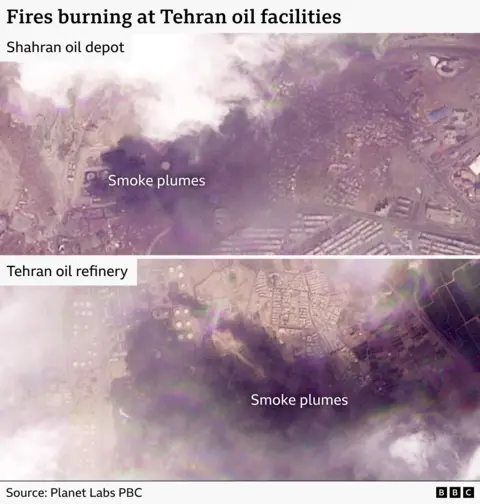
Since US-Israeli attacks on Iran began in late February, air strikes have damaged at least four major oil facilities around Tehran, creating an environmental crisis of unprecedented scale. Satellite imagery confirms ongoing fires at the Shahran oil depot and Tehran oil refinery, with smoke plumes blanketing the capital of nearly 10 million people. The resulting pollution has blocked sunlight, created a pervasive burning smell, and triggered reports of 'black rain'—rainfall contaminated with soot and chemicals. Experts warn the mix of pollutants released from damaged refineries poses serious immediate and long-term health risks to residents, with the World Health Organization expressing grave concerns about contamination of air, water, and food supplies in one of the most densely populated areas ever affected by such attacks.
The conflict between the United States, Israel, and Iran has escalated beyond military targets to create an environmental and public health crisis in Tehran. Since attacks began on 28 February, air strikes have damaged at least four major oil facilities around the Iranian capital, triggering fires that continue to burn and release dangerous pollutants into the atmosphere. This situation represents what atmospheric scientists describe as an unprecedented pollution event, with consequences that extend far beyond immediate military objectives.
The Scope of Damage to Tehran's Oil Infrastructure
BBC Verify analysis has confirmed strikes on multiple oil facilities surrounding Tehran, with the most significant damage occurring at the Shahran oil depot in northwest Tehran and the Tehran oil refinery in the southeast. Satellite images captured on 9 March show both facilities still on fire following reported air strikes overnight on Saturday, 8 March. Verified video footage from the moments after Saturday's strike showed massive fireballs illuminating the night sky at the refinery, indicating the intensity of the explosions.
The Israel Defense Forces acknowledged hitting "fuel depots" near Tehran in a 7 March social media post that included a photograph showing damage to the Tehran oil refinery. However, when BBC Verify provided coordinates of four identified locations for comment, the IDF stated there were "no IDF strikes at those sites," creating some ambiguity about responsibility for specific attacks. The Pentagon did not respond to requests for comment regarding the strikes.
Unprecedented Air Pollution Crisis
The environmental impact of these attacks has been immediate and severe. Residents report that smog and pollution have blocked out the sun in parts of Tehran, creating daytime conditions reminiscent of heavy overcast. A Tehran woman in her 20s told BBC Persian on Saturday that she could "smell the burning" caused by the attacks and noted, "I can't see the Sun. There is a horrible smoke. It's still there. I'm very tired."
Scientists emphasize that the pollution resulting from these attacks differs fundamentally from typical urban smog seen in cities like Beijing or Delhi. Dr. Akshay Deoras, research scientist at the University of Reading, explained that "what has happened [in Iran] is definitely unprecedented because it's all coming in from missiles dropping in and airstrikes on oil refineries." The combination of pollutants released represents what experts call an unusual "basket" of different chemicals rarely seen outside of catastrophic industrial accidents.

The Phenomenon of 'Black Rain'
On Sunday, 9 March, Tehran residents began reporting downpours of what they described as "black rain"—rainfall visibly contaminated with pollutants that turned the precipitation dark. This phenomenon occurs when raindrops act as "little sponges or magnets," collecting pollutants from the air as they fall, according to Dr. Deoras. Black rain typically results from exceptionally high levels of soot and other air pollutants being washed out of the atmosphere.
The occurrence of black rain indicates extreme pollution levels, as normal rainfall typically contains only minimal contaminants. Scientists note that some larger pollutant particles may have fallen out of the air even without rain, creating deposits on surfaces throughout affected areas. This represents a secondary contamination pathway beyond direct inhalation of polluted air.
Health Impacts and Environmental Concerns
The World Health Organization has expressed "great concerns" about the health impacts of the conflict, specifically noting that damage to oil facilities "risks contaminating food, water and air—hazards that can have severe health impacts especially on children, older people, and people with pre-existing medical conditions," according to Director-General Dr. Tedros Adhanom Ghebreyesus.
Professor Anna Hansell of the University of Leicester explained that "these very intense exposures of particulates have immediate impacts on the lungs" but warned they "can also have quite long lasting effects over many years afterwards, on both respiratory systems and increasing cancer risk." The unique danger in Tehran's situation stems from both the chemical mixture released and the population density exposed.
Doug Weir, director of the Conflict and Environment Observatory, noted that "what's unusual about Tehran is we haven't observed these attacks in such a densely populated area before." He added, "Often these oil field sites are quite far out in the countryside. People in Tehran are exposed to a huge range of substances in this black rain—not just oil."
Chemical Composition of the Pollution
Oil refinery fires release a complex mixture of hazardous substances that varies based on what materials are burning and combustion conditions. When incomplete burning occurs (due to insufficient oxygen), fires produce carbon monoxide and soot particles instead of the less harmful carbon dioxide and water. Oil fires can also release sulphur and nitrogen oxides, which can form acids if they dissolve in rainwater.
Additional hazardous substances released include various hydrocarbons, metallic compounds, and droplets of oil itself. Professor Eloise Marais of University College London noted that in most circumstances, this level and type of pollution would only be seen from "a very, very severe industrial accident where an entire refinery explodes." The scale of release from multiple facilities compounds the environmental impact.

Long-Term Environmental Consequences
While BBC Weather forecasts suggest rain and stronger winds in coming days that should help disperse and wash away some pollutants, this does not eliminate environmental risks. Pollutants washed from the air can enter rivers and other waterways, creating secondary contamination of water supplies. If pollutants settle on the ground and the surface dries, winds can resuspend them in the air, creating recurring exposure risks.
The contamination of soil and water systems represents a longer-term environmental challenge that may persist long after fires are extinguished. The specific chemical composition of the pollutants will determine their persistence in the environment and potential for bioaccumulation in food chains, though detailed analysis requires ground-based measurements currently unavailable due to the conflict situation.
Monitoring Challenges and Information Gaps
Assessing the full extent of pollution remains challenging because no ground-based air quality measurements are available from the affected areas. Satellite data provides some information but is difficult to interpret accurately due to factors like wind patterns, cloud cover, and the complex mixture of pollutants. The absence of real-time monitoring hampers both immediate response efforts and long-term health impact assessments.
This information gap complicates public health responses and makes it difficult to provide specific guidance to residents about protective measures. The situation underscores the broader challenges of environmental monitoring in conflict zones, where infrastructure damage often coincides with reduced capacity for scientific assessment just when it's most needed.
Conclusion: Beyond Military Objectives
The environmental consequences of attacks on Tehran's oil facilities demonstrate how modern conflict creates collateral damage extending far beyond immediate military targets. The unprecedented pollution event affecting one of the world's most populous urban areas highlights the intersection of warfare, public health, and environmental protection. As fires continue to burn and pollutants spread through air and water systems, the residents of Tehran face health risks that may persist for years beyond the resolution of immediate hostilities.
The situation serves as a stark reminder that environmental considerations must factor into military planning and conflict assessment, particularly when targeting industrial facilities in populated areas. The international community faces growing challenges in addressing both the immediate humanitarian needs and long-term environmental remediation required in conflict zones, with Tehran's current crisis representing a particularly severe case study in the environmental dimensions of modern warfare.