Read on the Guardian
Sheinbaum Challenges Trump's Narrative: US Gun Trafficking Fuels Mexican Cartel Violence
Mexican President Claudia Sheinbaum has directly countered former US President Donald Trump's characterization of Mexico as the 'epicenter of violence,' shifting the focus to the flow of illegal firearms from the United States. In response to Trump's comments at a 'Shield of Americas' summit, Sheinbaum called for concrete US action to stem the trafficking of high-powered weaponry that empowers cartels. This diplomatic exchange highlights the complex, bilateral nature of cartel violence and ongoing tensions over security cooperation between the neighboring nations.
The recent diplomatic exchange between Mexican President Claudia Sheinbaum and former US President Donald Trump has reignited a long-standing debate over the root causes of cartel violence. While Trump framed Mexico as the source of regional instability, Sheinbaum's rebuttal pointedly highlighted the critical role of illegal firearms trafficked from the United States, challenging the unilateral narrative and calling for shared responsibility.
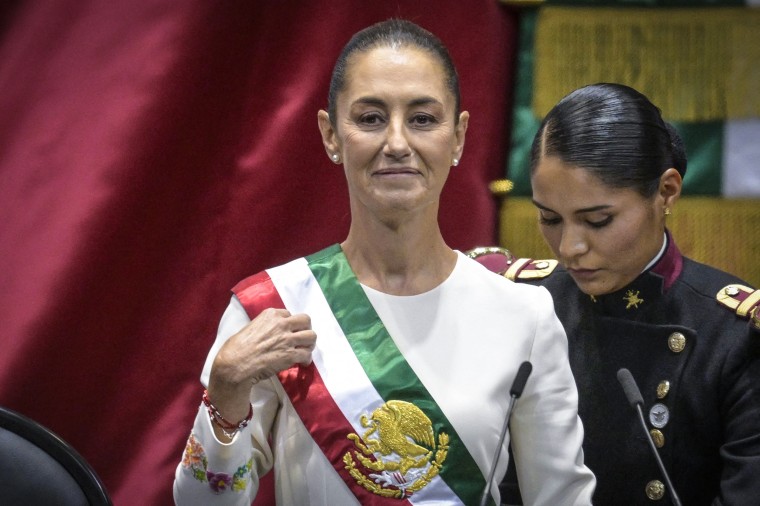
The Summit Exchange: Conflicting Narratives on Cartel Violence
The friction emerged during a gathering Trump hosted with Latin American leaders at his Florida golf club, dubbed the 'Shield of Americas' summit. In his remarks, Trump declared Mexico the 'epicenter of cartel violence,' asserting that Mexican cartels are 'fueling and orchestrating much of the bloodshed and chaos in this hemisphere.' He pledged that the US government would 'do whatever is necessary to defend our national security,' a statement often interpreted as a veiled reference to his past threats of military intervention in Mexico. Trump also made personal comments about Sheinbaum, calling her a 'beautiful woman' with a 'beautiful voice,' remarks that were criticized as sexist by analysts like Viri Ríos.
Sheinbaum's Counter-Argument: The Iron River of US Guns
President Sheinbaum's response reframed the issue from one of Mexican origin to one of US supply. She explicitly called on the US government to 'stop the trafficking of illegal weapons from the US to Mexico,' arguing that this action would critically undermine cartel power. 'If they stopped the entry of illegal weapons from the United States into Mexico,' Sheinbaum stated, 'then these groups wouldn’t have access to this type of high-powered weaponry to carry out their criminal activities.' This point is supported by data indicating that a significant majority—estimated at 75%—of guns used by cartels are sourced from the United States, a flow often described as an 'iron river.'

Mexico's Legal and Diplomatic Efforts
Sheinbaum's public statement is part of a broader, ongoing diplomatic and legal campaign by Mexico. In 2021, the Mexican government filed a lawsuit against several US gun manufacturers, accusing them of negligent business practices that facilitate arms trafficking. Although the US Supreme Court dismissed the lawsuit last year, it underscored Mexico's determination to address the supply side of the weaponry problem. Sheinbaum also reaffirmed Mexico's sovereignty, noting it was 'good that President Trump publicly says that when he has proposed that the United States military enter Mexico, we have said no.'
Analyst Perspectives: A Hemispheric Problem with US Roots
Political analysts have supported Sheinbaum's framing, arguing that cartel violence is a demand-driven phenomenon. Mexican analyst Viri Ríos contested Trump's 'epicenter' claim, stating, 'The epicenter of cartel violence is not Mexico, it’s the United States. The cartels are fueled by the United States’ demand for drugs and armed with US weapons.' This perspective highlights the dual role of the US as both a primary consumer market for illicit drugs and the primary source of the advanced weapons that cartels use to control territory and traffic those drugs, creating a cycle of violence that spans the hemisphere.
Conclusion: A Call for Bilateral Solutions
The Sheinbaum-Trump exchange underscores that effective counter-cartel strategy cannot be framed as a unilateral action by one nation against the other. Lasting security requires acknowledging the interconnected realities of drug demand and arms trafficking. Sheinbaum's call for the US to combat gun trafficking represents a direct challenge to move beyond rhetoric and toward cooperative, tangible measures that address the tools of cartel power at their source. The path forward lies not in assigning blame but in forging a partnership that tackles both the supply of weapons from the north and the demand for drugs that fuels the entire criminal ecosystem.