Astronomers Discover a Giant Iron Bar Hidden Within the Ring Nebula
A groundbreaking astronomical discovery has revealed a massive, previously unknown structure within the iconic Ring Nebula. Using the powerful new WEAVE instrument, a European-led team has detected an immense bar-shaped cloud composed of iron, stretching hundreds of times the width of Pluto's orbit and containing a mass equivalent to the planet Mars. This finding, published in Monthly Notices of the Royal Astronomical Society, challenges existing models of planetary nebula formation and opens new questions about the violent final stages of stellar evolution. The origin of this iron bar remains a compelling mystery, with theories ranging from a unique stellar ejection process to the vaporized remains of a planetary body.
A stunning and unexpected discovery has been made within one of the night sky's most famous celestial objects. Astronomers have identified a colossal, bar-shaped structure made of iron lurking deep inside the Ring Nebula, a finding that has sent ripples through the astrophysics community. This immense feature, invisible in previous observations, was revealed for the first time thanks to a revolutionary new instrument, offering a fresh and detailed look at a well-studied cosmic landmark and prompting new theories about the violent deaths of stars.

The Discovery: A New View of an Old Friend
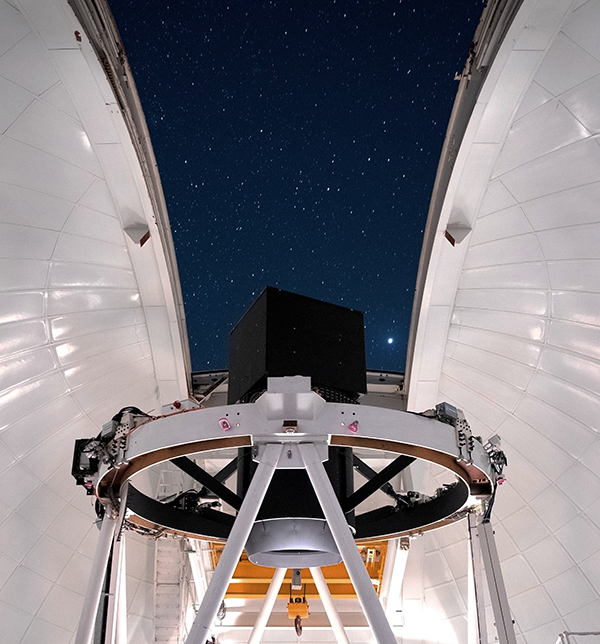
The discovery was made by a research team led by scientists from University College London (UCL) and Cardiff University. By employing the WHT Enhanced Area Velocity Explorer (WEAVE) instrument on the 4.2-meter William Herschel Telescope in the Canary Islands, the team was able to map the Ring Nebula with unprecedented spectral detail. The key to the breakthrough was WEAVE's Large Integral Field Unit (LIFU), which uses hundreds of optical fibers to capture a continuous spectrum of light from every point across the nebula's face. This allowed the researchers to create images at any specific wavelength and analyze the chemical composition at any location for the first time.
As lead author Dr. Roger Wesson explained, when processing this rich dataset, "one thing popped out as clear as anything -- this previously unknown 'bar' of ionized iron atoms, in the middle of the familiar and iconic ring." The structure, reported in the journal Monthly Notices of the Royal Astronomical Society, is not a minor feature. It is a narrow, elongated cloud that fits neatly within the nebula's inner elliptical cavity.
Scale and Significance of the Iron Bar
The sheer scale of this newly found structure is difficult to comprehend. The iron bar stretches an astonishing length approximately 500 times greater than the diameter of Pluto's orbit around the Sun. In terms of mass, it contains an amount of iron roughly equivalent to the entire planet Mars. This detection is significant because it reveals a major component of the nebula that was completely missed by all previous observations, including those by the James Webb Space Telescope.
The Ring Nebula itself, also cataloged as Messier 57 (M57) and NGC 6720, is a planetary nebula located about 2,600 light-years away in the constellation Lyra. It represents the final, glowing stage of a Sun-like star that has exhausted its nuclear fuel. As the star reached the end of its life, it expanded into a red giant and then ejected its outer layers into space, creating the beautiful, intricate shell we see today. The leftover core is now a white dwarf at the nebula's center. This process is a crucial recycling mechanism, returning elements forged in stellar cores—like carbon and nitrogen—back into interstellar space to seed future generations of stars and planets.
The Competing Theories of Origin
The origin of this immense iron bar is the central mystery driving ongoing research. Astronomers have proposed several competing ideas, but more data is needed to reach a definitive conclusion. One theory suggests the bar is a unique signature of the specific way the dying star expelled its material. The detailed structure could preserve new information about asymmetries or instabilities in the ejection process that were not previously understood.
A more speculative, yet fascinating, hypothesis is that the iron could be the remnant of a vaporized planet. As the central star expanded into its red giant phase, any orbiting rocky planets—like Earth or Mars—would have been engulfed and potentially torn apart. The iron bar could represent a curved arc of plasma, the shattered core of a world that met a fiery end thousands of years ago. Co-author Professor Janet Drew of UCL emphasized the need for further investigation, stating, "We definitely need to know more—particularly whether any other chemical elements co-exist with the newly-detected iron, as this would probably tell us the right class of model to pursue."
Future Research and Broader Implications
The discovery team is already planning follow-up studies using WEAVE at higher spectral resolution. These observations aim to detect other elements that may be mixed with the iron, which would be a critical clue to its formation history. Furthermore, the finding suggests that such hidden structures may not be unique to the Ring Nebula. As the WEAVE instrument begins its planned five-year survey of thousands of celestial objects, astronomers will be scrutinizing other planetary nebulae for similar features.
Professor Scott Trager, WEAVE Project Scientist, noted that this discovery "demonstrates the amazing capabilities of WEAVE." It underscores how new observational technologies can revolutionize our understanding of even the most familiar objects in the cosmos. The giant iron bar in the Ring Nebula is more than just a curiosity; it is a testament to the dynamic and often violent processes that shape our universe and a reminder that there are always new secrets waiting to be revealed in the starry night.